Oxygen 1000 Rack
Smart search
Rack Mountable Digital Broadcast Console
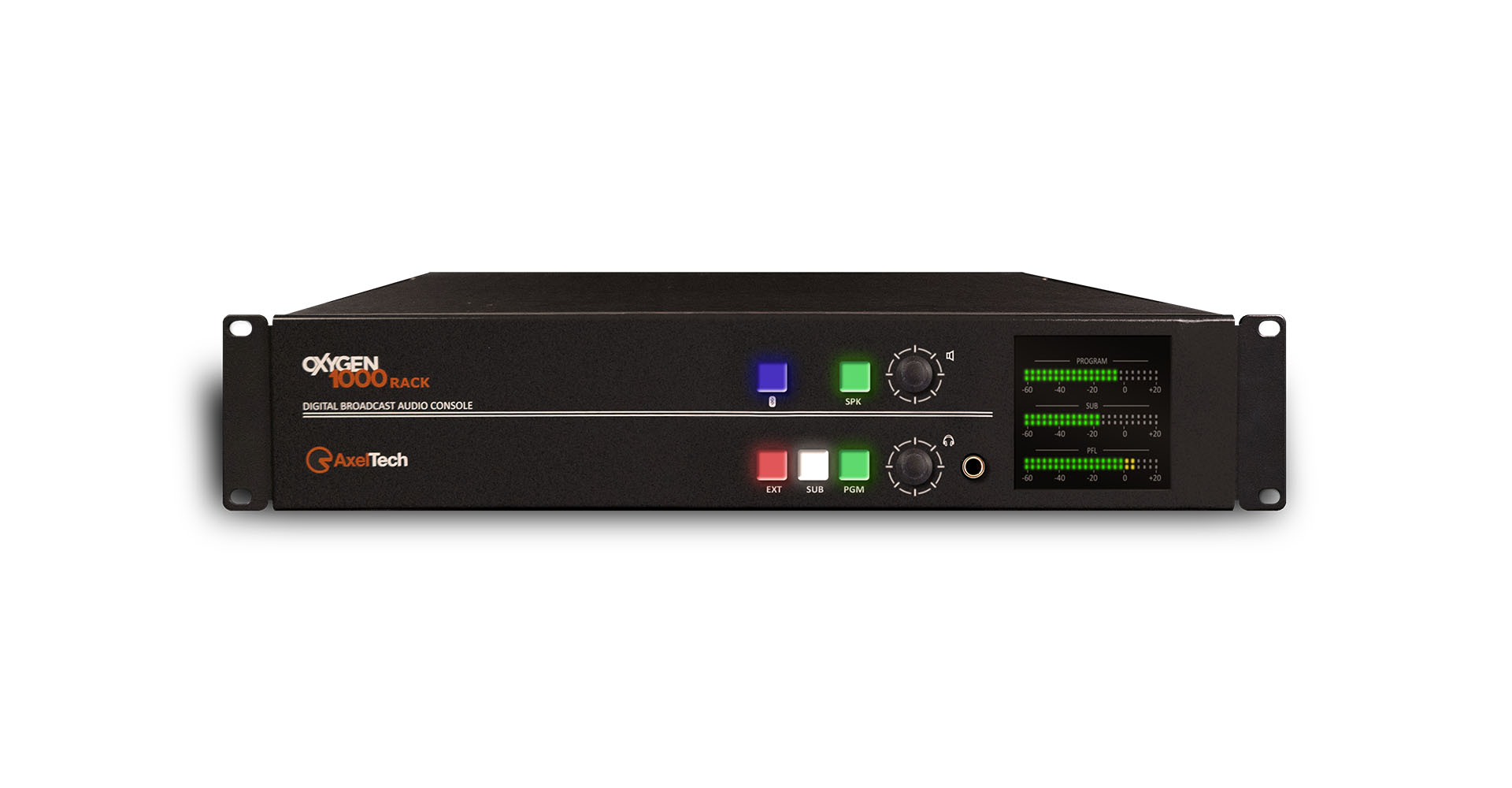
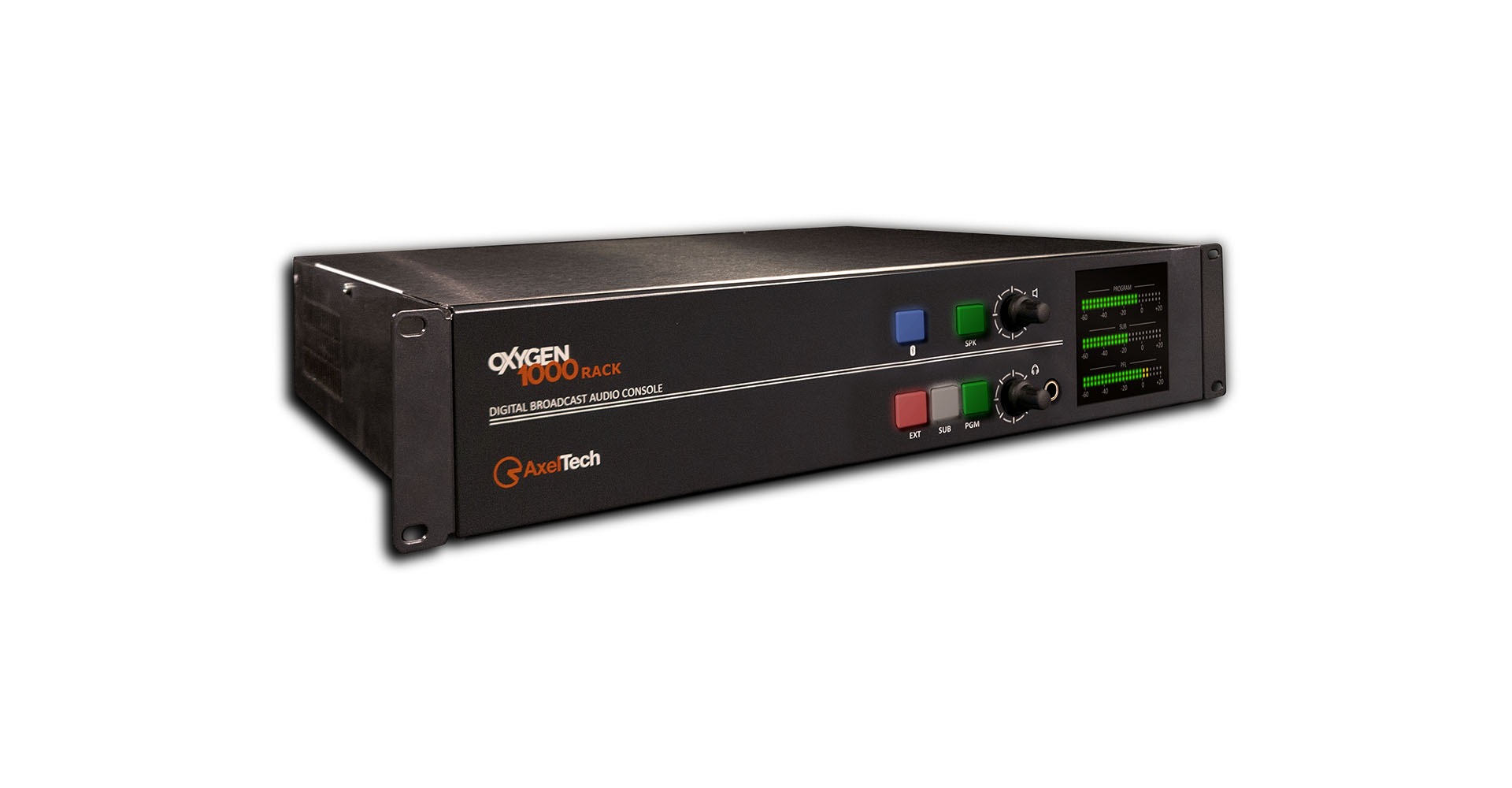
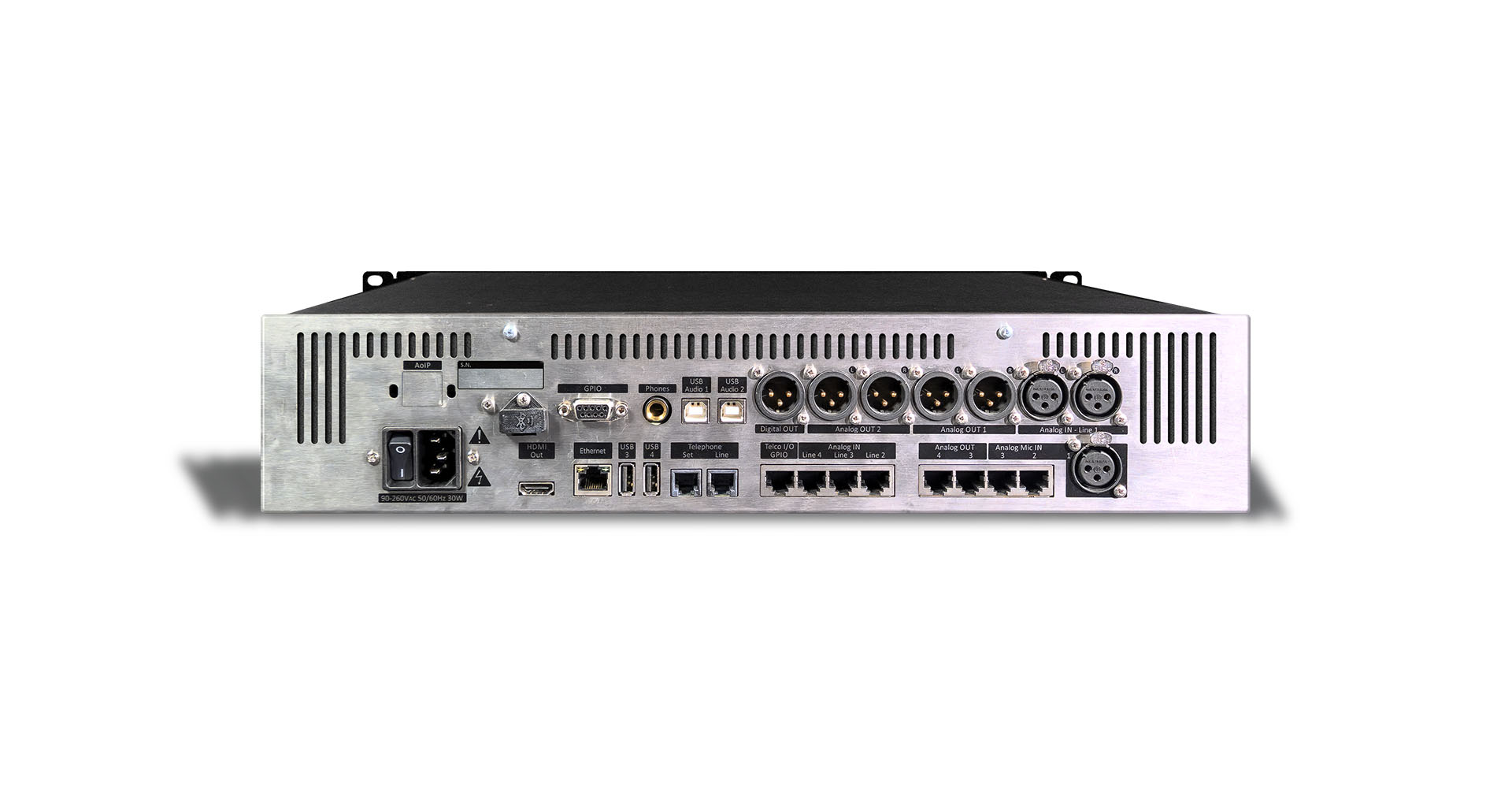
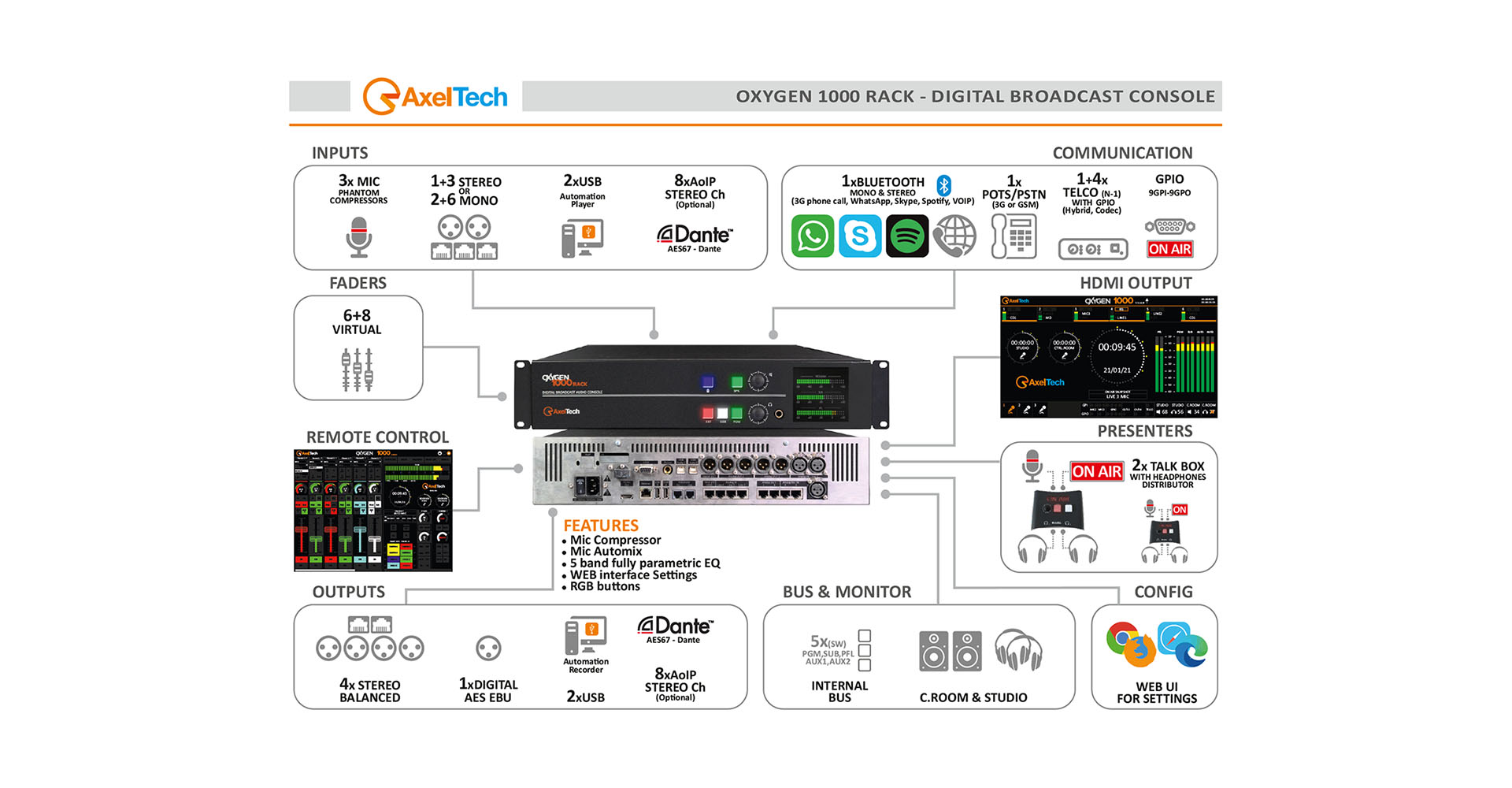
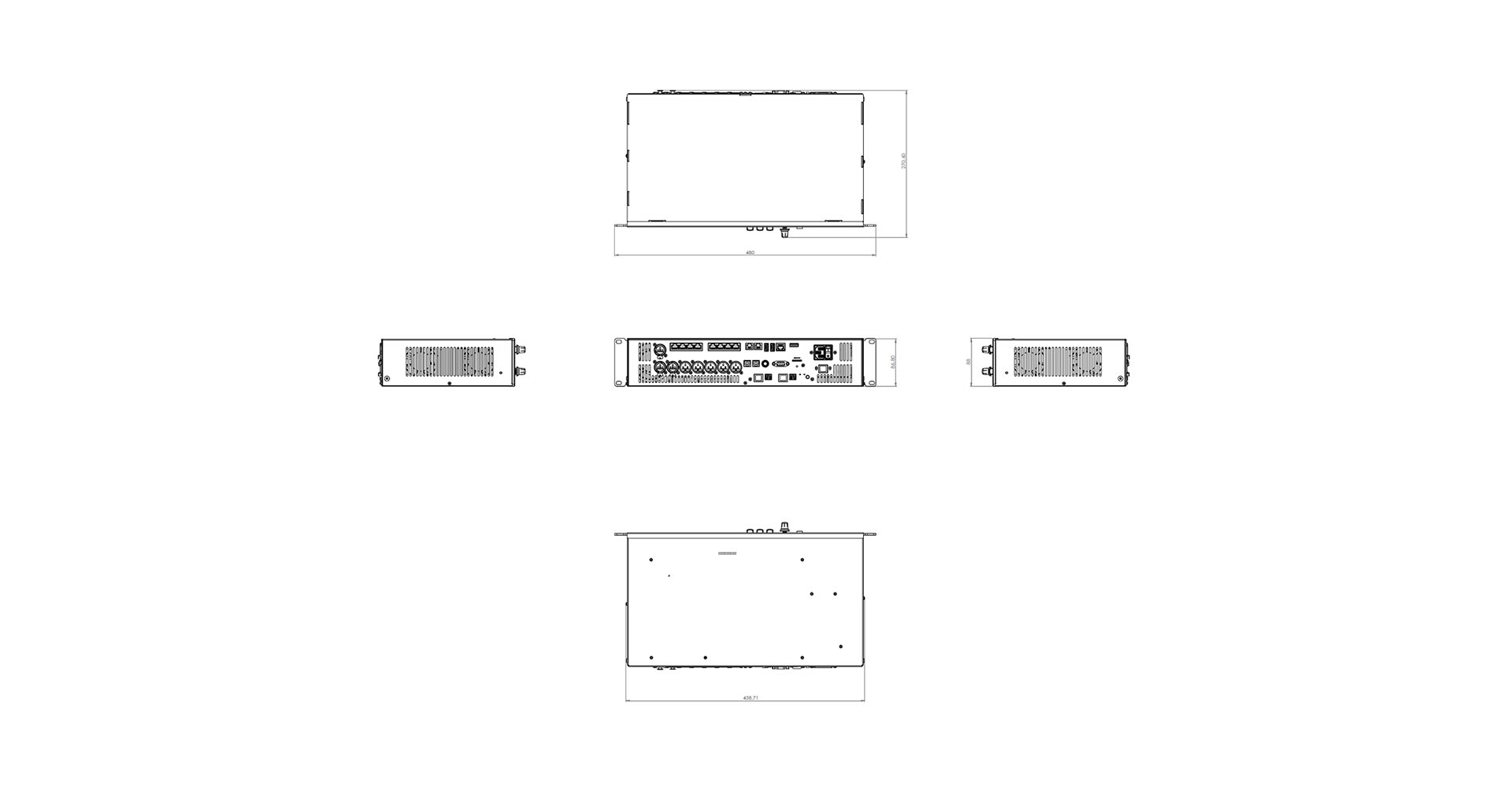

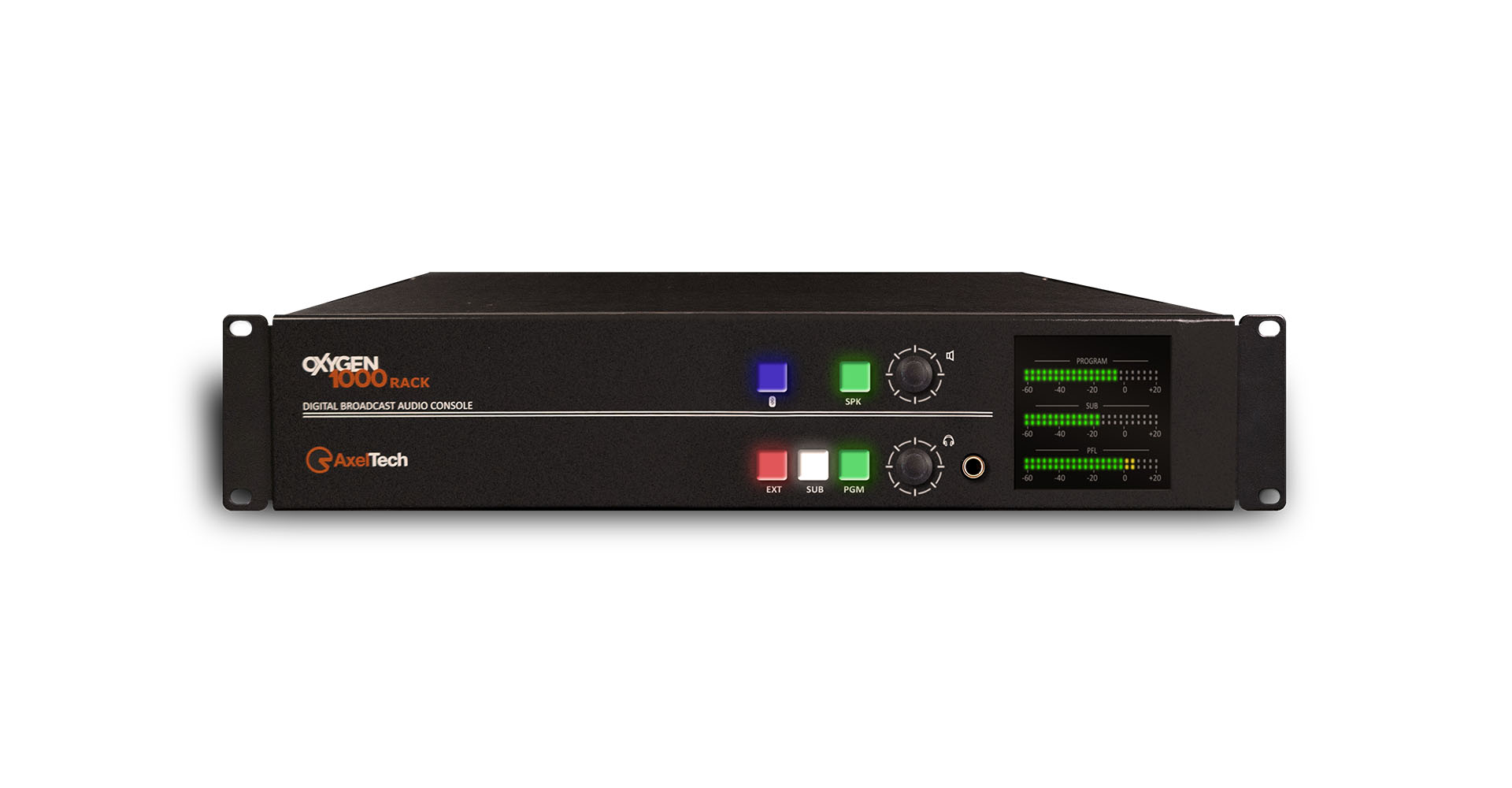
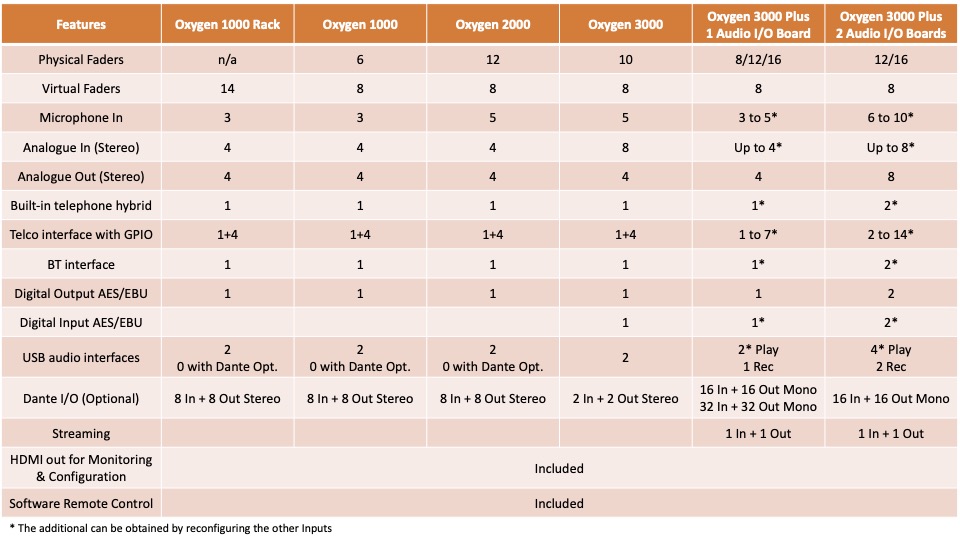
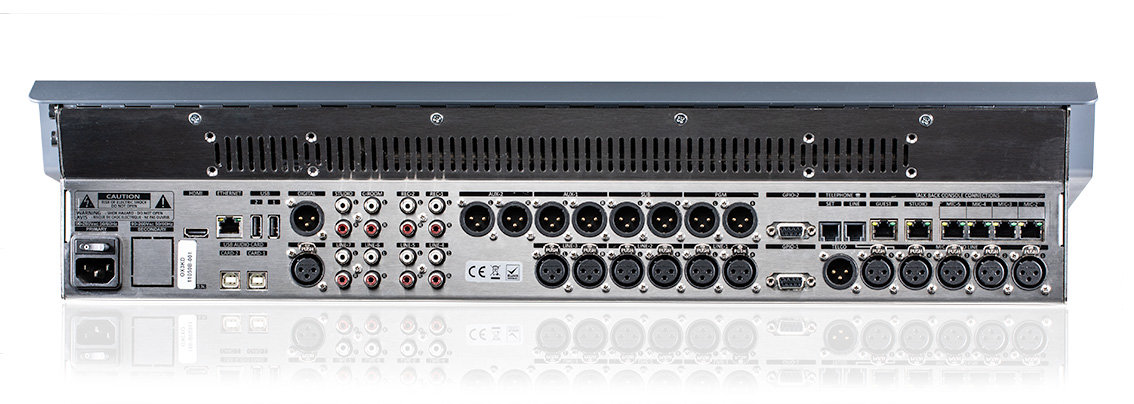
Oxygen 1000 Rack is a fader less fully Digital Broadcast Console designed for On Air and Production in any Radio Station, with 3 microphone inputs with Automix, a powerful internal audio routing and a wide range of controls and I/O in a rugged and classy steel 2 RU chassis.
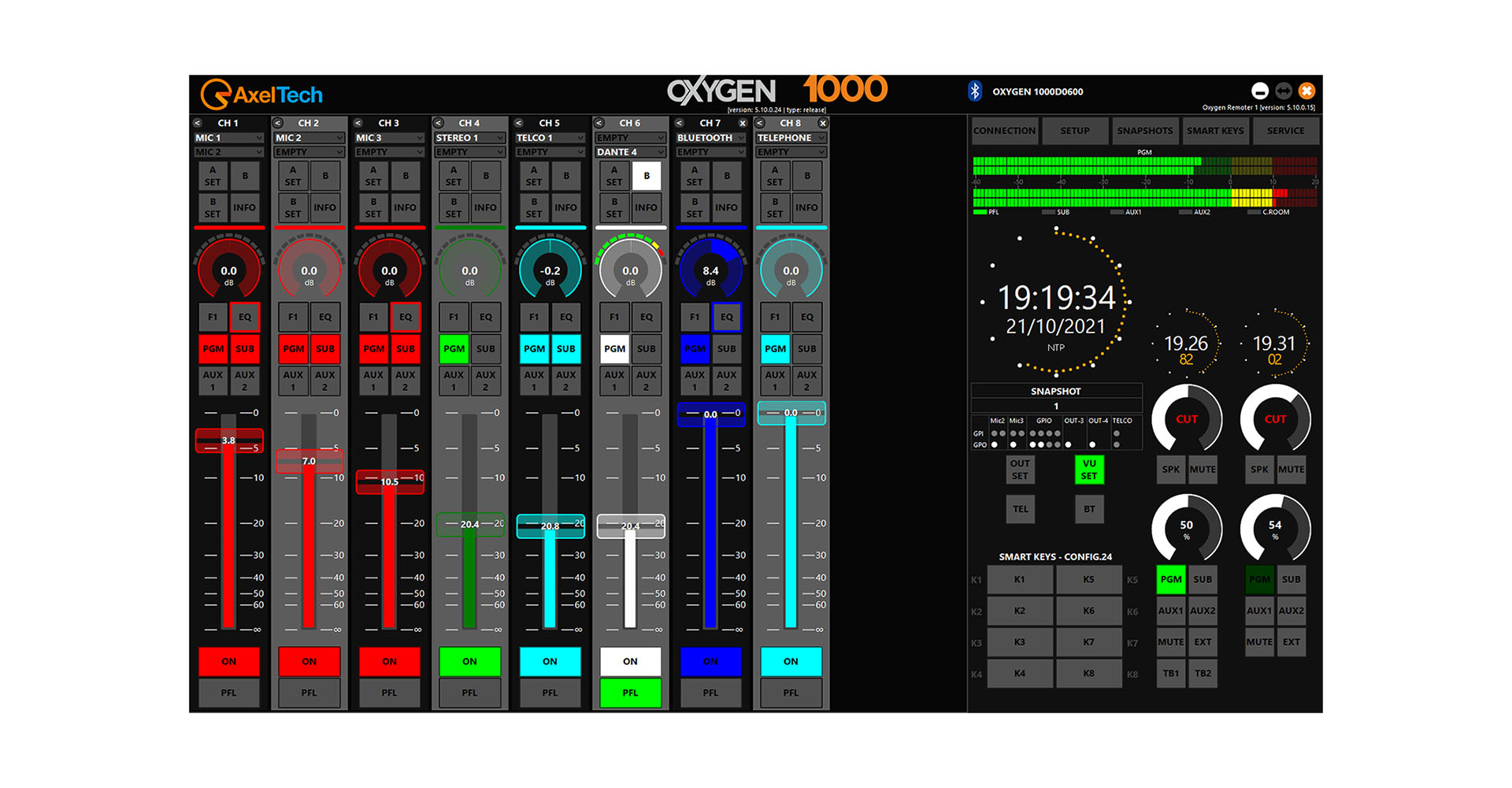
Oxygen 1000 Rack is remotely controlled through a dedicated application.
Oxygen 1000 Rack DSP based audio processing delivers high-end quality and guarantees latest features and flexibility.
Reliable and easy to use as an analogue mixing console Oxygen 1000 Rack offers top class features: Low Latency, Users Preset, Smart Keys, EQ, Compressors, Telephone Hybrid, HDMI Output, Analogue and Digital I/O, USB, BT, Dante™ AoIP, Telco, Presenter Talk Box.


Input & Output
- 3 microphone inputs with Automix
- 4 stereo analogue inputs
- 4 stereo analogue outputs
- 1 built-in telephone hybrid
- 1+4 telco interface with GPIO
- BT audio interface
- 1 digital Out (AES/EBU)
- 2 USB audio interfaces (disabled with Dante™ option installed)
- 8 stereo inputs + 8 stereo outputs via Dante™ (optional)
General
- Fully Digital Broadcast Console for Radio Broadcasting
- A/B Fast source switch buttons for each fader
- 4+1 busses (PGM, SUB, Aux1, Aux2, PFL)
- Near 0 latency (< 0,7 ms I/O)
- Complete Remote Control by means of an application replicating the surface
- Remote configuration and maintenance via Web Interface
- User-definable Presets & Snapshot
- 5 bands fully parametric Equalizer on every input
- Dynamic Processor with expander and compressor section on each microphone inputs
- Advanced and configurable Monitor Facilities for Control Room and Studio
- Customizable RGB colored buttons
- High Resolution (120 leds) meter bars for outputs
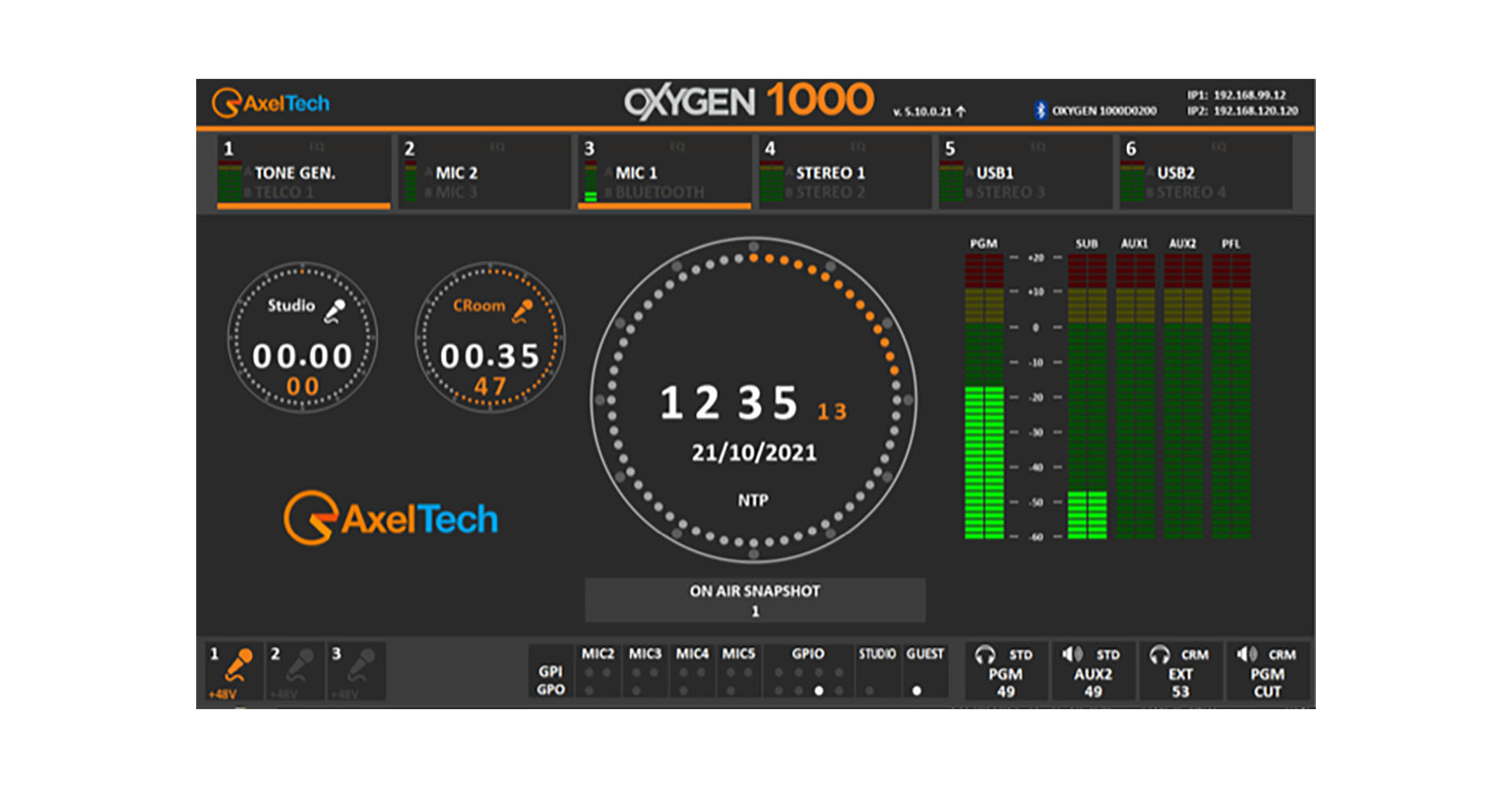
- HDMI Out for console status display
- 2 Timers (Ctrl-Room and Studio microphones timers on HDMI Monitor)
- TalkBox for guest and presenter (optional)
Versions
- Oxygen 1000 Rack
- Oxygen 1000 Rack Dante™
Options
- Talk Box
- Dante™ I/O Board
- RJ45 adapters for:
o Mic with GPIO
o Line In
o Line Out with GPIO
o Telco with GPIO
The complete Oxygen Line Up
Microphone Inputs
- 3 Microphone Inputs with Automix
- Mic 1 on XLR, Mic 2 & 3 on RJ45, all balanced with + 48V Phantom and GPIO
- Independent ON AIR Lights and Cut Off control, when opening Control Room and Studio microphones
- PFL button switches to private conversation on Hybrid/Telco/BT mode
- Enable TalkBack feature on any Studio or Control Room microphone
- Parametric Compressors/Expander for MICROPHONE and MONO inputs
- Save and recall microphone presets including Compressor/Expander settings
- Phase inversion on microphone inputs
- Ducking / AutoFader assignable to all sources (automatic attenuation of music on speech)
Automix
Automix feature simplifies mixing activities in the presence of many guests in the studio.
The function adds, to the existing sources, a new source called Automix, which is the sum of all enabled microphones.
The Automix source has all the features of a microphone source such as:
- Studio/Control Room loudspeakers control
- Studio/Control Room light control
- Can be used as audio in Private mode for phone calls
Using this new source, the user can manage in a very simple manner all the microphones of the studio with a series of benefits:
- Just 1 fader for the management of studio microphones;
- A dedicated AGC section for each microphone input automatically adjusts the correct level;
- Automatic management of attenuation on microphones not in use, simulating a slight closure of the fader;
- Final compressor that allows an automatic leveling of the Automix source;
- Possibility to use the microphones individually.
This feature further simplifies the work of the mixer engineer, even in the case he/she is also the host of the show.
Available settings in the Automix menu:
-
- MIC-1 ON/OFF
- MIC-2 ON/OFF
- MIC-3 ON/OFF
- Idle Mic Attenuation
- Attenuation Attack Speed
- Attenuation Release Speed
- Compression Threshold
- Compression Ratio
- Compression Attack Speed
- Compression Release Speed
- Autogain Speed
- Autogain Max Gain
- Autogain Max Attenuation
Analogue inputs
- Line Stereo Inputs: 4
- Balanced on XLR for Line 1, Balanced on RJ45 for Line 2-4
- Channel mode selection: STEREO, MONO, L, R, INV-L, INV-R, INV
- Stereo-1 & DANTE-1 inputs can be configured as 4 Telco Inputs
USB audio I/O
- 2 Built-in stereo USB (Type-B) I/O Audio Interfaces allow to directly connect the PC to the Oxygen 1000 console, with no need for audio cards
- In facts the PC detects each of the console USB as a digital audio card with 1 stereo inputs and 1 stereo outputs for simultaneous playout and recording
Telephone hybrid and Telco
- Telephone Hybrid: 1 POTS/PSTN telephone line with Line.In and Tel.Set connection
- Telco: 1 in/out N-1 to connect external telephone hybrid with control via TLC/GPIO
- 4 mono additional Telco can be obtained configuring Analog Inputs (Stereo-1 & DANTE-1) and (OUT-2 & DANTE-1) stereo outputs.
- GPI and GPO management on all 5 Telco channels
- RING and HOOK on F1 key for each TELCO channels
- N-1 on Telco outputs for all BUS (PGM, SUB, AUX-1, and AUX-2)
BT
Oxygen 1000 Rack has a BT module. This allows airing the calls made via GSM, Skype, Viber and WhatsApp with a Smartphone, a Tablet or a PC. Oxygen 1000 has two BT connection modes: bidirectional to support phone calls, monodirectional to put on air high quality stereo audio (A2DP) streamed by BT sources.
With BT calls, PFL enables PRIVATE conversation mode.
Analogue outputs
- 4 Balanced Outputs:
- OUT-1 – XLR – Fixed as PGM
- OUT-2 – XLR – by default assigned as SUB
- OUT-3 – RJ45 – by default assigned as AUX-1
- OUT-4 – RJ45 – by default assigned as AUX-2
- OUT-2 stereo output can be configured as N-1 to achieve up to 2 mono additional Telco
- OUT-1 & OUT-2 outputs are both equipped with a GPO
Digital output
- 1 AES/EBU output on XLR
Headphones and local monitor outputs
- OUT-2-4 outputs: can be configured as Studio Presenter and Studio Guest Headphones
- Unbalanced outputs: 2 Line out on Jack 6.3 for Control Room Headphones
- Adjustable maximum Control Room and Studio speakers volume
- Adjustable maximum Control Room and Studio headphones volume
- Adjustable CUT or Attenuation mode (-40, -30, -20, -10 dB) on Control Room and Studio speakers
- Independent source selection (PGM, SUB, AUX1, AUX2, EXT) for control room and studio speakers, control room and studio headphones with or without PFL
- Independent Talk Back management on Control Room and Studio speakers
- Independent Talk Back management on Control Room, Studio headphones
- Same source selection for Control Room and Studio headphones, with independent leve
GPI/GPO
- GPI: 9 in total, for Talk back, Telephone Hybrid or other features
- GPO: 9 total, to control OnAir lamps or provide HOOK and RING commands for external telephone Hybrid
- User custom GPIs (e.g. Ring, Talkback, channel ON/OFF, etc.)
- User custom GPOs (e.g. Hook/ONAIR, Studio-Light, Control Room-Light)
Surface & Management
- Direct Firmware update via Internet
- WEB UI for Console configuration and service features (Save, restore, update, logs, etc.)
- Save and recall EQ presets (up to 10)
- New real-time EQ algorithm with graphic
- Fast and accurate Led Meters display
- Save and recall control panel configuration with 10 Snapshots
- Save and recall total console configuration. The configuration can be saved to internal memory (microSD), USB and PC (via WEB interface)
- Gain adjustment knobs with adaptive speed
- Dimmable buttons light
- Adjustable fader ON/OFF threshold (from -50 dB to 0 dB)
Telephone Hybrid and Telco
The built-in telephone hybrid allows direct connection of a telephone line POTS/PSTN on RJ-11C. The audio is processed via DSP that delivers a state-of-the-art audio processing. It’s also available a Telco N-1 in/out, to connect Oxygen 1000 to an external telephone hybrid. The Telco N-1 is always available on RJ45. TLC commands are available on the same RJ45 with Hook and Ring interface.
TLC commands for Telco-2-5 are available and configurable on GPIO-DB9 connector with Hook and Ring.
Software Remote Control
Oxygen Remoter is a software tool available for free with any Oxygen console. It offers advanced remote control features such as accessing to any set up and information, fader and buttons control and any other operation available on the physical consoles. It is very useful especially for compact consoles and in any environment that has limited space.
The Virtual Fader technology enables users to assign each input to a virtual fader/channel on the remote surface, this is of course very useful when controlling channels remotely. Additionally, transforming the A/B pair into two virtual faders is a smart solution that maximizes the management of the available sources.
Oxygen Remoter can remotely control multiple consoles and create an ecosystem, this can be very helpful for remote productions where, for instance, a portion of the channels may need to be controlled from a studio while the others are still managed from the physical surface in the control room.
Oxygen Remoter is a powerful tool that provides extra flexibility and control’s tools to all the Oxygen consoles.
Oxygen Remoter is downloadable from the Oxygen console’s administration web page.
HDMI output
The HDMI output allows to connect an HD display monitor to the console, suitable to be used to Monitor the following information:
- Audio input source levels
- 4+1 BUS output levels
- A/B source names assigned of 10 channels
- Display On-Air sources
- Microphone On timer (control room & studio)
- Large Clock
- Audio output level (Loudspeakers & Headphones)
- On-Air microphone
- Telephone active
HDMI output can be personalized with the customer logo. Selectable display layouts are available.
Talk Box
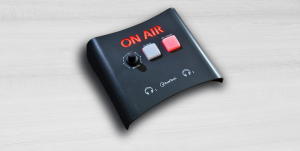 It is a device dedicated to the presenter and guests. Talk Box is very simple to connect to the On Air Console: its take 2 RJ45 cables of the length that is needed to connect it to the mixer. It is possible to connect up to 2 Talk Boxes to the Oxygen 1000. The Talk Box offers a direct connection of the microphone and relative On-Air light, it is also possible to directly connect the studio’s On-Air Light. The Talk Box has a headphone amplifier with two 6.3mm outputs. Through the two large backlit buttons it is possible to activate and deactivate your own microphone (On / Off / Cough) or enable Talk back to the console.
Dante™ AoIP Interface
Oxygen 1000 can be equipped with a Dante™ interface (also supporting AES67 and SMPTE ST 2110-30 transport protocols) which provides 8 Stereo Inputs and 8 Stereo Outputs on a dedicated Ethernet port, with independent Level Control and Sample Rate Conversion.
On Oxygen 1000 Dante™ versions the USB I/O ports are disabled.
Dante™ AoIP interface is installed at the factory and must be requested at ordering stage.
Cable Adapters
RJ45 adapters are available for:
o Mic with GPIO
o Line In
o Line Out with GPIO
o Telco with GPIO
Analog Balanced Microphone Inputs
Connector RJ45 & XLR Balanced – EMI Suppressed
Input Impedance 2,4 KΩ
Nominal Input Level (sensitivity) -9/-66 dBu
Max Input Level (clipping point) +9 dBu
A/D conversion 24 bit / 48 Khz
Signal To Noise Ratio (referred to peak level) >90 dB
THD+N <0,01%
Analog Gain Adjustable +0 ÷ +57 dB (3dB step)
Phantom Power +48V
Analog Balanced Stereo Inputs
Connector XLR & RJ45 Balanced – EMI Suppressed
Input Impedance 10 KΩ
Nominal Input Level (sensitivity) 0 dBu
Max Input Level (clipping point) +18 dBu
A/D conversion 24 bit / 48 Khz
Frequency response +/-0,5 dB from 20 Hz to 20 kHz
Signal To Noise Ratio (referred to peak level) >100 dB
Stereo Separation (referred to peak level) >90 dB
THD+N <0,002 %
Analog Balanced Telco Input
Connector RJ45 Balanced – EMI Suppressed
Input Impedance 10 KΩ
Nominal Input Level (sensitivity) 0 dBu
Max Input Level (clipping point) +18 dBu
A/D conversion 24 bit / 48 Khz
Signal To Noise Ratio (referred to peak level) >100 dB
THD+N <0,002%
PSTN Interface
Connector RJ11
Transhybrid loss >20 dB
Analog Balanced Stereo Outputs
Connector RJ45 Balanced – EMI Suppressed
Output Impedance 23 Ω, nominal 600 Ω
Nominal Output Level 0 dBu
Max Output Level (clipping point) +18 dBu
D/A conversion 24 bit / 48 Khz
Signal To Noise Ratio (referred to peak level) >100 dB
Stereo Separation (referred to peak level) >90 dB
THD+N <0,002 %
USB Audio Digital I/O
Connector USB Type B – EMI Suppressed
Playback And Recording Sample Rate SRC 44.1-48 KHz
Resolution 16 bit
Available Stereo Channels 1 Play & 1 Rec for each USB interface
Digital Output
Connector Balanced on 1 XLR – EMI Suppressed
Input Impedance 110 Ω
Standard AES3
Audio Sample Rate 48 KHz
Resolution 24 bit
Dynamic Range (Converter Values) 124 dB
Analog Balanced Telco Output
Connector RJ45 Balanced – EMI Suppressed
Output Impedance 23 Ω, nominal 600 Ω
Nominal Output Level 0 dBu
Max Output Level (clipping point) +18 dBu
D/A conversion 24 bit / 48 Khz
Signal To Noise Ratio (referred to peak level) >100 dB
THD+N <0,002 %
System
Audio Core Analog Devices ADAU1452 32bit 294 MHz fixed point DSP
Audio CODECs Cirrus CS42448 24 bit/192 kHz
System Core Allwinner A20 dual core cortex-A7 at 800MHz, 1GB RAM
LAN Connection RJ45 - 100Mbit
Nominal Delay (analog input to analog output) 0,7 ms
GPIO Inputs/Outputs 4 GPI/4 GPO on DB9; 4 GPI/2 GPO on Mic2 & Mic3 RJ45; 2 GPO on Out3 & Out4 RJ45; 1 GPI/1 GPO on Telco RJ45
Communication Port 2xUSB type-A, 2xUSB type-B , 1xLAN, 1xHDMI
Operating Temperature 0°C ÷ 40°C
PSU
Power Supply 90-260 VAC / 47-63 Hz / 30 W
Dimensions
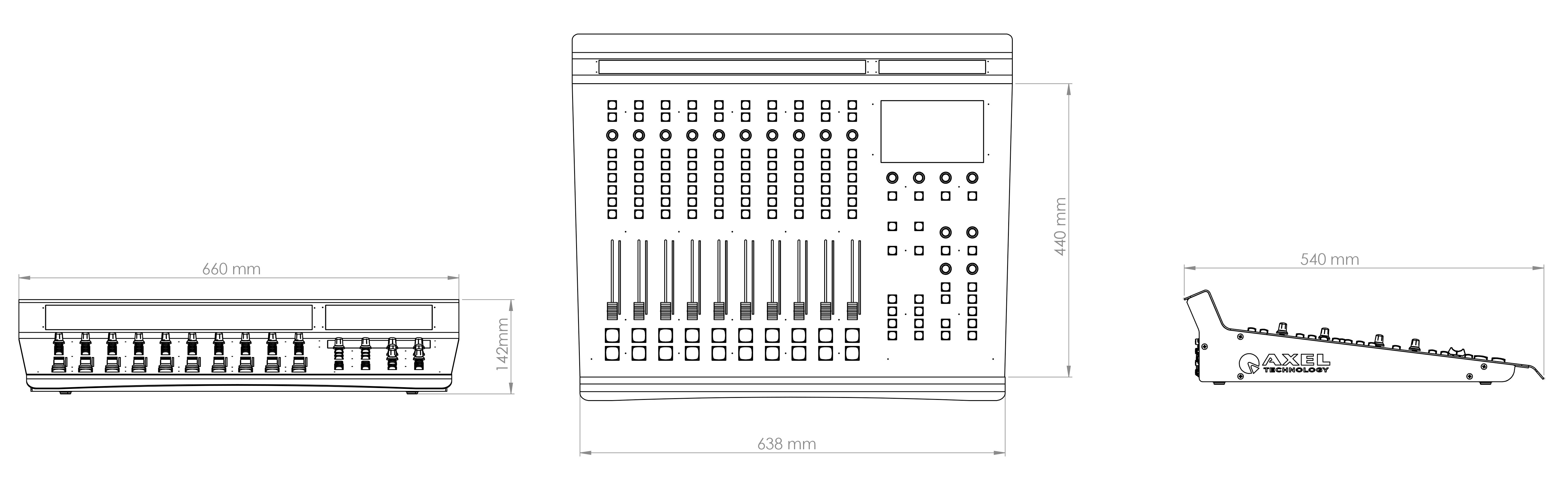
Dimensions (W; H; D) 344mm; 80mm; 343mm
Weight < 5Kg



Case Histories
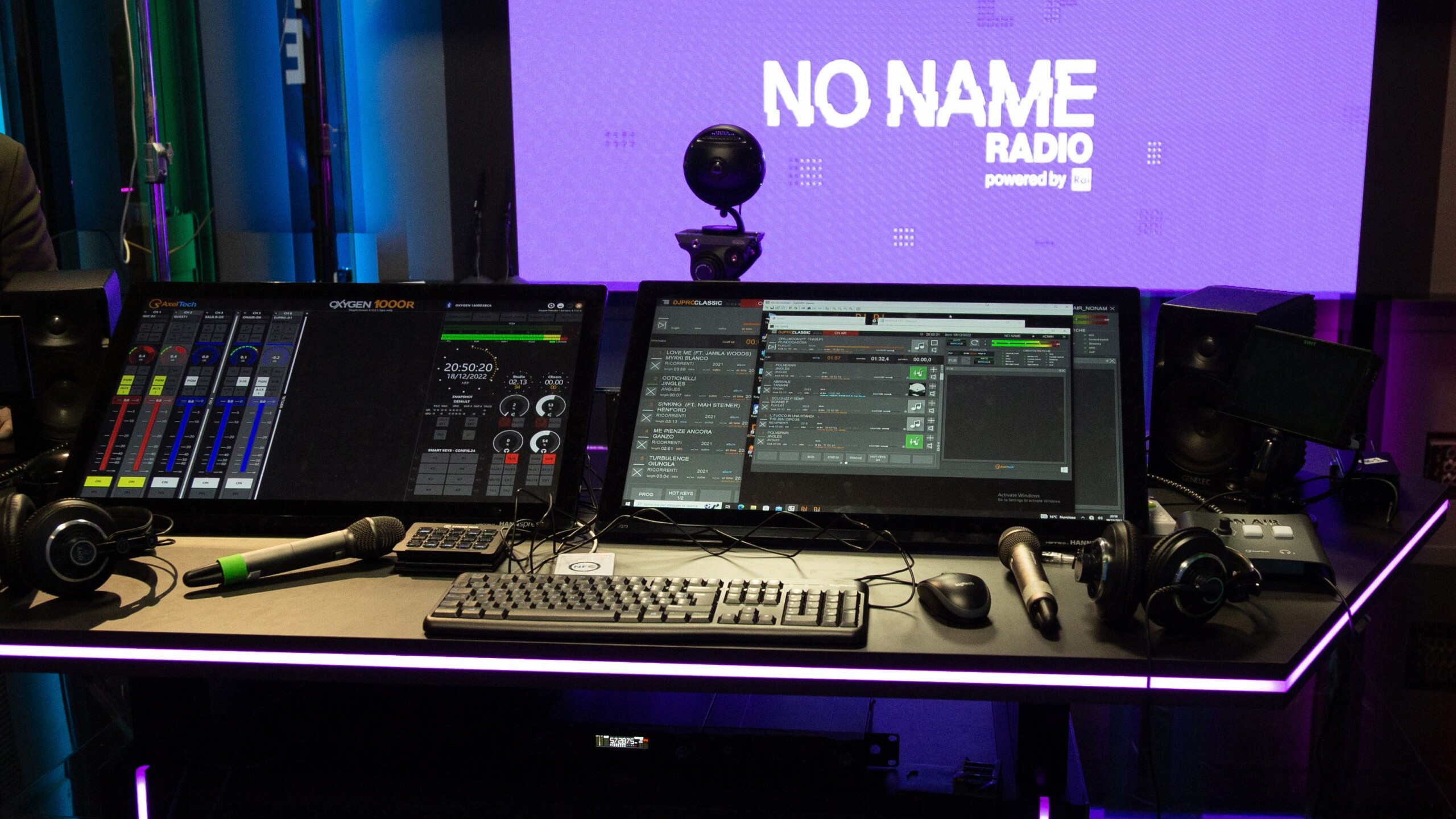
RAI Radio
Italy

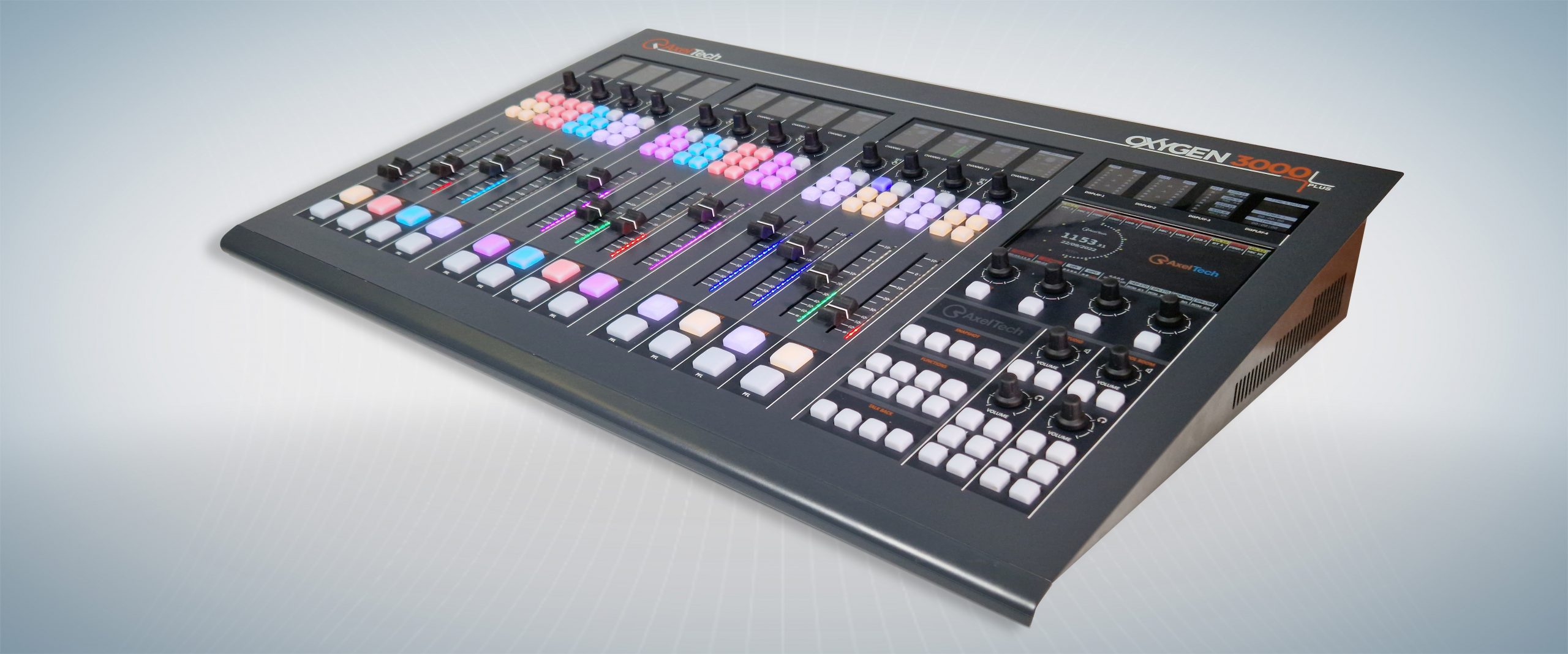
Oxygen 3000 Plus
Smart search
Digital Broadcast Console
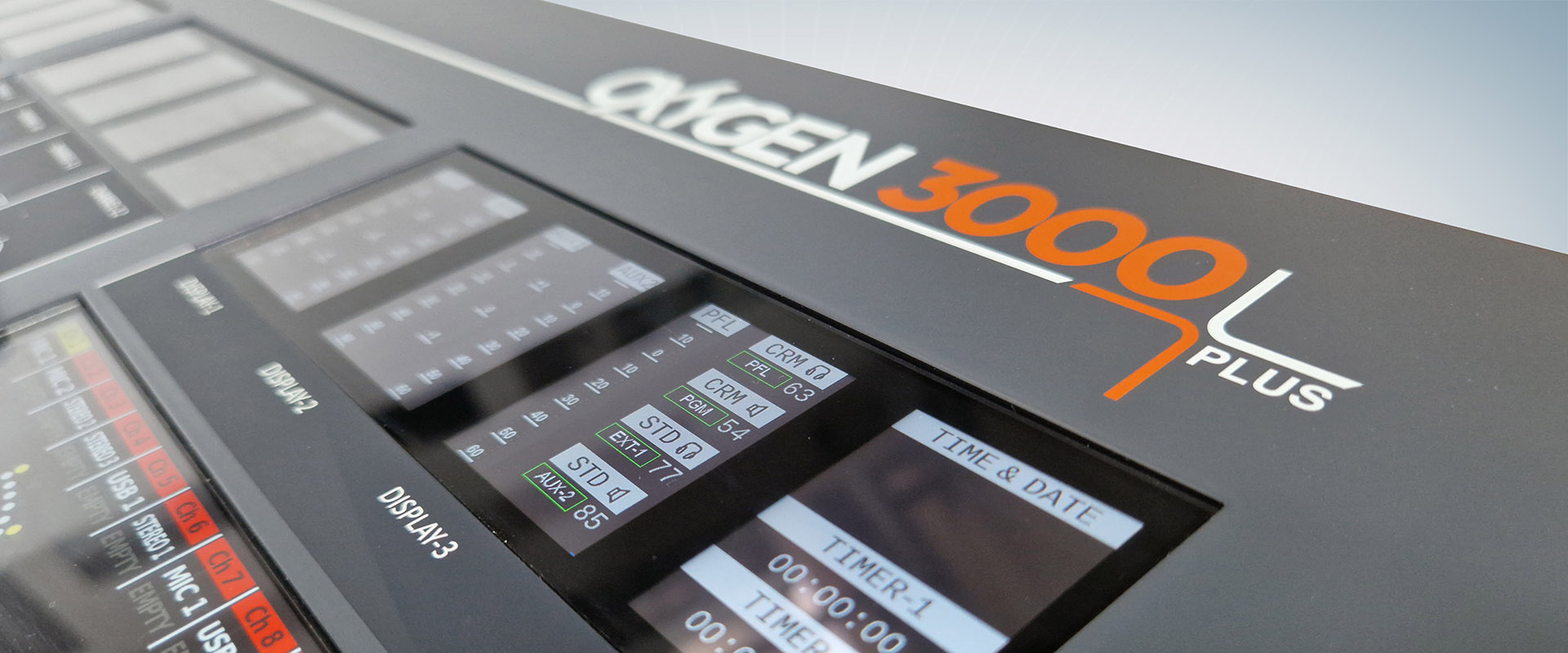
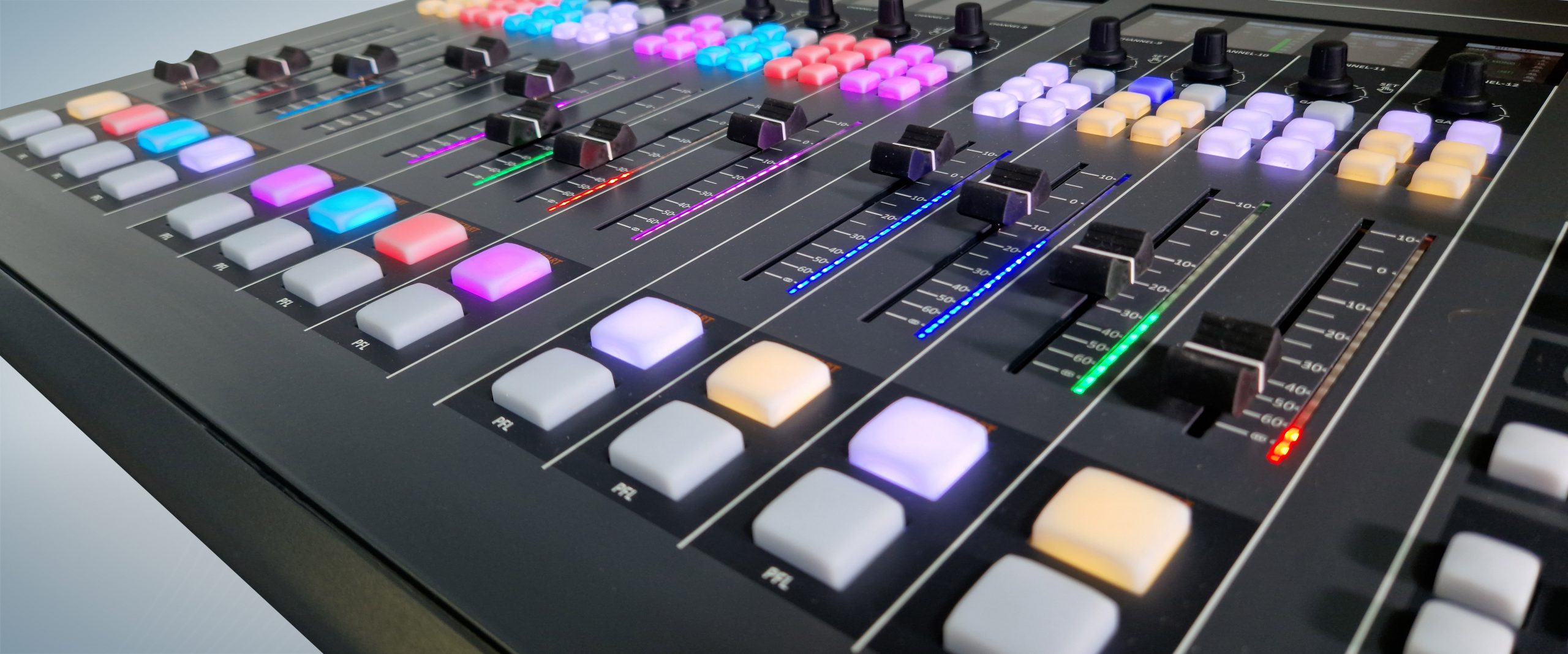
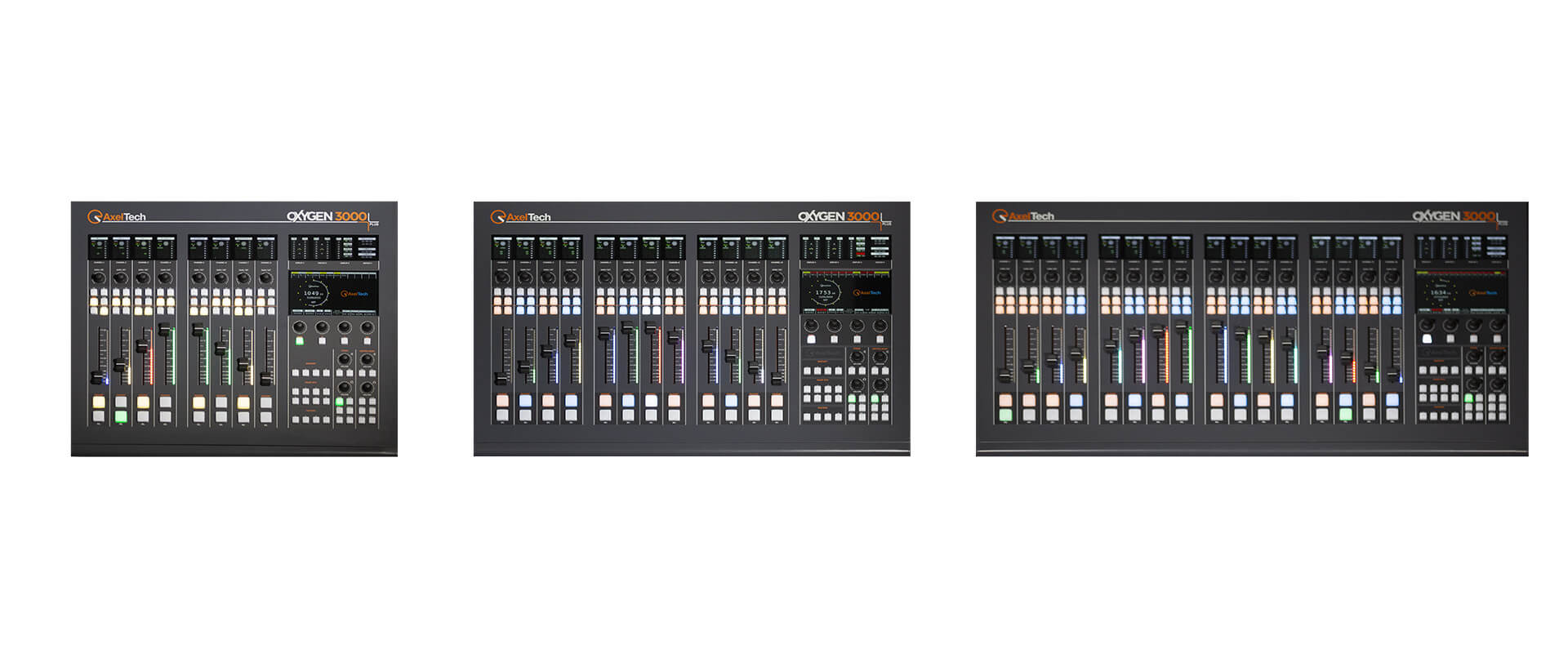

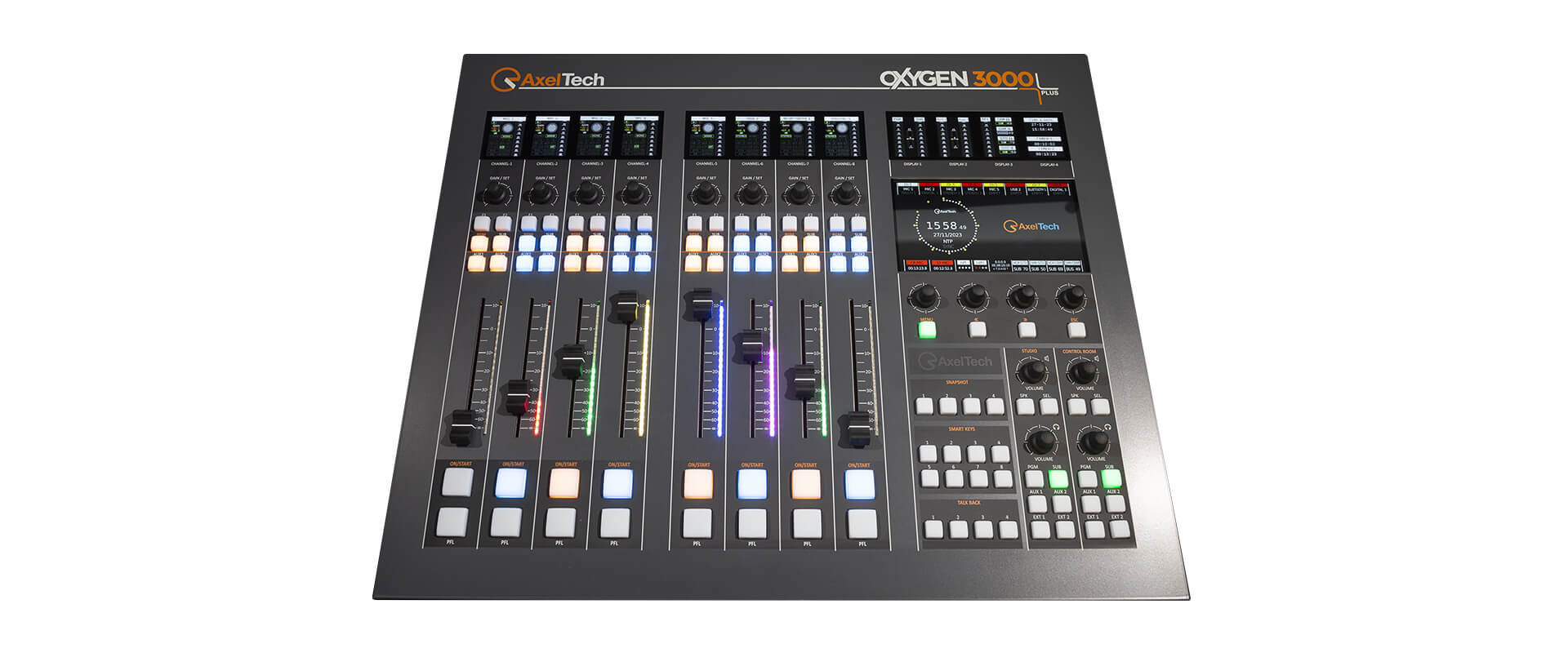
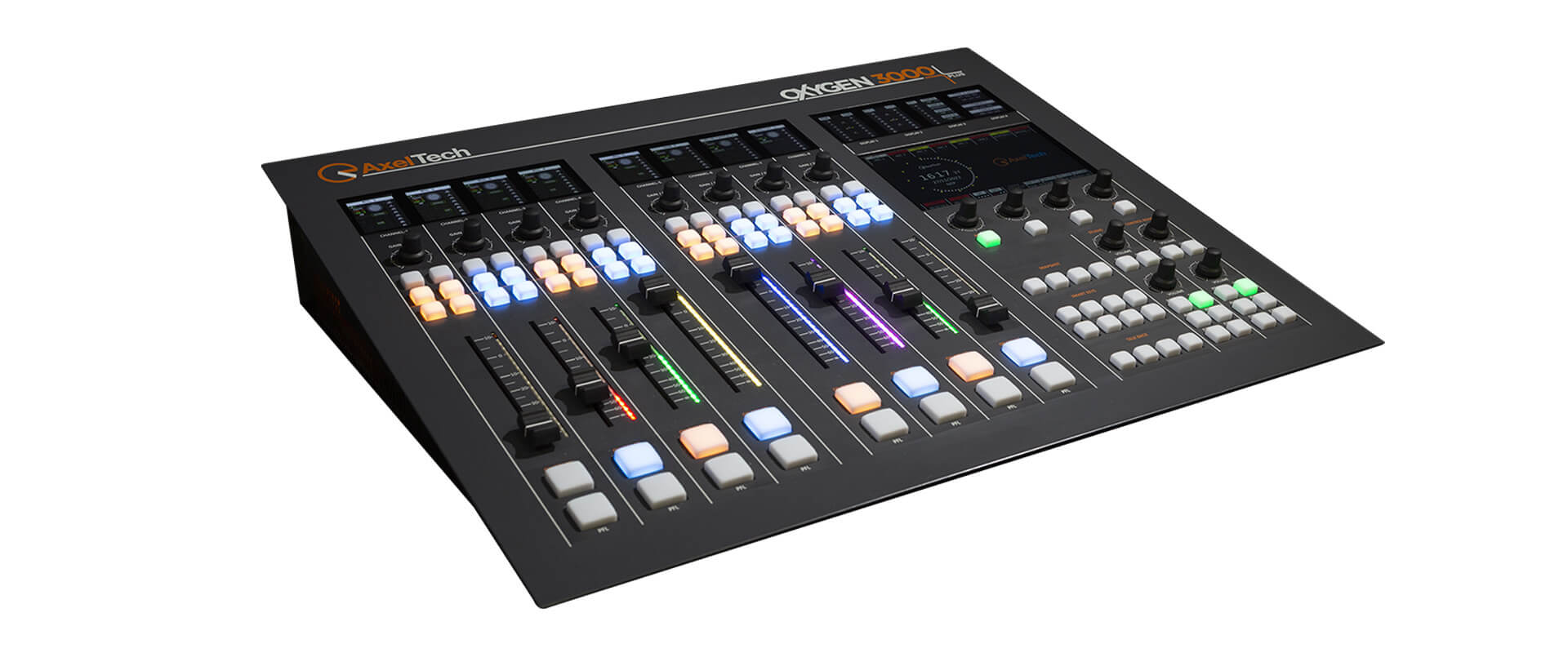
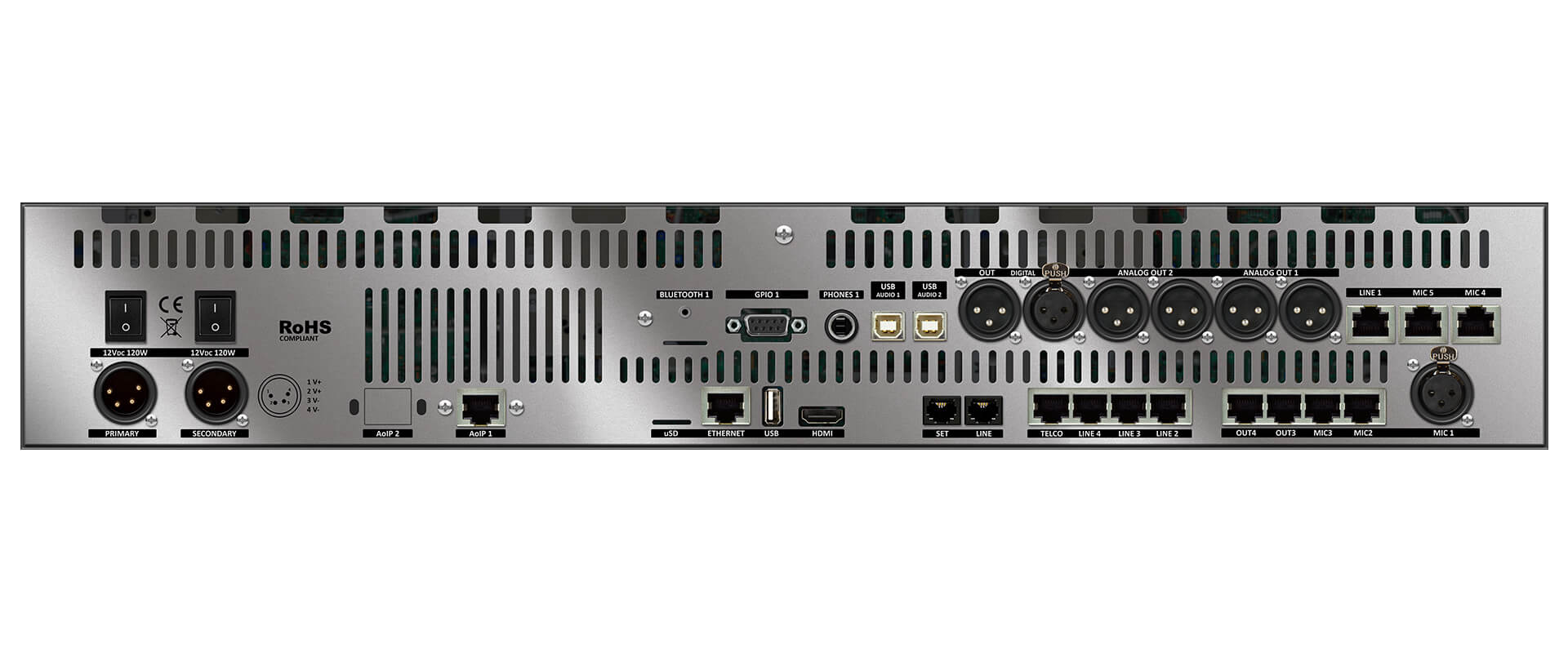

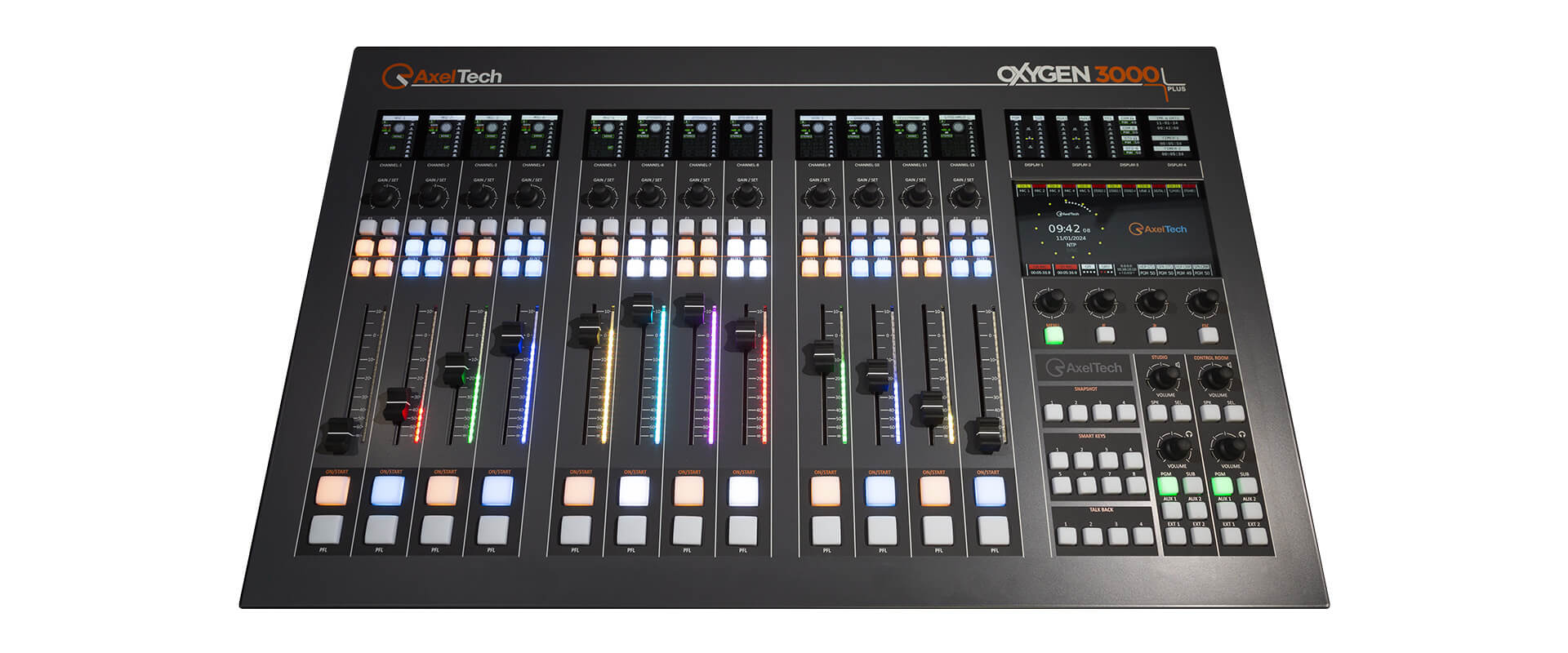

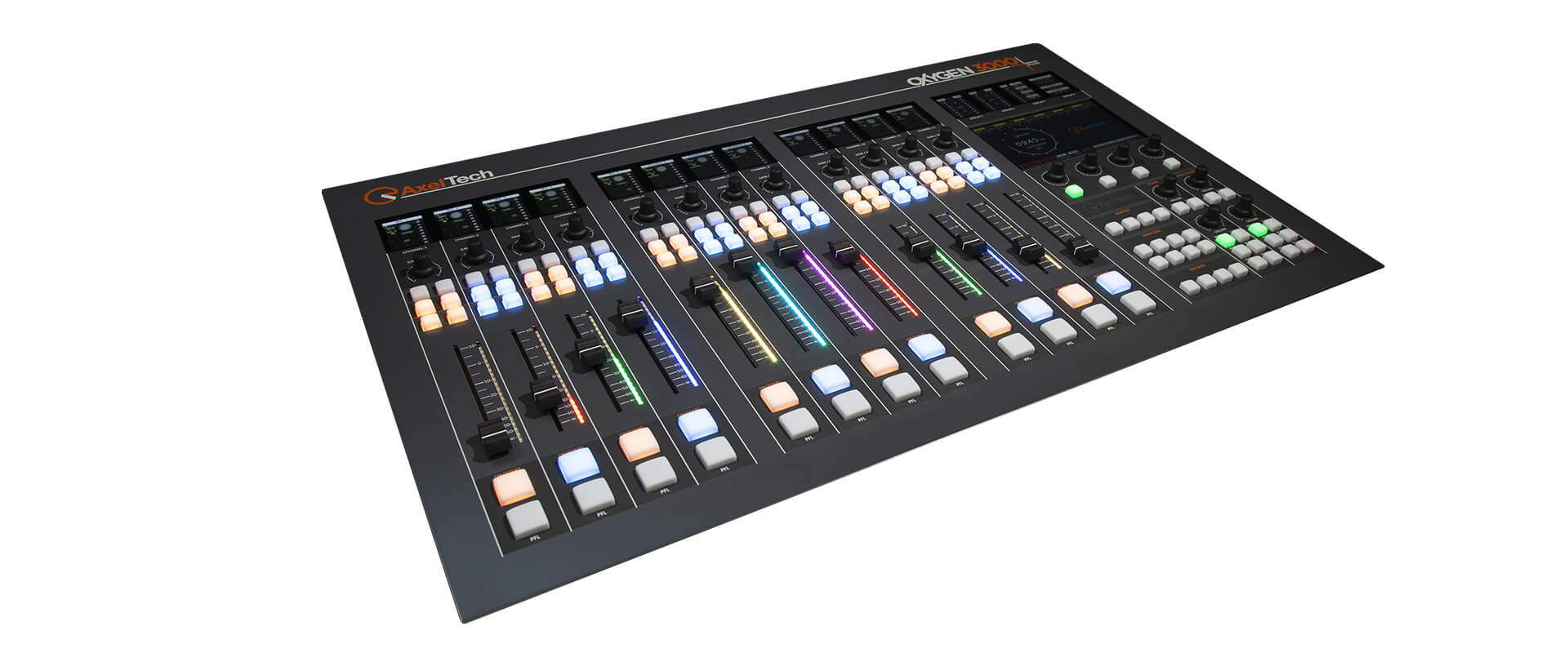
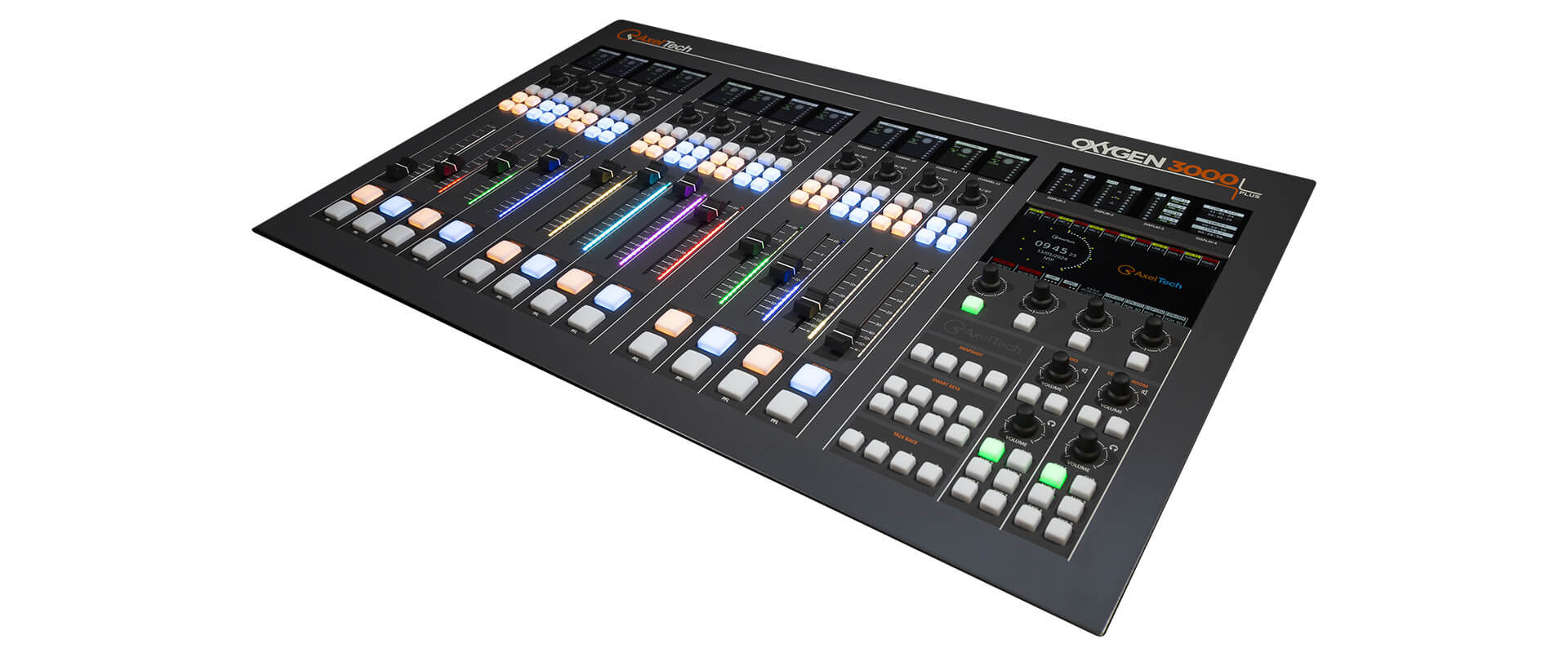
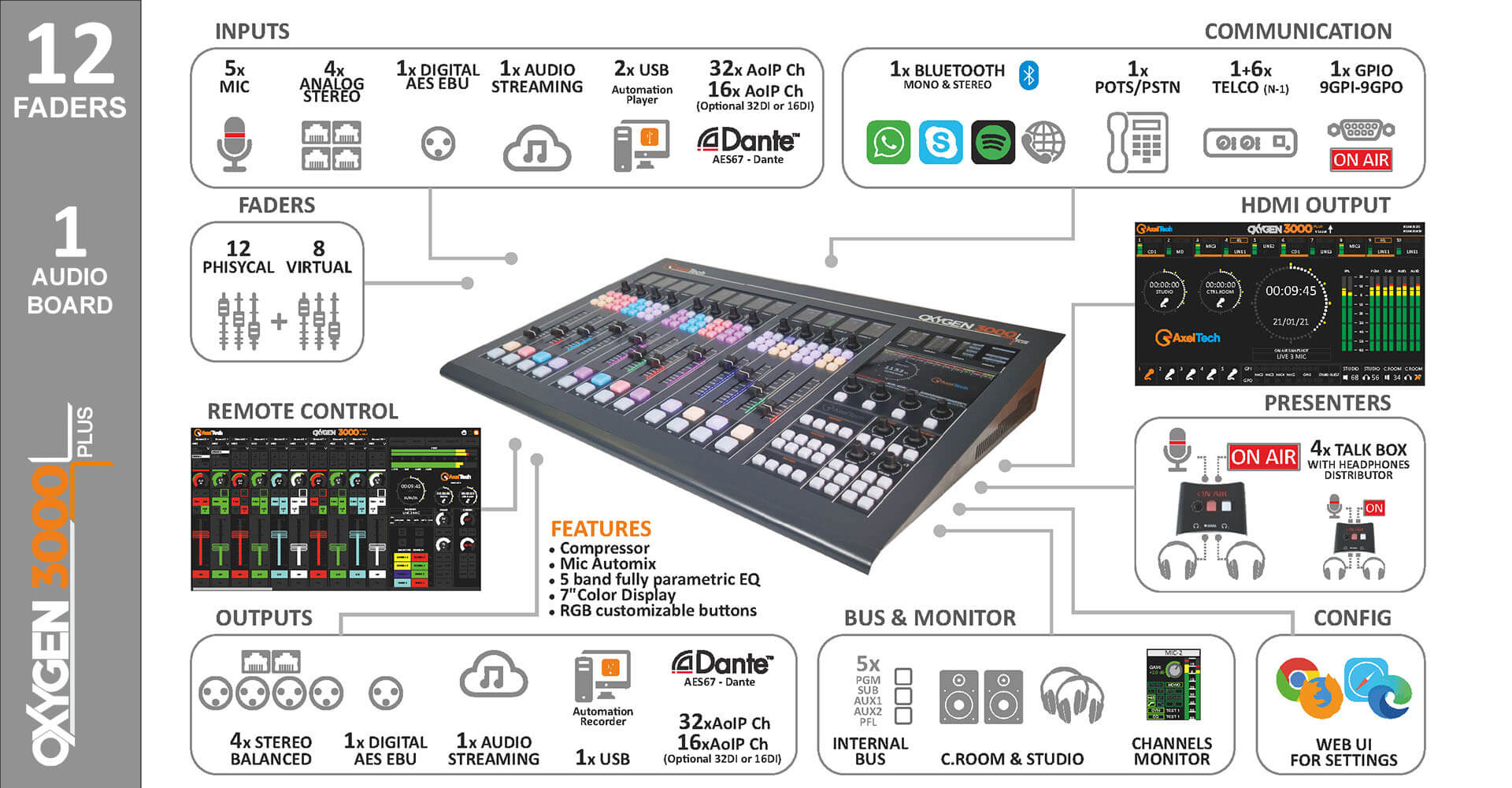
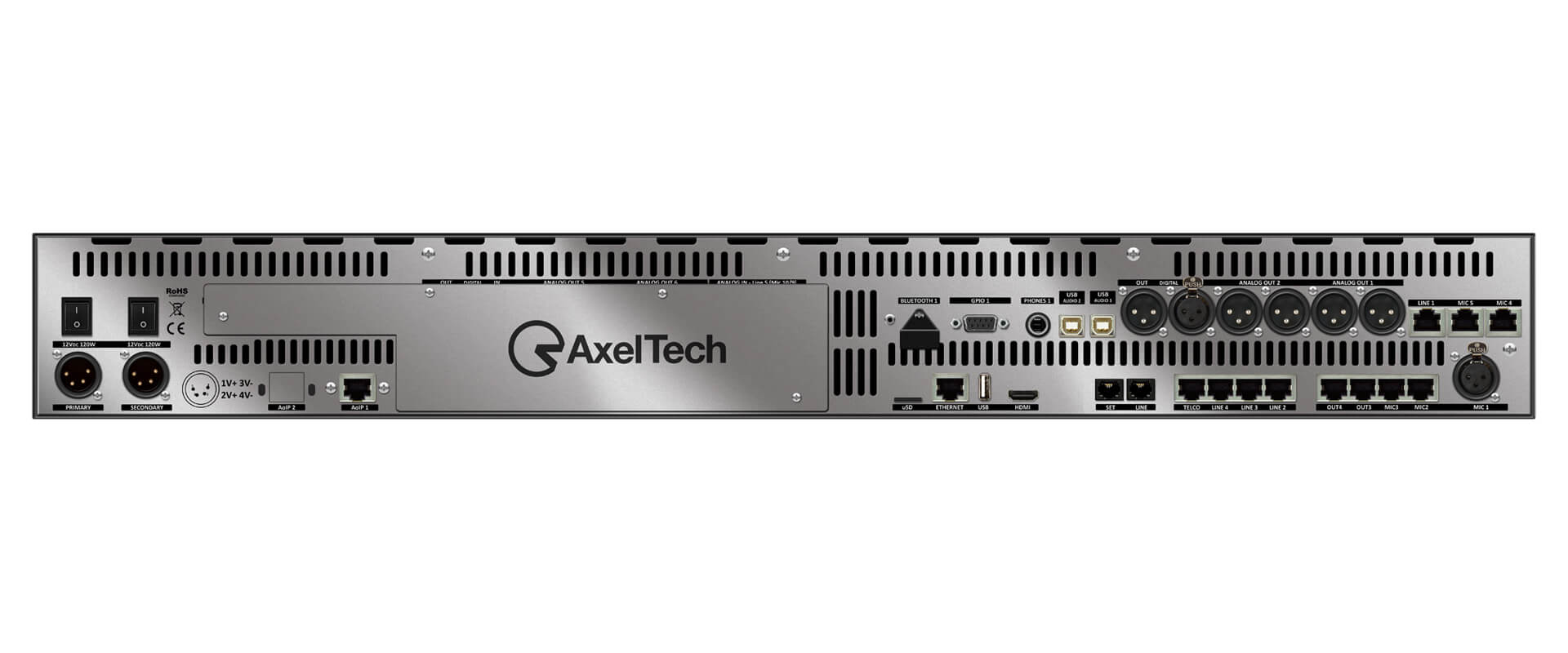
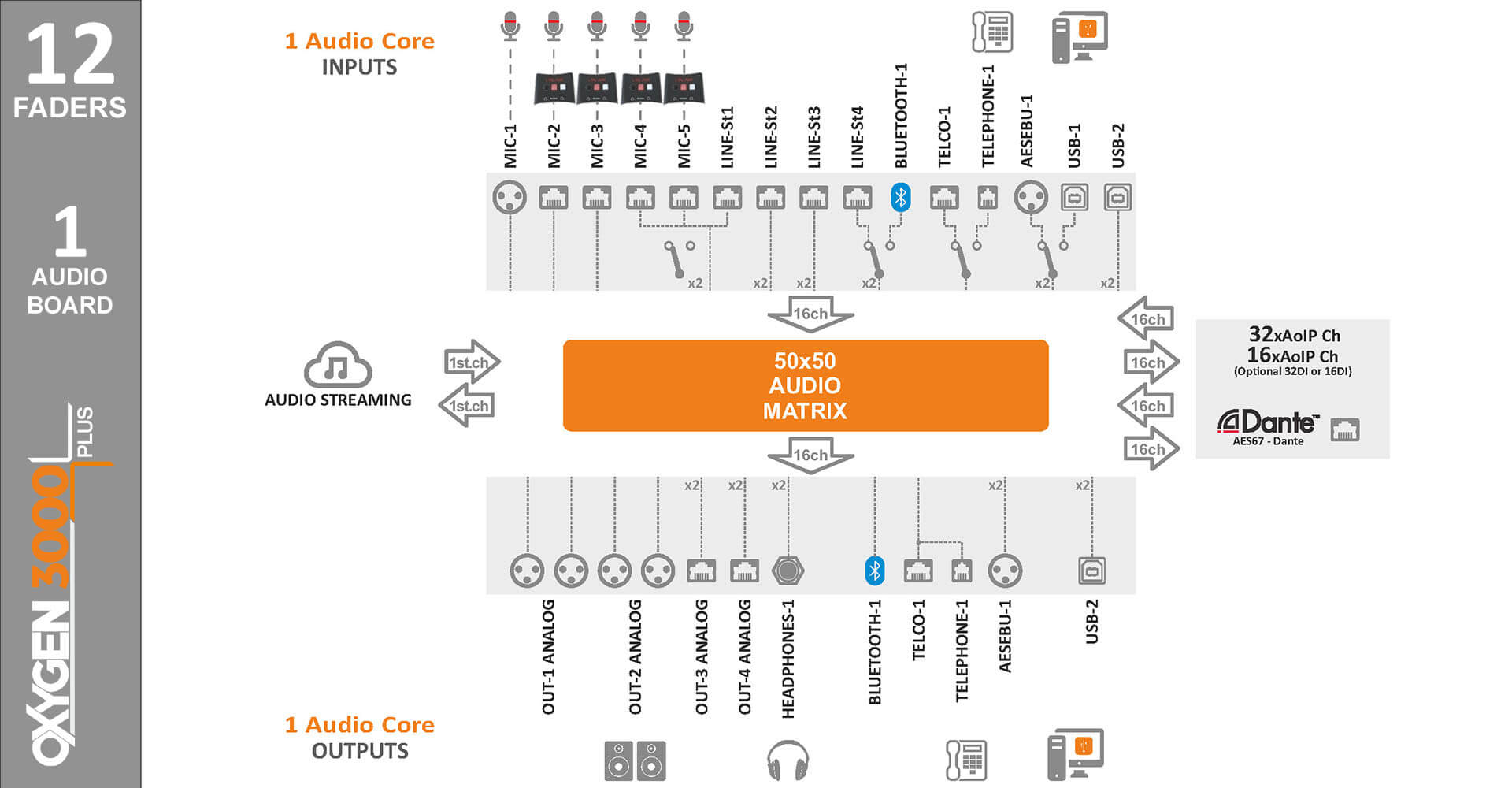
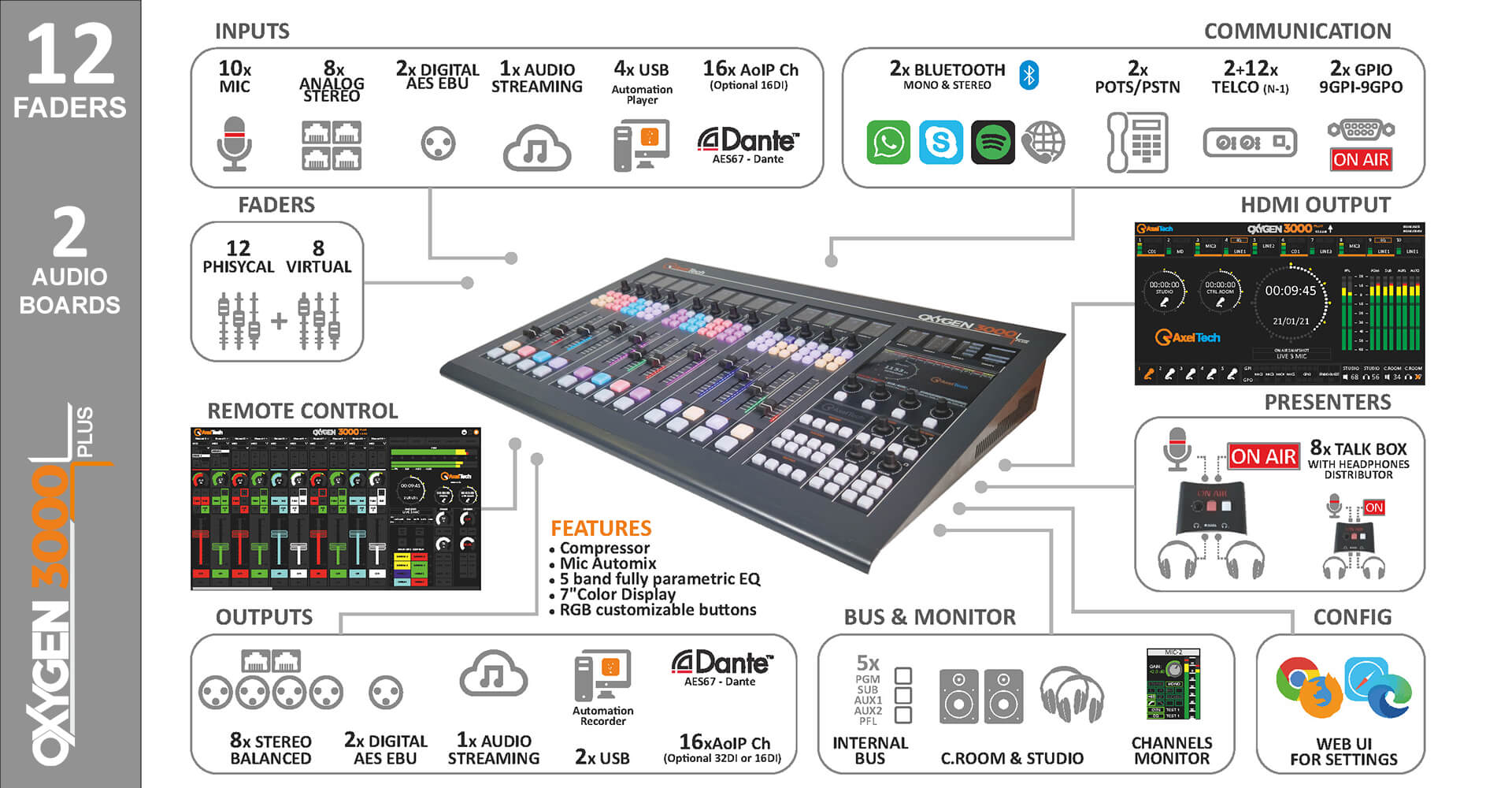
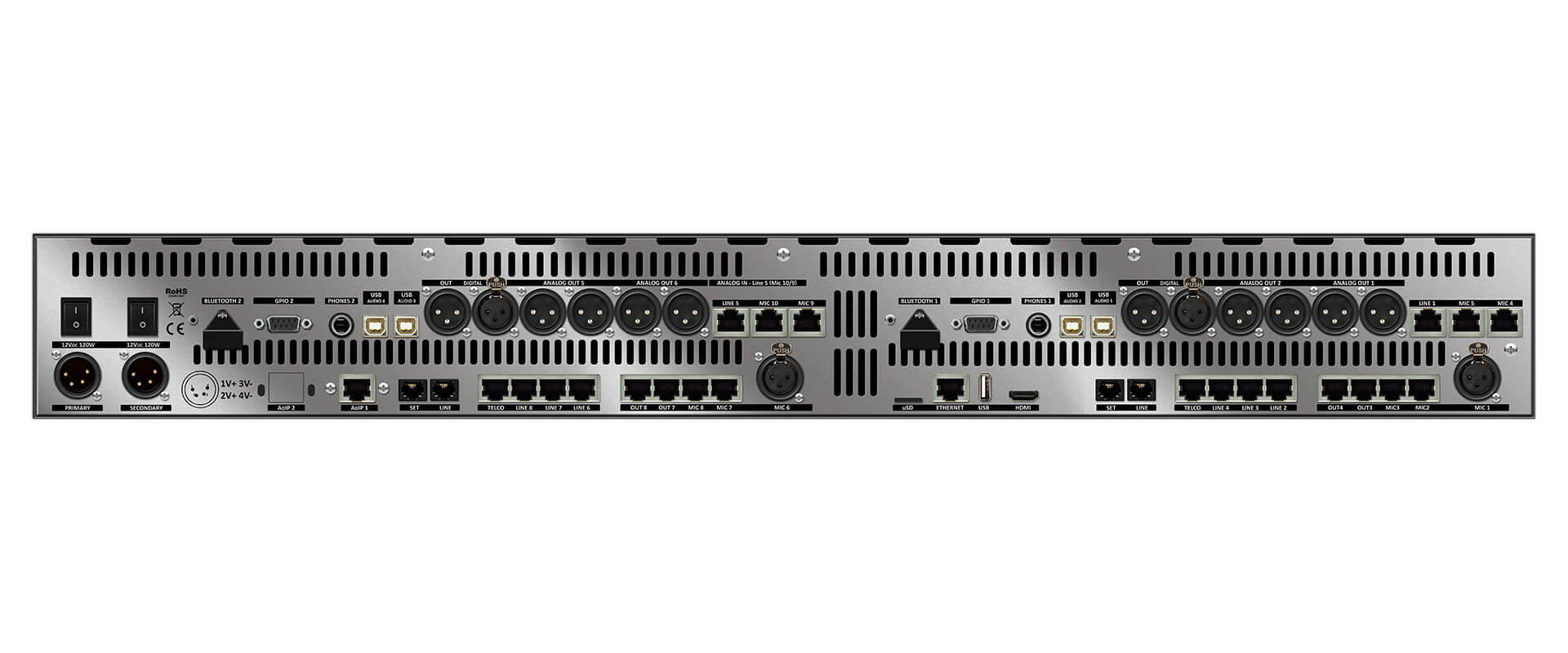
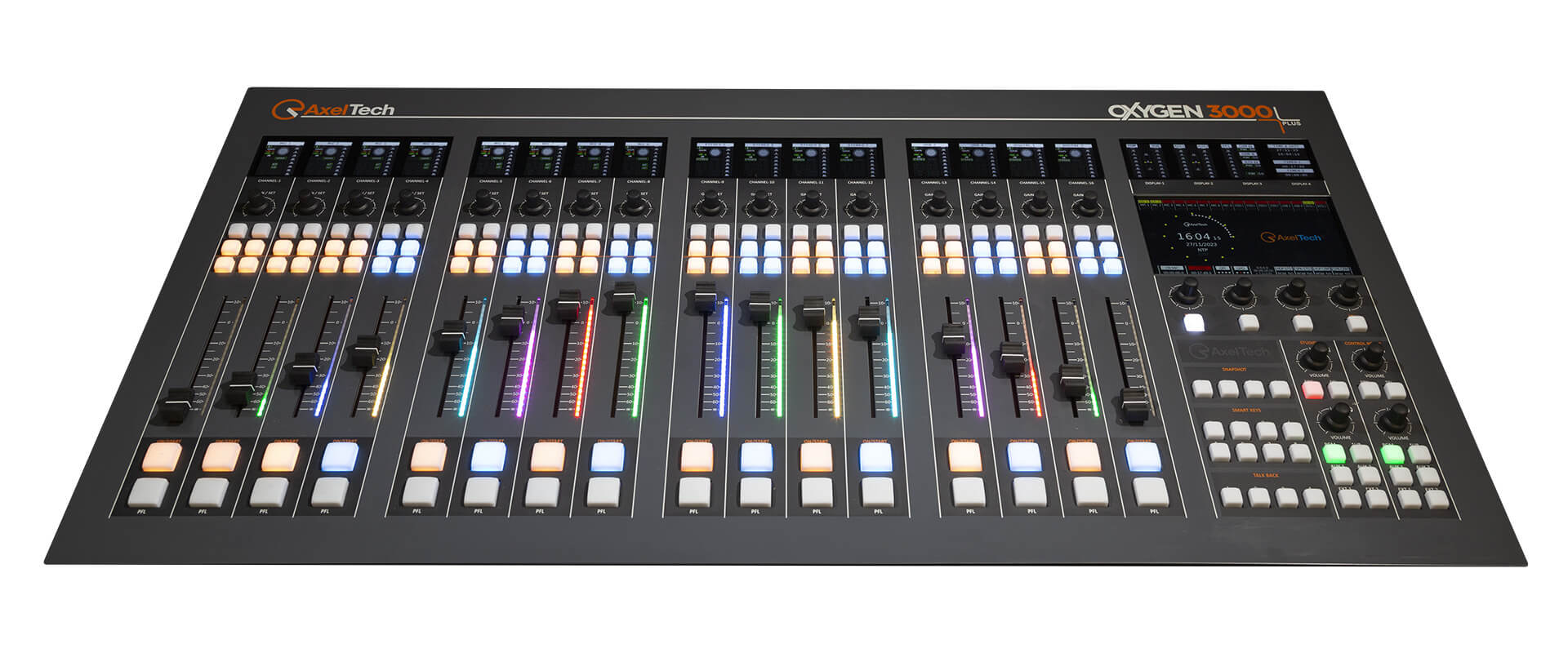
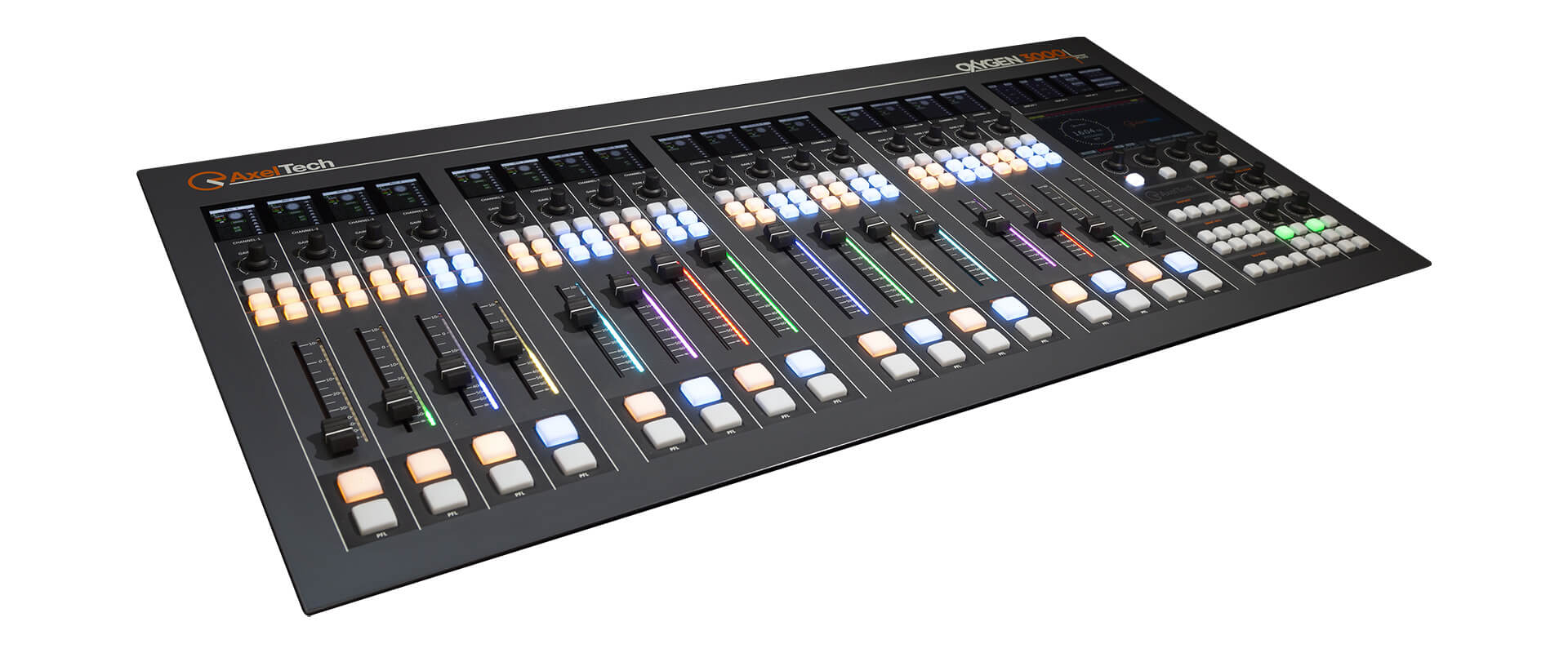
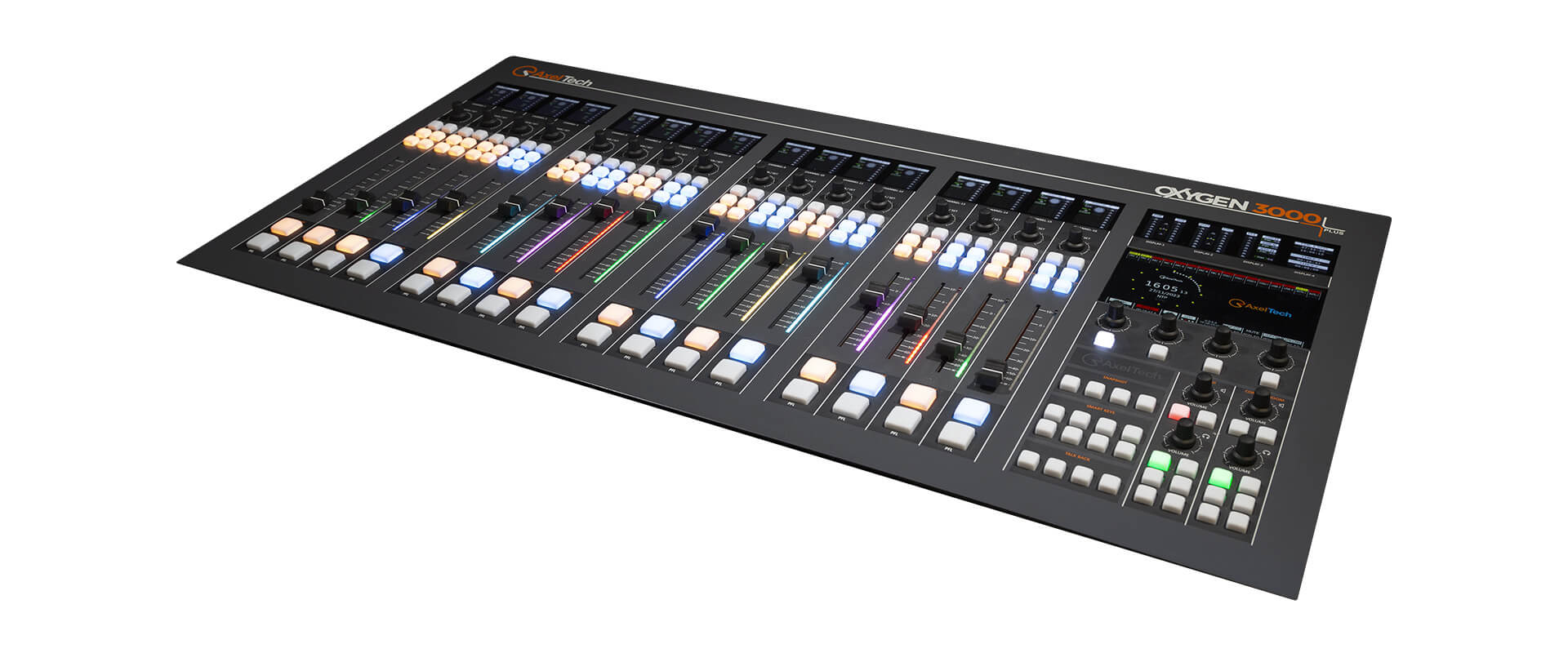
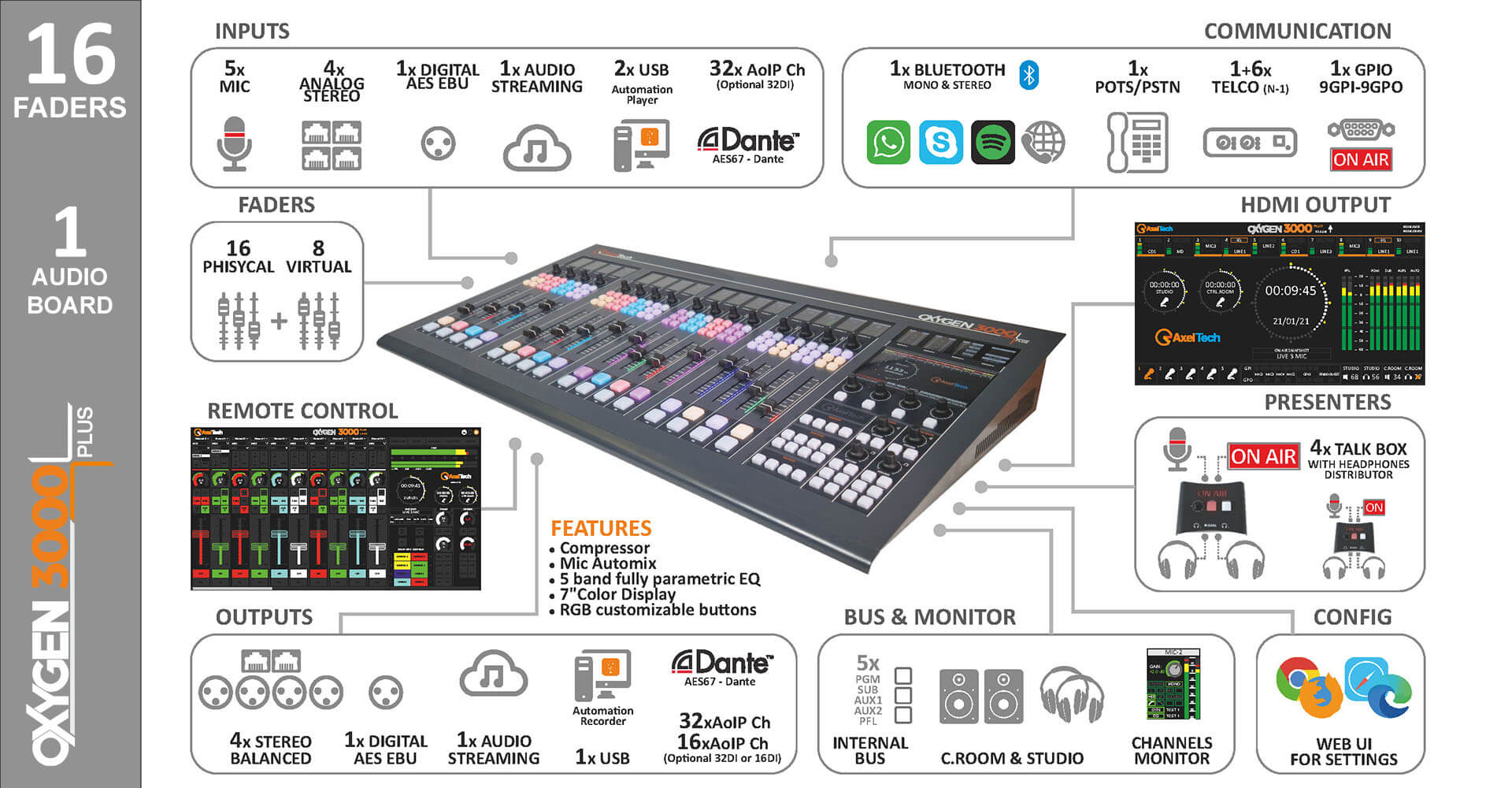
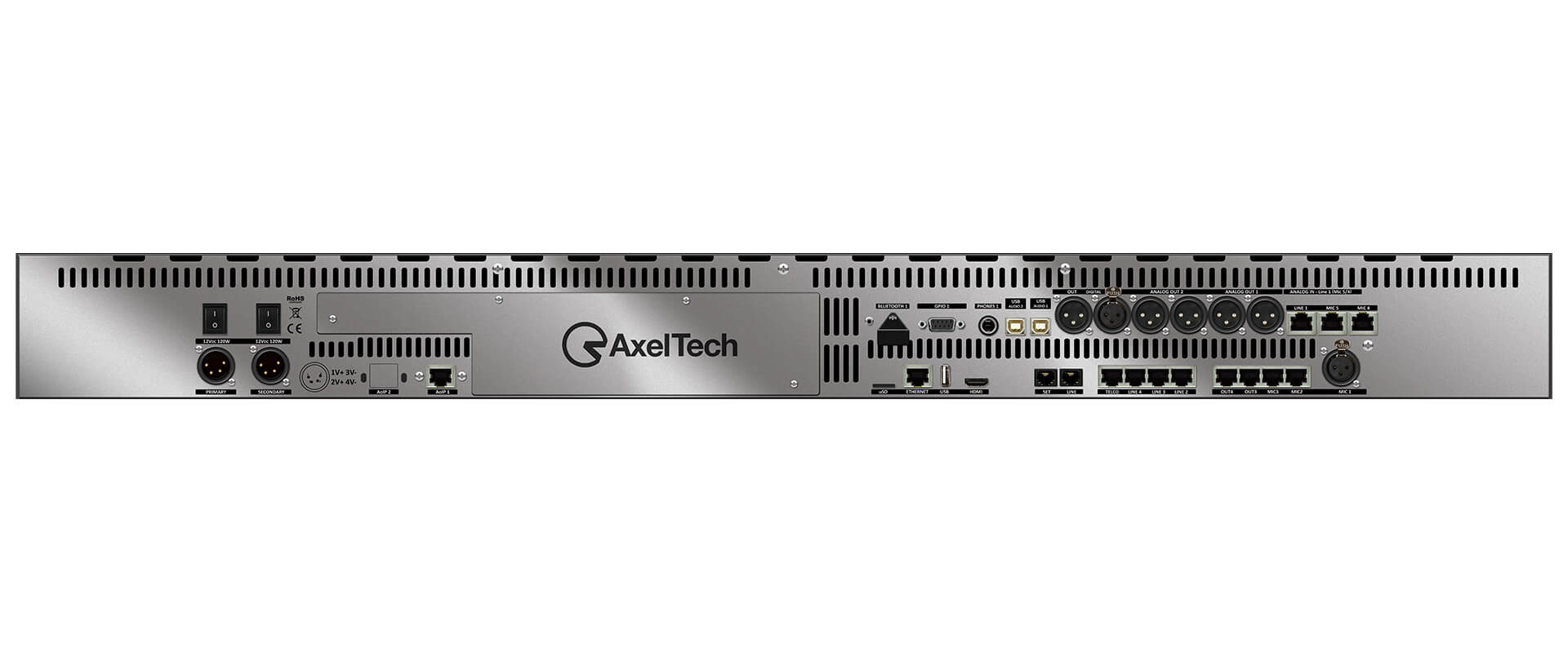

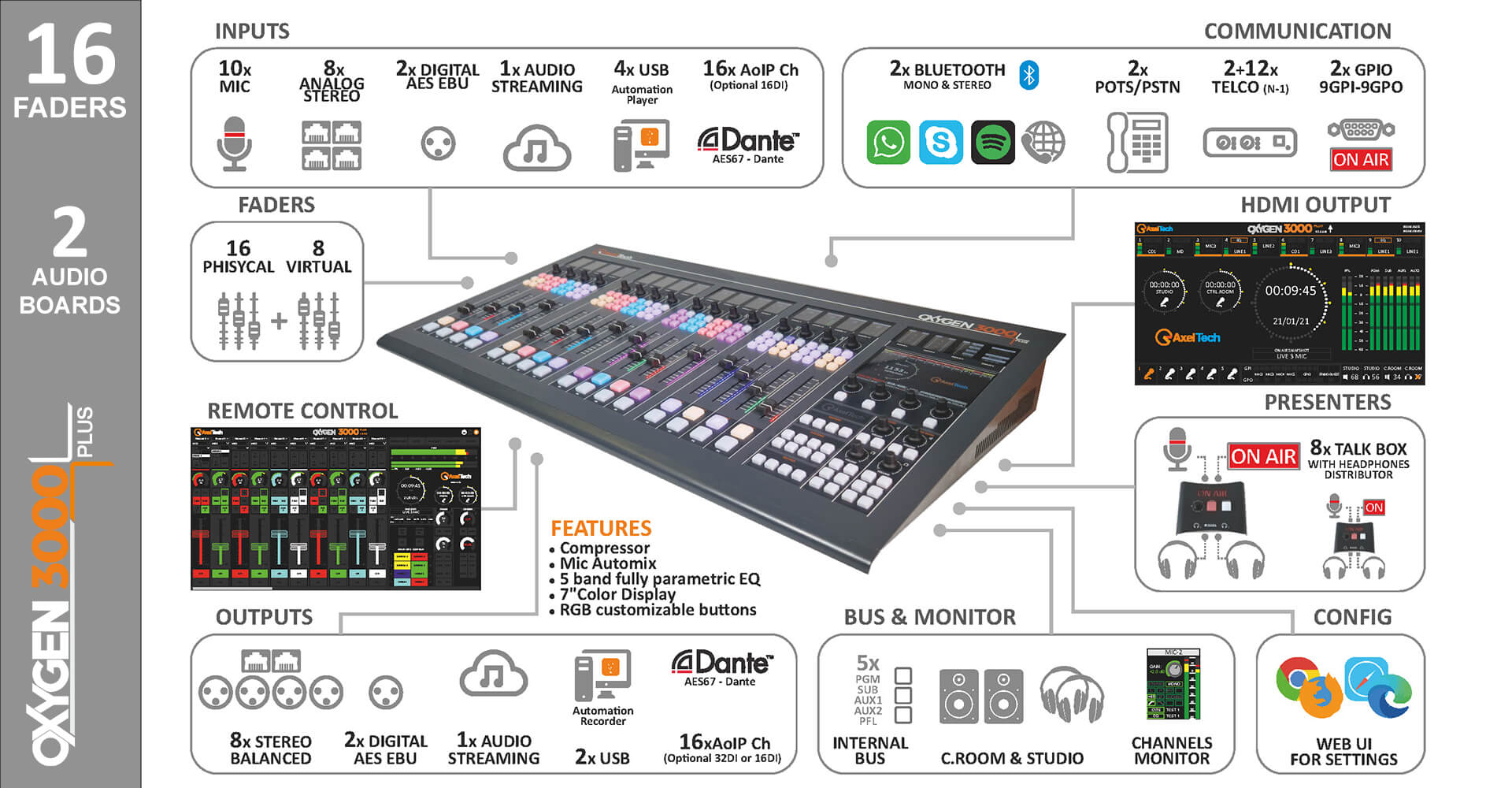

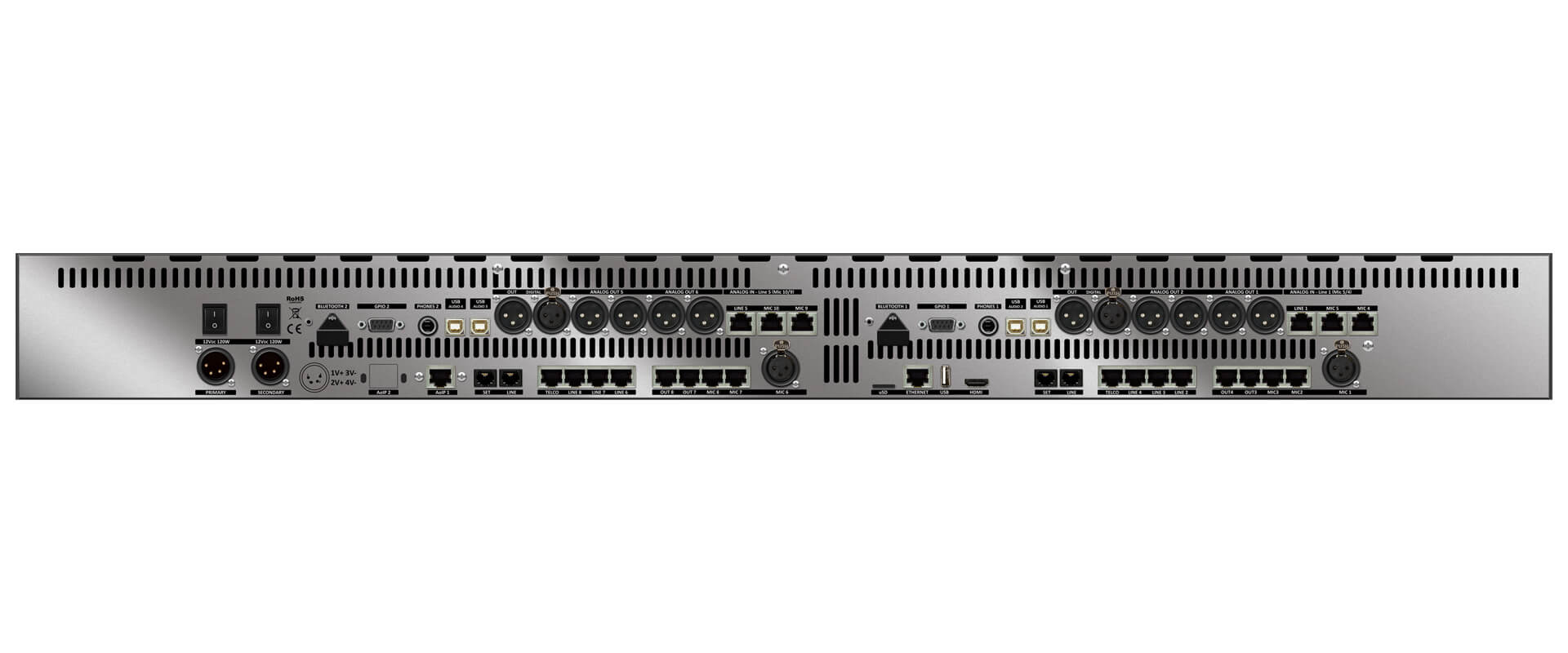
Oxygen 3000 Plus: much more than a Digital Broadcast Mixer!
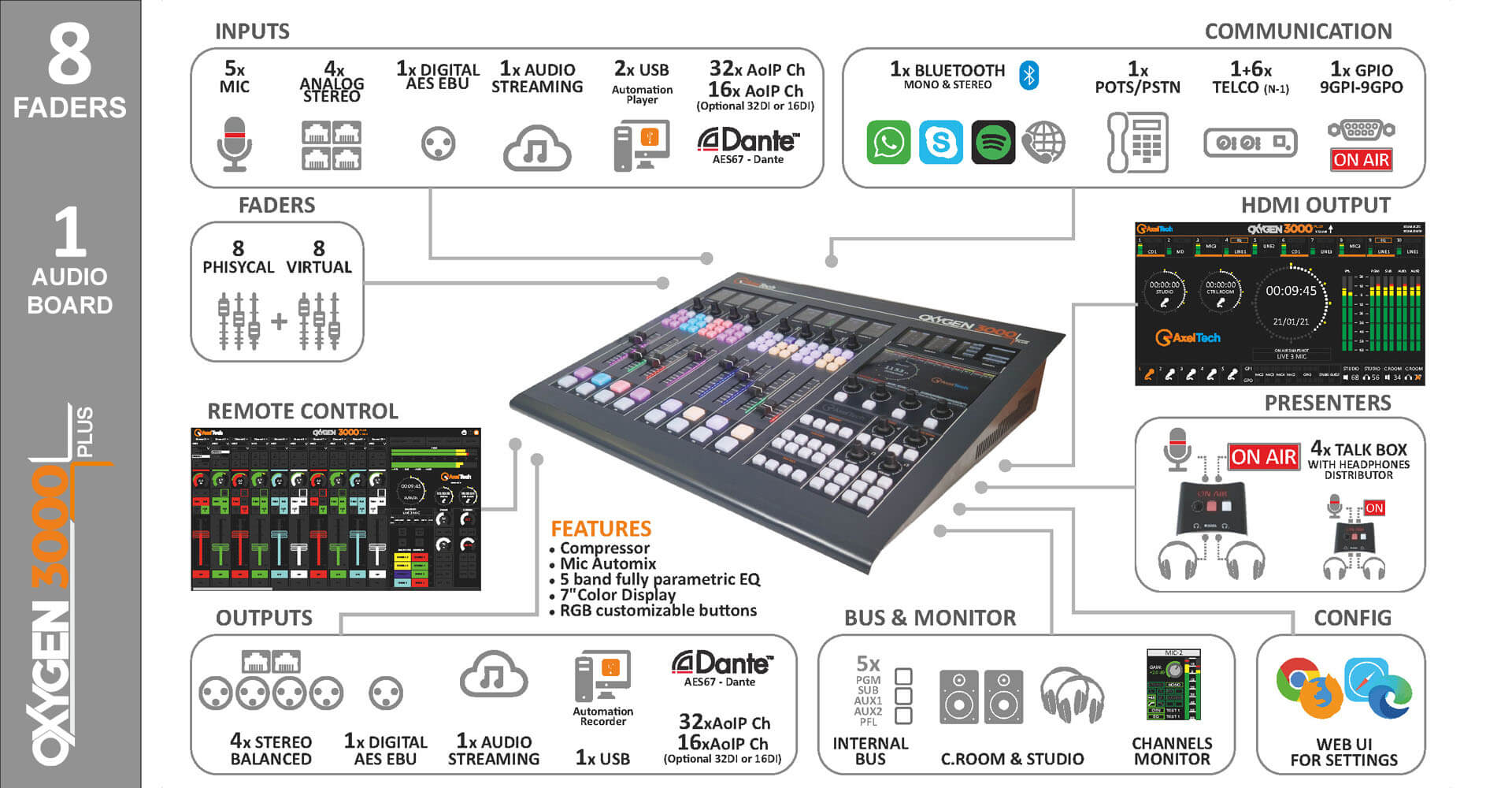
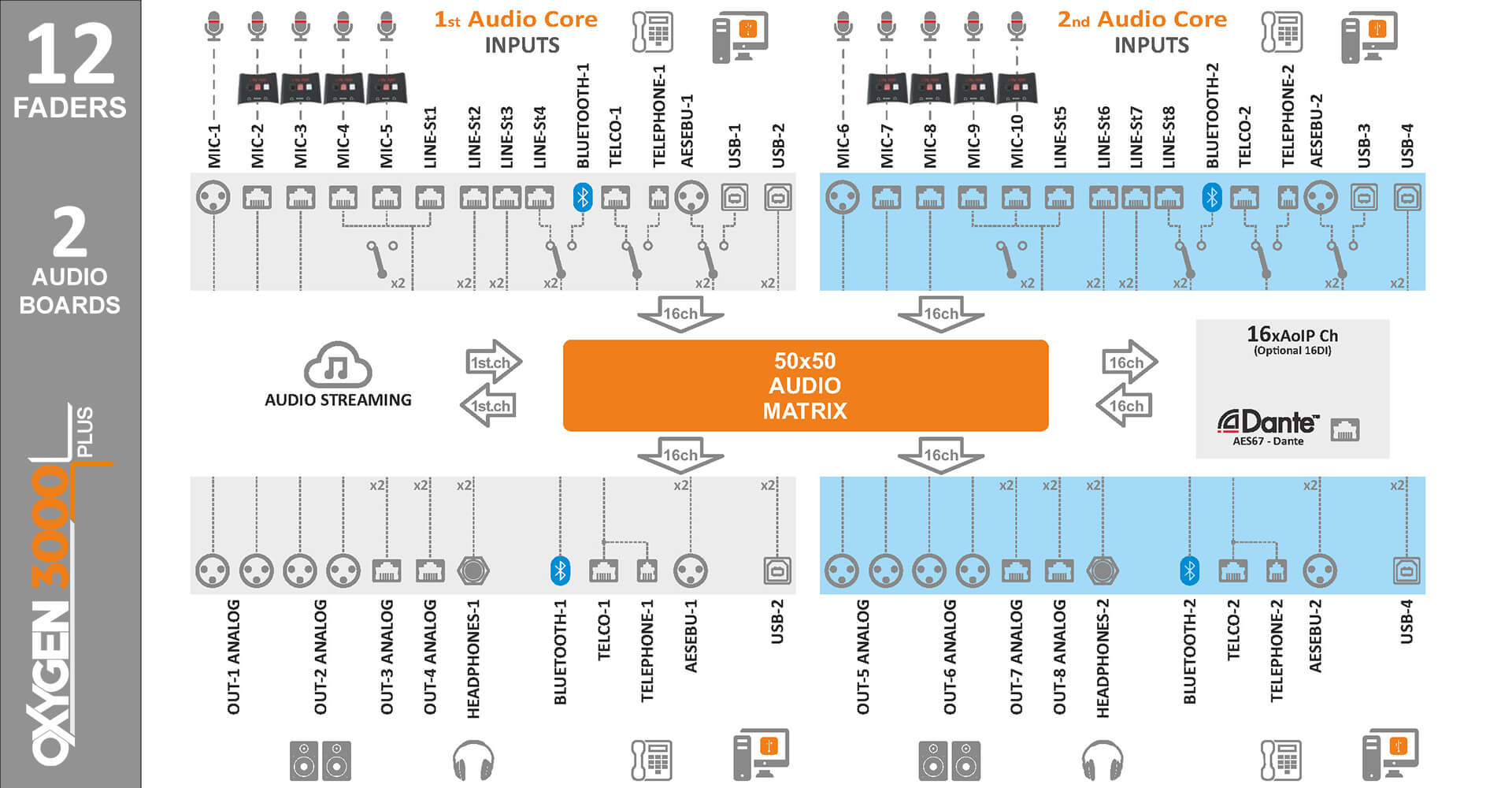
A full range of powerful features for Radio On-Air and Production available in 3 different formats and flexible configurations: 8, 12 and 16 faders with 1 or 2 Audio I/O Boards and 16+16 or 32+32 Dante™ I/O.
Oxygen 3000 Plus is the best-equipped console of its category: Low Latency, Users Preset, Smart Keys, EQ, Compressors, Telephone Hybrid, HDMI Output, Analogue and Digital I/O, USB, BT, Dante™ AoIP, Telco, Presenter Talk Box, Streaming In/Out.
The DSP based processing guarantees high-end quality audio and of course you will find the easiness of use that marks all the AxelTech’s products.
Oxygen Remoter Software, which enables up to 8 additional virtual faders for a full I/O control is available on Oxygen 3000 Plus as it is, for free, in any Oxygen Digital Console model.

Input & Output with 1 Audio I/O Board
- Up to 5 microphone inputs with Automix
- 2 stereo analogue inputs, up to 4 Stereo analogue inputs using other input sources
- 4 stereo analogue outputs
- 1 built-in telephone hybrid or 1 Telco with GPIO
- Up to 4 Telco using other input sources
- 1 BT audio interface or 1 stereo analogue input
- 1 digital In (AES/EBU) or 1 USB Input (play)
- 1 digital Out (AES/EBU)
- Up to 2 USB audio Input (play)
- 1 USB audio Output (rec)
- 1 Streaming In + 1 Streaming Out
- 16 inputs + 16 outputs or 32 inputs + 32 outputs via Dante™ (optional) configurable as mono/stereo/telco
Input & Output with 2 Audio I/O Boards
- Up to 10 microphone inputs with Automix
- 4 stereo analogue inputs, up to 8 Stereo analogue inputs using other input sources
- 8 stereo analogue outputs
- 1-2 built-in telephone hybrid or 1-2 Telco with GPIO
- Up to 8 Telco using other input sources
- 1-2 BT audio interface or 1-2 stereo analogue input
- 1-2 digital In (AES/EBU) or 1-2 USB Input (play)
- 2 digital Out (AES/EBU)
- Up to 4 USB audio Input (play)
- 2 USB audio Output (rec)
- 1 Streaming In + 1 Streaming Out
- 16 inputs + 16 outputs via Dante™ (optional) configurable as mono/stereo/telco
General
- Fully Digital Broadcast Console for Radio Broadcasting with 8, 12 or 16 faders
- Knob with A/B Fast source switch or source selection for each fader
- 4+1 busses (PGM, SUB, Aux1, Aux2, PFL)
- Near 0 latency (< 0,7 ms I/O)
- Digital Signals Routing 50×50 matrix with direct Input to Output
- Assignable Stereo N-1 on any output
- Complete Remote Control by means of an application replicating the surface
- Remote configuration and maintenance via Web Interface
- User-definable Presets & Snapshots
- 5 bands fully parametric Equalizer on each input
- Dynamic Processor with expander and compressor section on each microphone input
- Advanced and configurable Monitor Facilities for Control Room and Studio
- Customizable RGB colored buttons
- 7” TFT IPS Graphic Color Display for console configuration
- Four 2,2” TFT IPS displays for the output levels monitoring
- 2,2” TFT IPS displays on top of each fader displaying channel status, levels and source name
- HDMI Out for console status display
- 2 Timers (Ctrl-Room and Studio microphones on HDMI Monitor)
- START/ON Buttons for each fader
- 4 recall Snapshot buttons
- 4 direct Talkback buttons
- RGB led Bar for each fader
- Studio & Control Room Monitor Section
- 8 customizable Smartkey Buttons
- 2 customizable Function Keys for each fader
- TalkBox for guest and presenter (optional)
- Redundant PSU (optional)
Built In Decoder and Streamer
Oxygen 3000 Plus, in addition to analog/digital/AoIP inputs and outputs, is open to integration with the IP world thanks to the ability to decode an audio streams (stereo or mono) as input and generate an output audio stream (stereo or mono).
Versions
- Oxygen 3000 Plus 8 Fader 1 Audio I/O Board
- Oxygen 3000 Plus 8 Fader 1 Audio I/O Board Dante™ 16
- Oxygen 3000 Plus 8 Fader 1 Audio I/O Board Dante™ 32
- Oxygen 3000 Plus 12 Fader 1 Audio I/O Board
- Oxygen 3000 Plus 12 Fader 1 Audio I/O Board Dante™ 16
- Oxygen 3000 Plus 12 Fader 1 Audio I/O Board Dante™ 32
- Oxygen 3000 Plus 12 Fader 2 Audio I/O Board
- Oxygen 3000 Plus 12 Fader 2 Audio I/O Board Dante™ 16
- Oxygen 3000 Plus 16 Fader 1 Audio I/O Board Dante™ 32
- Oxygen 3000 Plus 16 Fader 2 Audio I/O Board
- Oxygen 3000 Plus 16 Fader 2 Audio I/O Board Dante™ 16
Options
- Redundant power supply
- Talk Box
- Dante™ I/O board
- RJ45 adapters for:
- Mic
- Line In
- Line Out
- Telco
- GPIO
The Oxygen Consoles Line Up
Microphone Inputs
- Up to 5 Microphone Inputs with Automix on each Audio I/O Board
- 3 Mic on XLR and 2 Mic on RJ45 (with Talk Box connector/adaptor) all balanced with + 48V Phantom and GPIO on each Audio I/O Board
- Independent ON AIR Lights and Cut Off control when opening Control Room and Studio microphones
- PFL button switches to private conversation on Hybrid/Telco/BT mode
- Enable TalkBack feature on any Studio or Control Room microphone
- Parametric Compressors/Expander with enhanced features for MICROPHONE and MONO inputs
- Save and recall microphone presets including Compressor/Expander settings
- Phase inversion on microphone inputs
- MONO inputs assignable as EXT source
- Ducking/AutoFader assignable to all sources (automatic attenuation of music on speech)
Automix
The Automix feature simplifies mixing activities if many guests are in the studio.
The Automix adds a new source to the existing ones (called “Automix”) and it will be the sum of all the enabled microphones.
The Automix source has all the features of a normal microphone source such as:
- Studio/Control Room loudspeakers control
- Studio/Control Room light control
- Can be used as audio in Private mode for phone calls
Using the Automix source, the user can manage in a very simple way all the microphones of the studio with many benefits:
- Managing all the studio’s microphones with one fader only;
- A dedicated AGC section for each microphone input automatically adjusts the correct level;
- Automatic management of attenuation on microphones not in use, simulating a slight closure of the fader;
- Final compressor with automatic leveling of the Automix source;
- Possibility to use the microphones individually.
This feature simplifies the work of the mixer engineer, especially if he/she is also hosting the show.
Available settings in the Automix menu:
- MIC-1 ON/OFF
- MIC-2 ON/OFF
- MIC-3 ON/OFF
- MIC-4 ON/OFF
- MIC-5 ON/OFF
- MIC-6 ON/OFF (with second audio board)
- MIC-7 ON/OFF (with second audio board)
- MIC-8 ON/OFF (with second audio board)
- MIC-9 ON/OFF (with second audio board)
- MIC-10 ON/OFF (with second audio board)
- DANTE-1 ON/OFF (with Dante™ option)
- DANTE-2 ON/OFF (with Dante™ option)
- DANTE-3 ON/OFF (with Dante™ option)
- DANTE-4 ON/OFF (with Dante™ option)
- DANTE-5 ON/OFF (with Dante™ option)
- DANTE-6 ON/OFF (with Dante™ option)
- Idle Mic Attenuation
- Attenuation Attack Speed
- Attenuation Release Speed
- Compression Threshold
- Compression Ratio
- Compression Attack Speed
- Compression Release Speed
- Autogain Speed
- Autogain Max Gain
- Autogain Max Attenuation
Analogue Inputs
- 2 balanced stereo analogue inputs on RJ45, up to 2 additional balanced stereo analogue inputs (one on XLR and one on RJ45) using other input sources, on each Audio I/O Board
- Channel mode selection: STEREO, MONO, L, R, INV-L, INV-R, INV
Digital Input Line
- 1 AES/EBU Input on XLR with Sample Rate Converter (32 – 192 kHz), on each Audio I/O Board
USB Audio I/O
- 2 Built-in stereo USB (Type-B) (2 Stereo Inputs-1 Stereo Output) Audio Interfaces on each Audio I/O Board, allow to directly connect the PC to the Oxygen 3000 Plus console, with no need for extra audio cards (the PC detects the console as a digital audio card with 2 stereo inputs and 1 stereo output for simultaneous playout and recording)
Telephone Hybrid and Telco
- Telephone Hybrid: 1 POTS/PSTN telephone line with Line In and Tel Set connection on each audio I/O board
- Telco: 1 in/out N-1 to connect external telephone hybrid with control via TLC/GPIO, on each Audio I/O Board
- Up to 6 Telco using other input sources, on each Audio I/O Board
- GPI and GPO management on max 5 Telco I/O, on each Audio I/O Board
- RING and HOOK on F keys for each TELCO I/O
- N-1 on Telco outputs for all BUS (PGM, SUB, AUX-1, and AUX-2)
Analogue Outputs
- For each Audio I/O Board 4 Balanced Outputs:
- OUT – 1 & 2 XLR – Assignable
- OUT – 3 & 4 RJ45 – Assignable
Digital Output
- 1 AES/EBU output (32 – 192 kHz) on XLR on each Audio I/O Board
Headphones and Local Monitor Outputs
- For each Audio I/O Board, 1 Unbalanced output line on Jack 6.3 for Control Room and Studio Headphones
- Adjustable maximum Control Room and Studio speakers volume
- Adjustable maximum Control Room and Studio headphones volume
- Adjustable CUT or Attenuation mode (-40, -30, -20, -10 dB) on Control Room and Studio speakers
- Independent source selection (PGM, SUB, AUX1, AUX2, EXT1, EXT2) for control room and studio speakers, control room and studio headphones with or without PFL
- Independent Talk Back management on Control Room and Studio speakers
- Independent Talk Back management on Control Room, Studio and Guest headphones
- Selectable source for Guest headphones (PGM, SUB, AUX1, AUX2, EXT1, EXT2)
- Same source selection for Control Room and Studio headphones, with independent level
GPI/GPO
- GPI: 9 on each Audio I/O Board, for Talk back, Telephone Hybrid or other features
- GPO: 9 on each Audio I/O Board, to control OnAir lamps or provide HOOK and RING commands for external telephone Hybrid
- User custom GPIs (e.g. Ring, Talkback, channel ON/OFF, etc.)
- User custom GPOs (e.g. Hook/ONAIR, Studio-Light, Control Room-Light)
Surface & Management
- Direct Firmware update via Internet
- WEB UI for Console configuration and service features (Save, restore, update, logs, etc)
- Conditional Access (4-digit PIN) to limit console configurations to authorized users
- Save and recall EQ presets (up to 10)
- New real-time EQ algorithm with graphic
- Fast and accurate Meters on 2.2” TFT IPS displays
- Save and recall control panel configuration with 10 Snapshots
- Save and recall total console configuration. The configuration can be saved to internal memory (microSD), USB and PC (via WEB interface)
- Gain adjustment knobs with adaptive speed
- Dimmable buttons light
- Adjustable fader ON/OFF threshold (from -50 dB to 0 dB)
- CountUp/Timer on studio and control room microphones on the built-in 7″ display
Telephone Hybrid and Telco
The built-in telephone hybrid allows direct connection of a telephone line POTS/PSTN on RJ-11C.
It’s also available a Telco N-1 in/out, to connect Oxygen 3000 Plus to an external telephone hybrid. Telco-1 N-1 output is always available on RJ45. TLC commands are available on RJ45 connector with Hook and Ring interface for external telephone hybrid.
6 inputs/outputs N-1 are also available (with 4 GPI controls).
Software Remote Control
Oxygen Remoter is a software tool available for free with any Oxygen console. It offers advanced remote control features such as accessing to any set up and information, fader and buttons control and any other operation available on the physical consoles. It is very useful especially for compact consoles and in any environment that has limited space.
The Virtual Fader technology enables users to assign each input to a virtual fader/channel on the remote surface, this is of course very useful when controlling channels remotely. Additionally, transforming the A/B pair into two virtual faders is a smart solution that maximizes the management of the available sources.
Oxygen Remoter can remotely control multiple consoles and create an ecosystem, this can be very helpful for remote productions where, for instance, a portion of the channels may need to be controlled from a studio while the others are still managed from the physical surface in the control room.
Oxygen Remoter is a powerful tool that provides extra flexibility and control’s tools to all the Oxygen consoles.
Oxygen Remoter is downloadable from the Oxygen console’s administration web page.
Displays
On the OXYGEN 3000 Plus AxelTech reinvented the experience between the studio engineer and the console.
The 7″ TFT IPS graphic display shows all the airing parameters and with the 4 rotary knobs allows the fast and intuitive programming of all the mixer’s parameters.
Selectable home page layouts are available with many theme icons. Default page shows the levels and the A & B source names for any fader.
Four 2,2 ”TFT IPS displays have been implemented for an immediate and complete monitoring of the outputs.
The 2,2 ”TFT IPS displays on top of each fader show the channel status, levels, sources and main settings.
HDMI Output
The HDMI output connects the console to a HD display monitor and it can monitor all the following information:
- Audio input source levels
- 4+1 BUS output levels
- A/B source names assigned of 10 channels
- Display On-Air sources
- Microphone On timer (control room & studio)
- Large Clock
- Audio output level (Loudspeakers & Headphones)
- On-Air microphone
- Telephone active
- HDMI output combined with 4 rotary knobs allow the fast and intuitive programming of all the mixer parameters.
- The programming GUI has been designed in order to be very easy and intuitive.
- Selectable home page layouts are available, with many theme icons.
HDMI output can be customized with the user’s logo. Selectable display layouts are available.
BT
Oxygen 3000 Plus has a BT module on each Audio I/O Board. This allows airing the calls made via GSM, Skype, Viber and WhatsApp with a Smartphone, a Tablet or a PC. Oxygen 3000 Plus has two BT connection modes: bidirectional to support phone calls; monodirectional to put on air high quality stereo audio (A2DP) streamed by BT sources.
With BT calls, PFL enables PRIVATE conversation mode.
Built In Decoder and Streamer
Oxygen 3000 Plus, in addition to analog/digital/AoIP inputs and outputs, are open to integration with the IP world, thanks to the ability to decode an audio streams (stereo or mono) as input and generate an output audio stream (stereo or mono).
Supported CODECs:
Input (CBR & VBR):
- AAC (AAC-LC): 32-256 kbps, 16/32/44.1/48 kHz
- Linear PCM – 16 bit, 16/32/44.1/48 kHz
- MP3 (MPEG1-Layer 3): 32-320 kbps, 16/32/44.1/48 kHz
- MP2 (MPEG1-Layer 2): 32-320 kbps, 32/44.1/48 kHz
- OGG VORBIS: 32-256 kbps, 16/32/48 kHz
- OPUS: 6-320 kbps, 48 kHz
Output (CBR):
- AAC (AAC-LC): 32-256 kbps, 16/32/48 kHz
- Linear PCM – 16 bit, 16/32/48 kHz
- MP3 (MPEG1-Layer 3): 32-320 kbps, 16/32/48 kHz
- MP2 (MPEG1-Layer 2): 32-320 kbps, 16/32/48 kHz
- OGG VORBIS: 32-256 kbps, 16/32/48 kHz o OPUS: 6-320 kbps, 48 kHz
Supported Streaming Servers:
- Icecast: MP3, OPUS and Ogg Vorbis
Network and Transport & protocols:
- Transport: Real-time Transport Protocol (RTP), Real-time Streaming Protocol (RTSP)
- Protocols: IPv4, IPv6, TCP/IP, UDP, RTP, RTSP
Casting modes: Multicast and Unicast
Key applications:
- STL and SSL links, DVB S/T audio, WEB radio
- Audio streaming over internet
Redundant Power Supply
Oxygen 3000 Plus is equipped with an external Universal Switching Power Supply 12V (with 4 poles XLR connections) able to operate with a voltage between 90Vac and 264Vac and a frequency between 50 and 60Hz. This PSU can adapt itself to the operating voltage of any country in the world. Optionally the console can be equipped with a redundant power supply: in this configuration the fault of one of the PSU is promptly noticed on the 7” display.
Talk Box
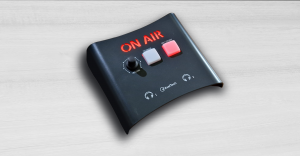 Talk Box is very simple to connect to the On Air Console: it takes 2 RJ45 cables of the length that is needed to connect it to the mixer. It is possible to connect up to 4 Talk Boxes on each Audio I/O Board. The Talk Box manages a direct connection of the microphone and its own On-Air light. It is also possible to connect it to the studio’s On-Air Light. The Talk Box has a headphone amplifier with two 6.3mm outputs. Through the two backlit buttons it is possible to activate and deactivate your own microphone (On/Off/Cough) or enable Talk back to the console.
Dante™ AoIP Interface
Oxygen 3000 Plus can be equipped with a Dante™ interface (also supporting AES67 and SMPTE ST 2110-30 transport protocols) which provides 16 Inputs and 16 Outputs or 32 Inputs and 32 Outputs on dedicated Ethernet port, with independent Level Control and Sample Rate Conversion.
Dante™ AoIP interface is installed at the factory and has to be requested at the order.
Cable Adapters
RJ45 adapters are available for:
- Mic with GPIO
- Line In
- Line Out with GPIO
- Telco with GPIO
Analog Balanced Microphone Inputs
Connector RJ45 & XLR Balanced – EMI Suppressed
Input Impedance 2,4 KΩ
Nominal Input Level (sensitivity) -9/-66 dBu
Max Input Level (clipping point) +9 dBu
A/D conversion 24 bit / 48 Khz
Signal To Noise Ratio (referred to peak level) >110 dB
THD+N <0,01%
Analog Gain Adjustable +0 ÷ +60 dB (3dB step)
Phantom Power +48V
Analog Balanced Stereo Inputs
Connector XLR & RJ45 Balanced – EMI Suppressed
Input Impedance 10 KΩ
Nominal Input Level (sensitivity) 0 dBu
Max Input Level (clipping point) +18 dBu
A/D conversion 24 bit / 48 Khz
Frequency response +/-0,5 dB from 20 Hz to 20 kHz
Signal To Noise Ratio (referred to peak level) >110 dB
Stereo Separation (referred to peak level) >90 dB
THD+N <0,002 %
Analog Balanced Telco Input
Connector RJ45 Balanced – EMI Suppressed
Input Impedance 10 KΩ
Nominal Input Level (sensitivity) 0 dBu
Max Input Level (clipping point) +18 dBu
A/D conversion 24 bit / 48 Khz
Signal To Noise Ratio (referred to peak level) >110 dB
THD+N <0,002%
Digital Input
Connector Balanced on 1 XLR – EMI Suppressed
Input Impedance 110Ω
Standard AES3
Audio Sample Rate 32/44.1/48/96/192 KHz with SRC
Resolution 24 bit
Dynamic Range (Converter Values) 124dB
Analog Balanced Stereo Outputs
Connector RJ45 Balanced – EMI Suppressed
Output Impedance 23 Ω, nominal 600 Ω
Nominal Output Level 0 dBu
Max Output Level (clipping point) +18 dBu
D/A conversion 24 bit / 48 Khz
Signal To Noise Ratio (referred to peak level) >110 dB
Stereo Separation (referred to peak level) >90 dB
THD+N <0,002 %
Dante I/O
Sample Rates (16x16 Versions) 44.1/48/88.2/96 kHz
Sample Rates (32x32 Versions) 44.1/48/88.2/96 kHz
Audio Flows In/Out Up to 32x32 simultaneous streams
Digital Audio Formats TDM, I2S
Audio Transport Formats Dante Audio over IP, AES67 RTP, SMPTE ST2110-30 RTP (enrolled devices)
Sample Bit Depth 16, 24 or 32 bits per sample
Audio Buffering Up to 2000 samples per channel
Clocking Onboard word clock or external word clock
Form Factor Card edge module. 4.5cm x 6cm (1.75” x 2.4”)
FPGA High performance Xilinx Spartan6 FPGA
Microprocessor Soft-core Microblaze processor
Clock High quality, low jitter onboard SiLabs
Ethernet Standard RGMII/MII interface for Ethernet PHY or switch chip
Power 3.3VDC @ 2W max
Physical Connector Mini-PCI
Control Interfaces SPI Master and Slave; GPIO; I2C
Network RGMII/MII
USB Audio Digital I/O
Connector USB Type B – EMI Suppressed
Playback And Recording Sample Rate SRC 44.1-48 KHz
Resolution 16 bit
Available Stereo Channels 2 stereo USB - 2 Inputs & 1 Output on each Audio I/O Board
Analog Balanced Talkbox Outputs
Connector RJ45 balanced – EMI Suppressed
Output Impedance 100ohm, nominal 600ohm
Nominal Output Level 0dBu
Max Output Level (clipping point) +14dBu
D/A conversion 24 bit / 48 Khz
Signal To Noise Ratio (referred to peak level) >110dB
Stereo Separation (referred to peak level) >90dB
THD+N <0,05%
Analog Balanced Telco Output
Connector RJ45 Balanced – EMI Suppressed
Output Impedance 23 Ω, nominal 600 Ω
Nominal Output Level 0 dBu
Max Output Level (clipping point) +18 dBu
D/A conversion 24 bit / 48 Khz
Signal To Noise Ratio (referred to peak level) >110 dB
THD+N <0,002 %
Digital Output
Connector Balanced on 1 XLR – EMI Suppressed
Input Impedance 110 Ω
Standard AES3
Audio Sample Rate 32/44.1/48/96/192 KHz
Resolution 24 bit
Dynamic Range (Converter Values) 124 dB
PSTN Interface
Connector RJ11
Transhybrid loss >20 dB
System
Audio Core Analog Devices ADAU1452 32bit 294 MHz fixed point DSP
Audio CODECs Cirrus CS42448 24 bit/192 kHz
LAN Connection RJ45 - 1 Gbit
Nominal Delay (analog input to analog output) 0,7 ms
GPIO Inputs/Outputs 4 GPI/4 GPO on DB9; 4 GPI/2 GPO on Mic2 & Mic3 RJ45; 2 GPO on Out3 & Out4 RJ45; 1 GPI/1 GPO on Telco RJ45
Communication Port 2xUSB type-A, 2xUSB type-B , 1xLAN, 1xHDMI
Operating Temperature 0°C ÷ 40°C
Dimensions
8 Faders Dimensions (W; H; D) 584 mm; 113,5 mm; 495,5 mm
12 Faders Dimensions (W; H; D) 764 mm; 113,5 mm; 495,5 mm
16 Faders Dimensions (W; H; D) 944 mm; 113,5 mm; 495,5 mm
Weight 15 to 25 Kg
PSU
Type External Universal Switching Power Supply 12V with 4 poles XLR connections - Optional Redundant
Power Supply 90-264 VAC / 50-60 Hz / 120 W
Case Histories

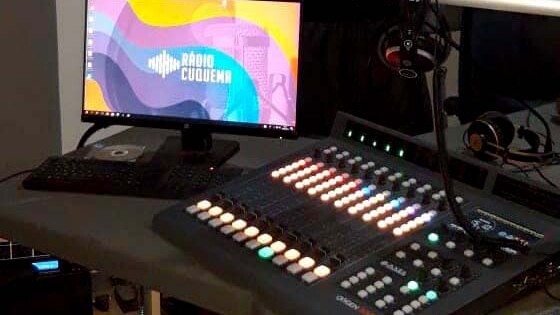
Radio Cuquema – Radio Station
Angola with SiteMaster
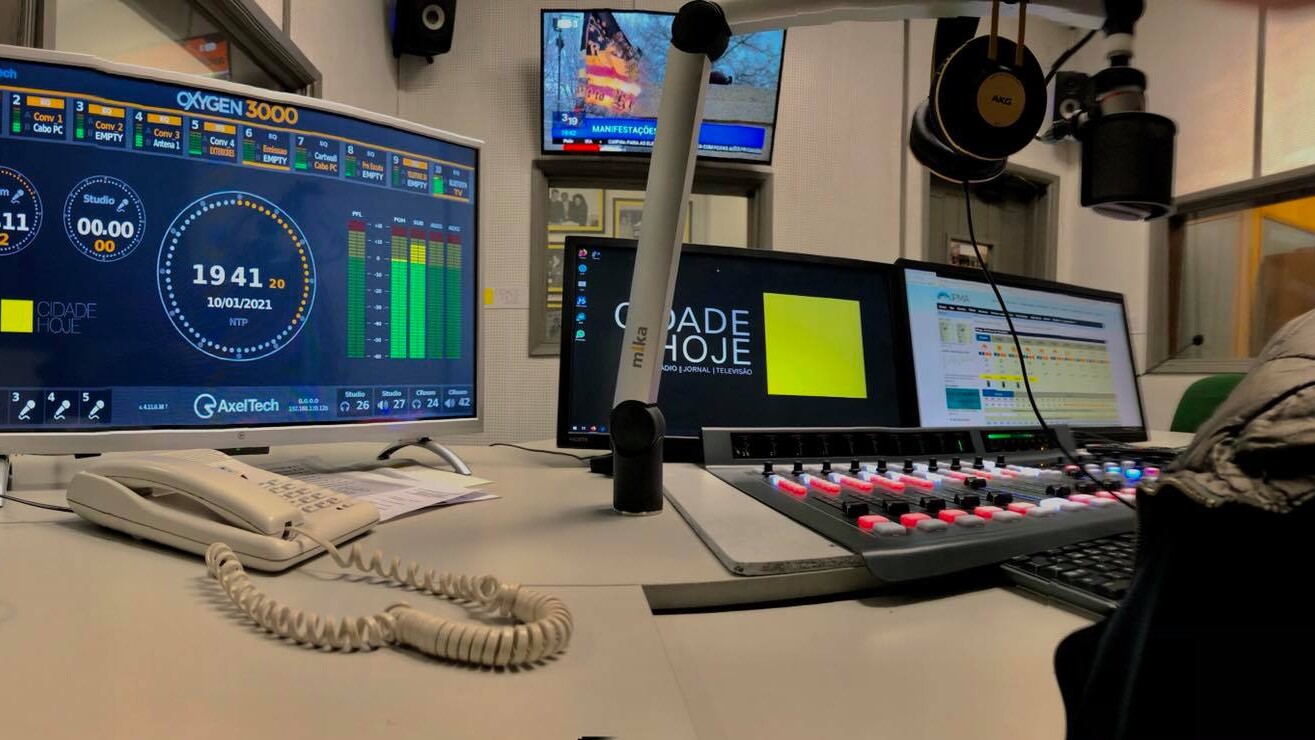
Cidade Hoje – Radio Station
Portugal with SiteMaster
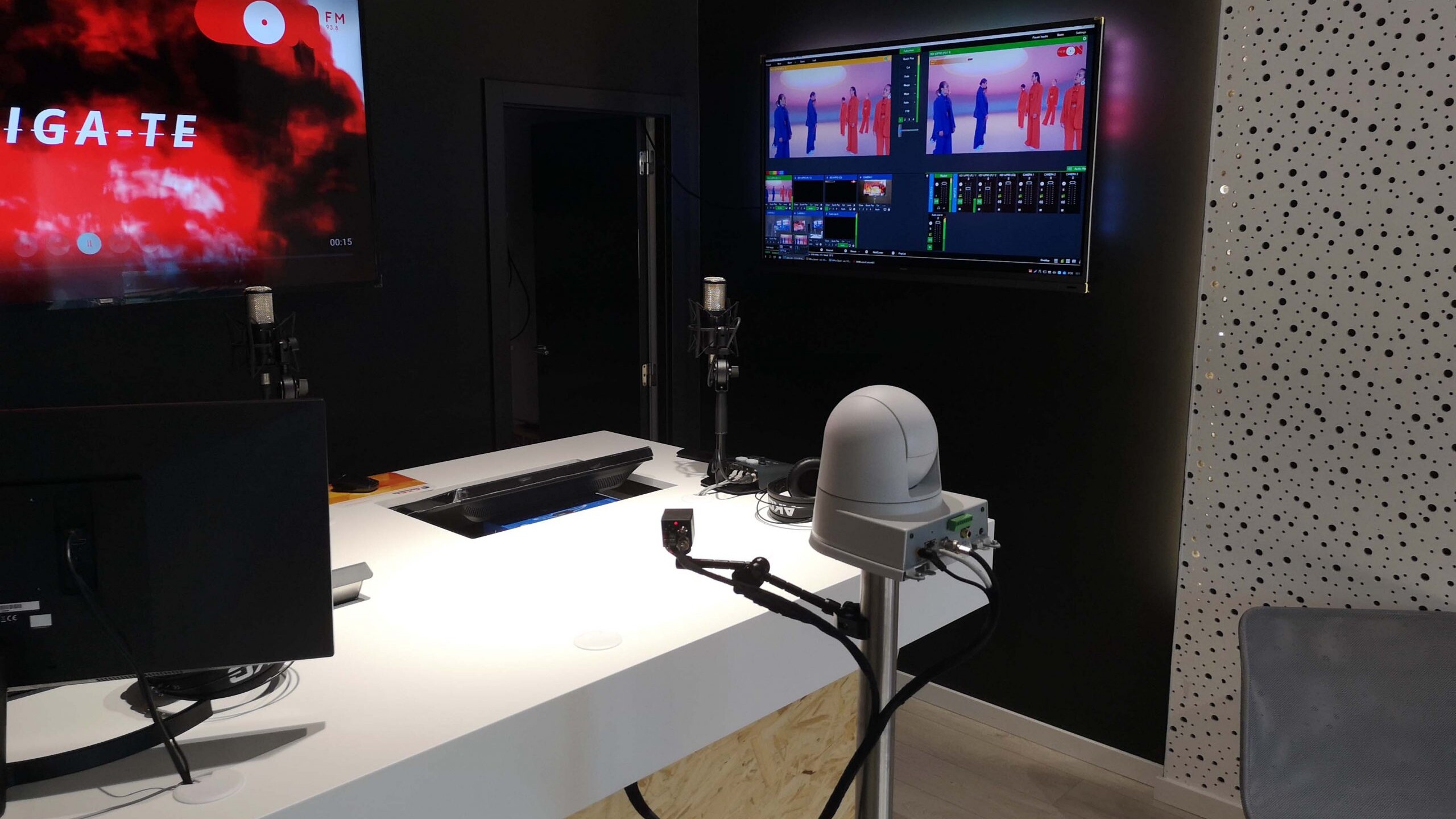
ON FM – Visual Radio
Portugal with SiteMaster
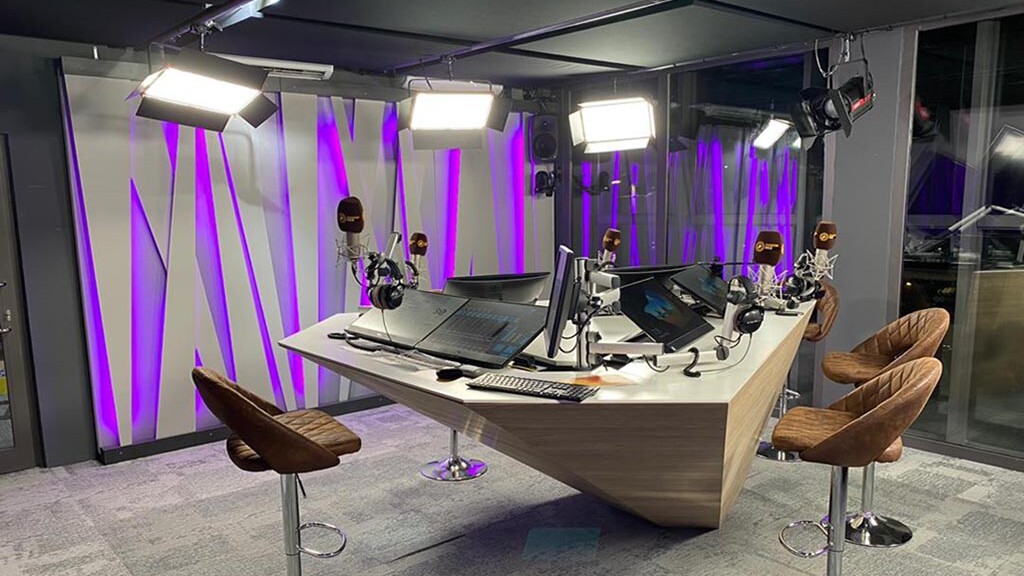
Asaase – Visual Radio
Ghana with Bahamus
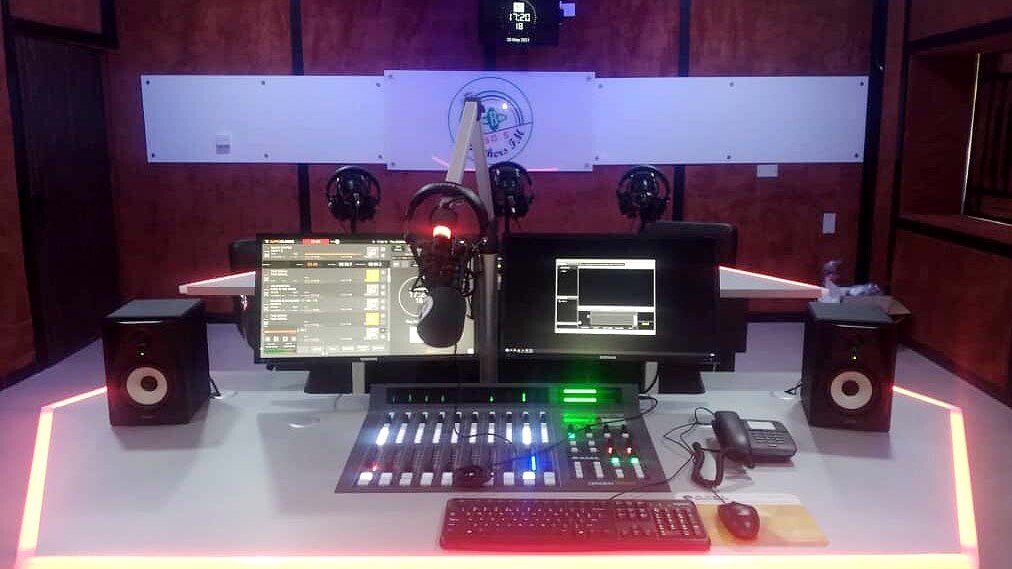
Brothers FM, Lobi Broadcasting
Nigeria with Ecalpemos
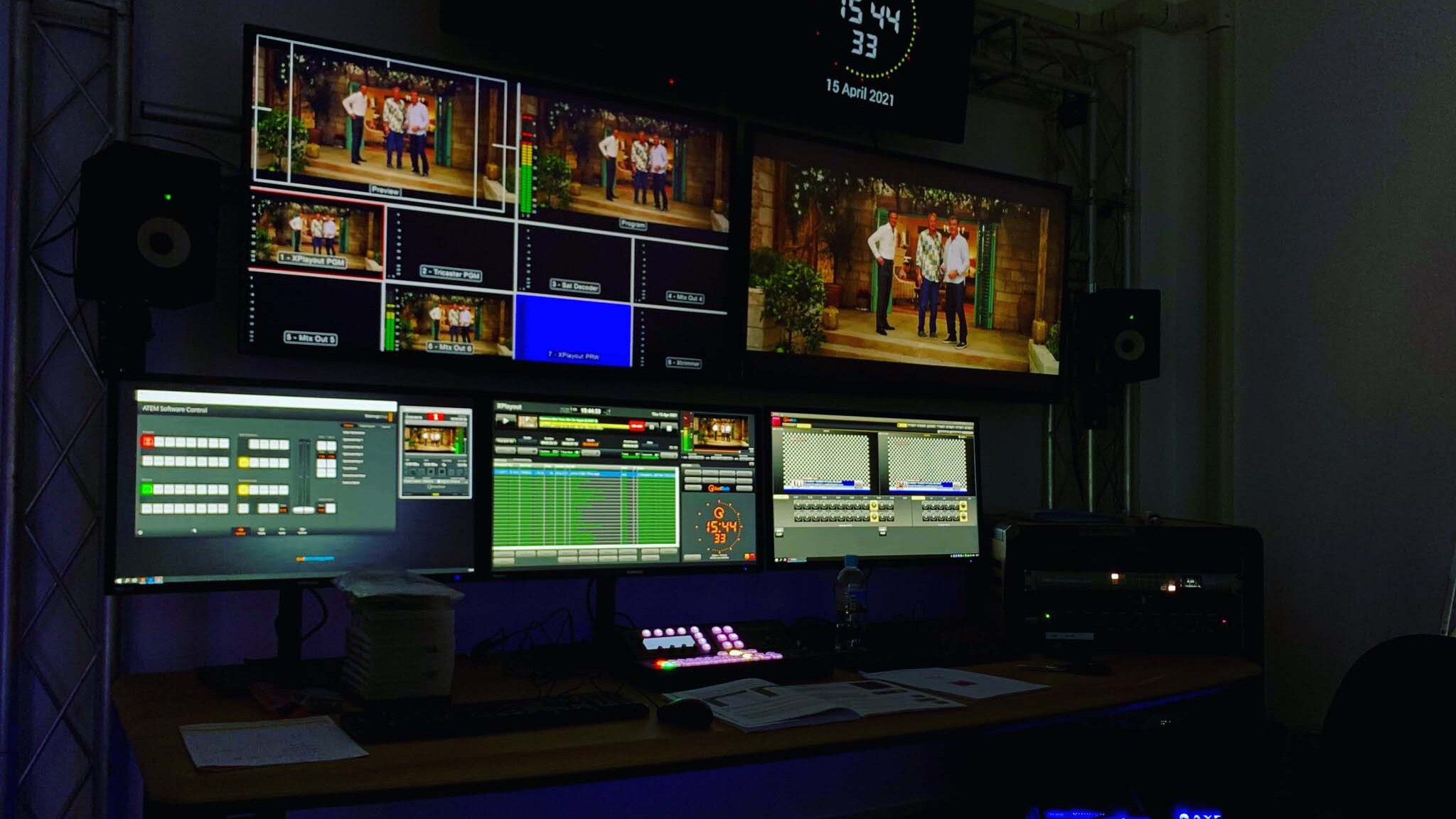
Nauru National Media Centre
Radio/TV Facility Facility - Nauru
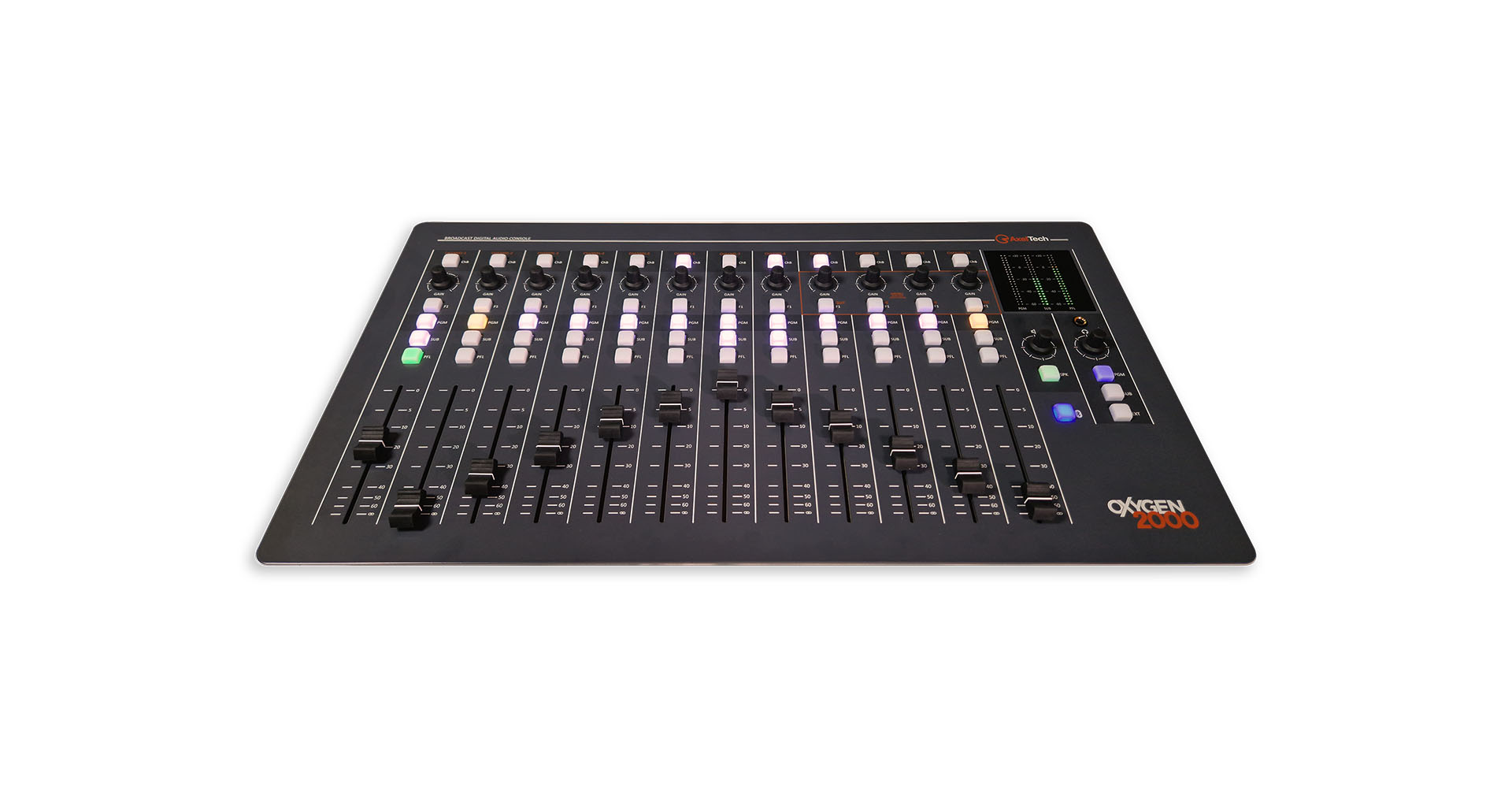
Oxygen 2000
Smart search
Digital Broadcast Console
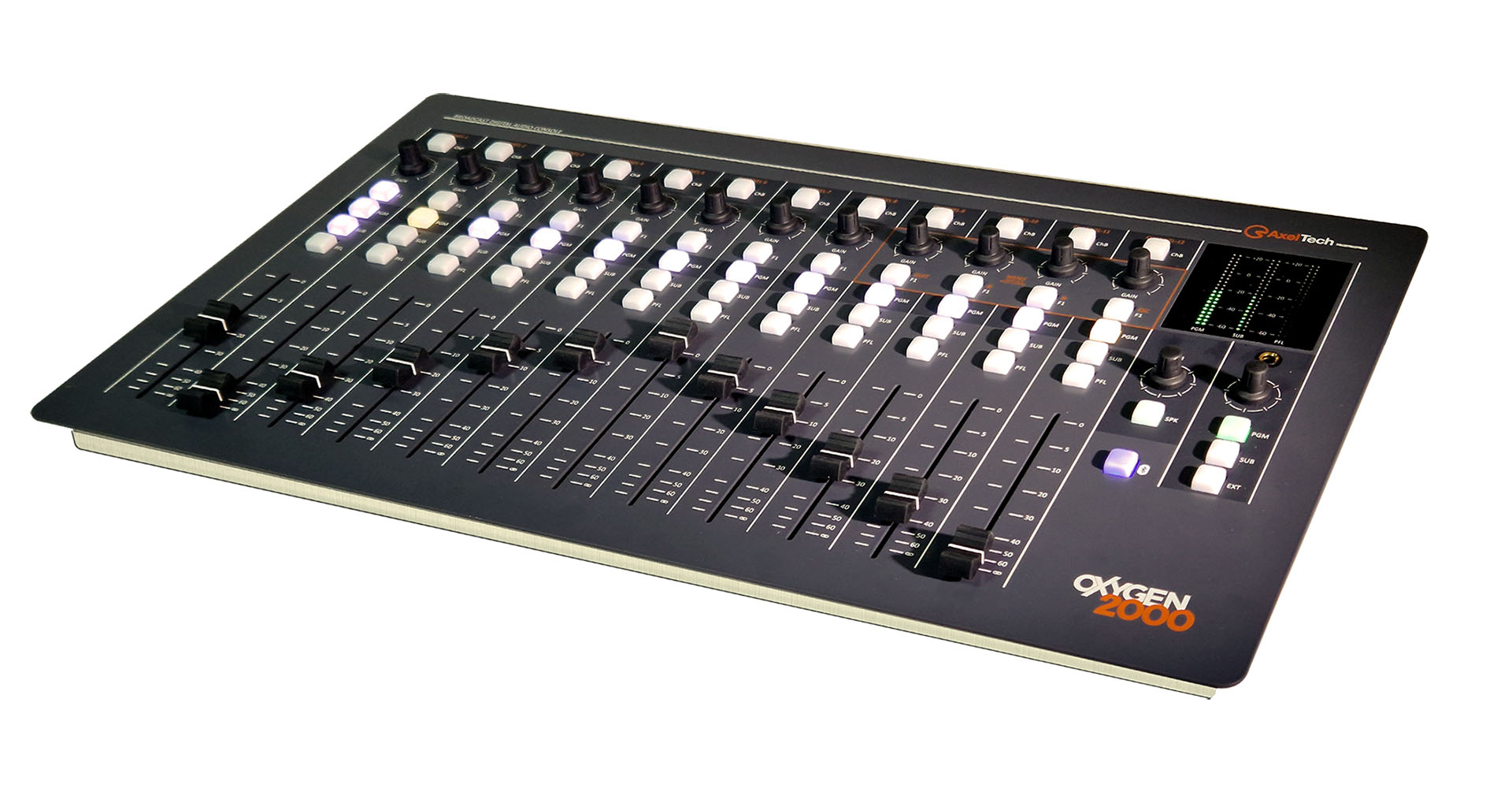

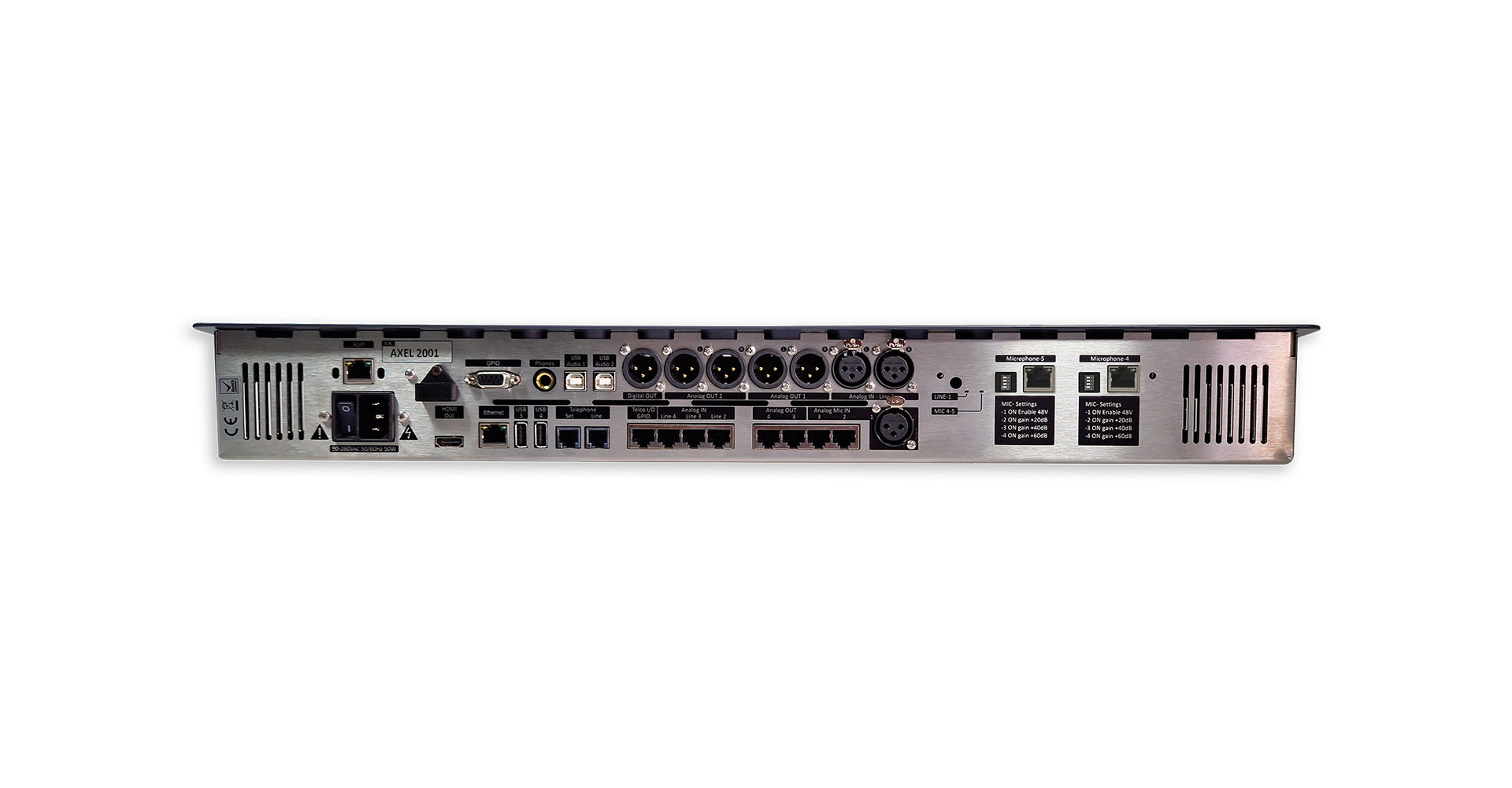
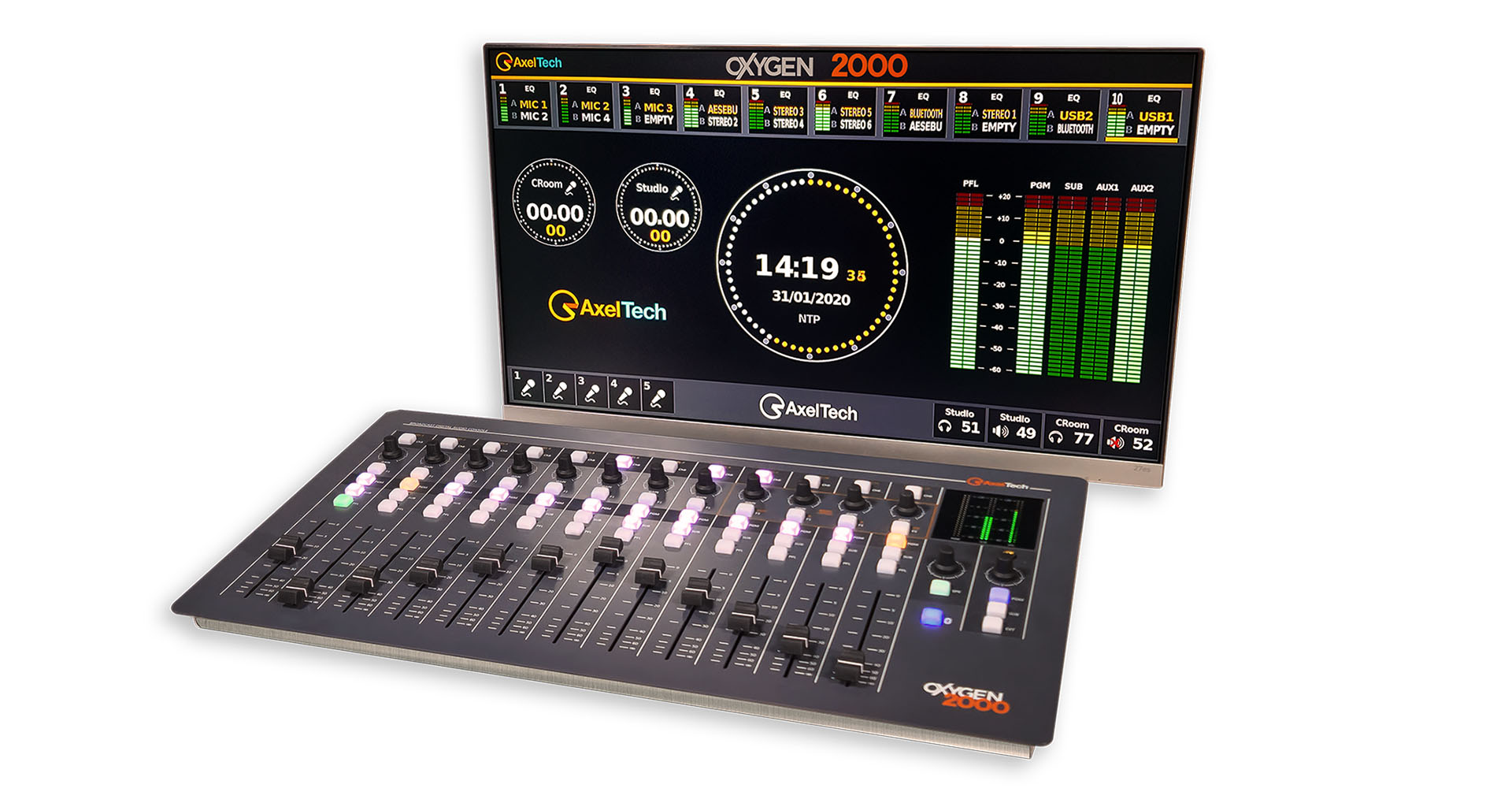
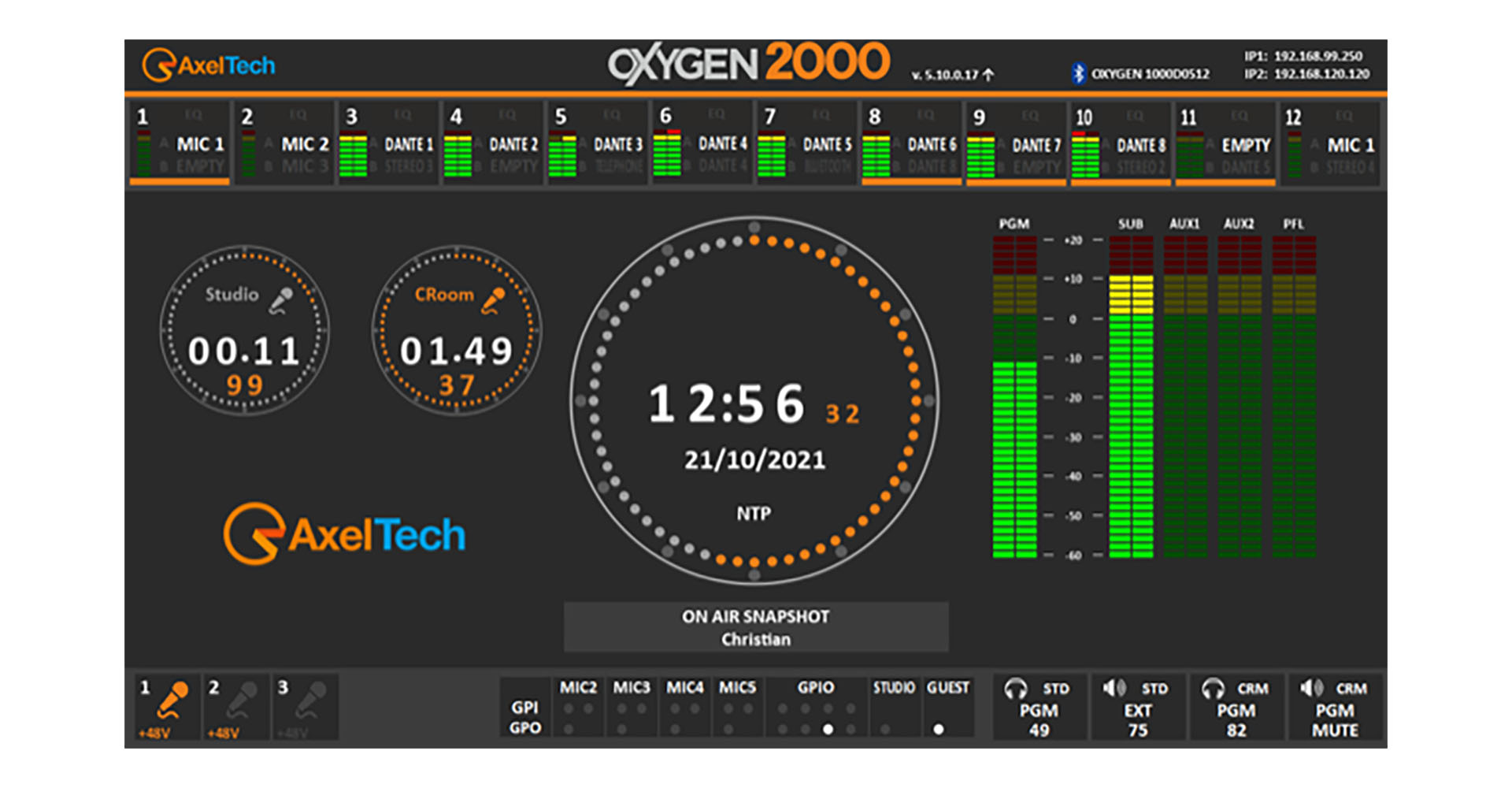

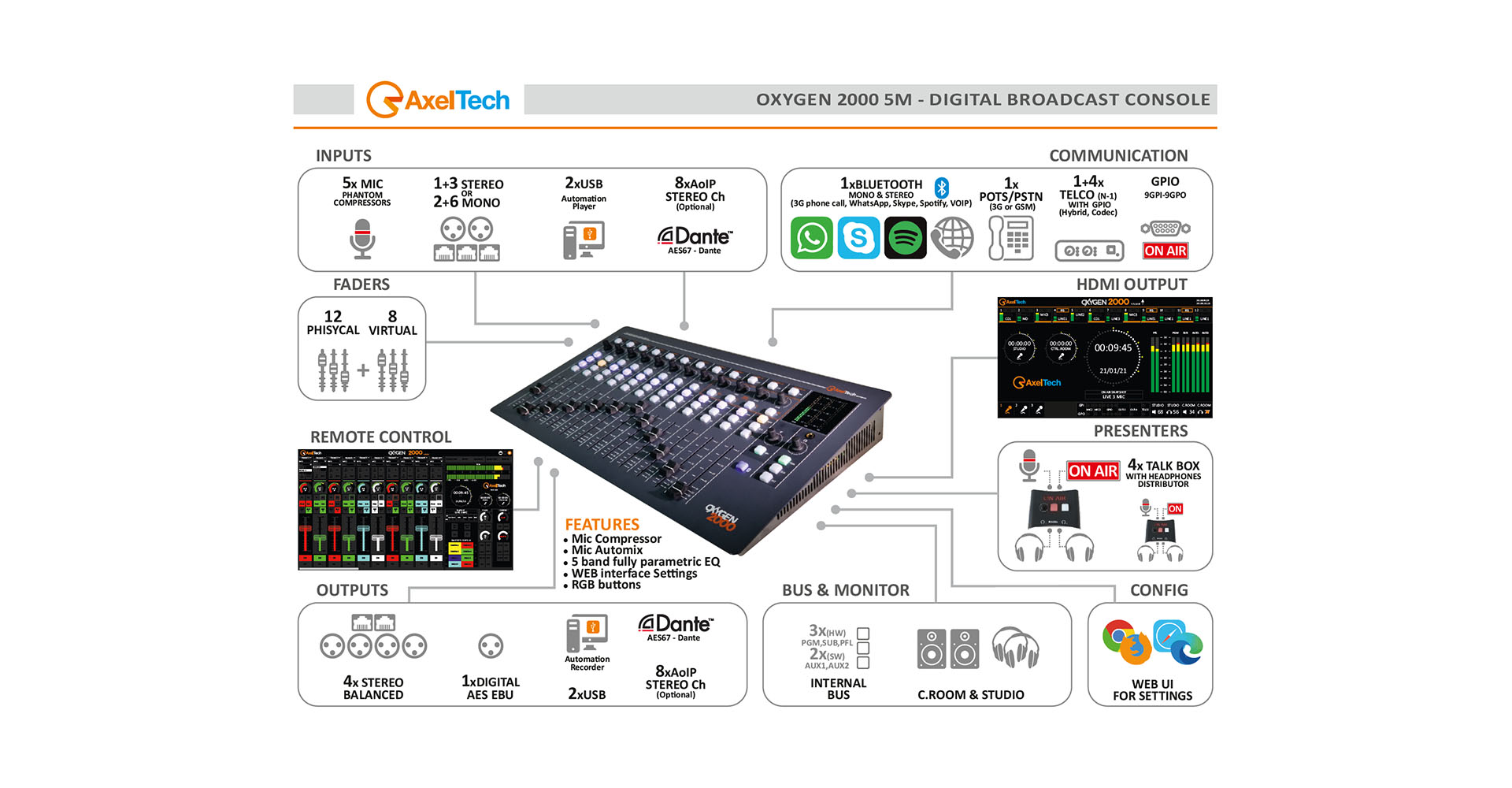
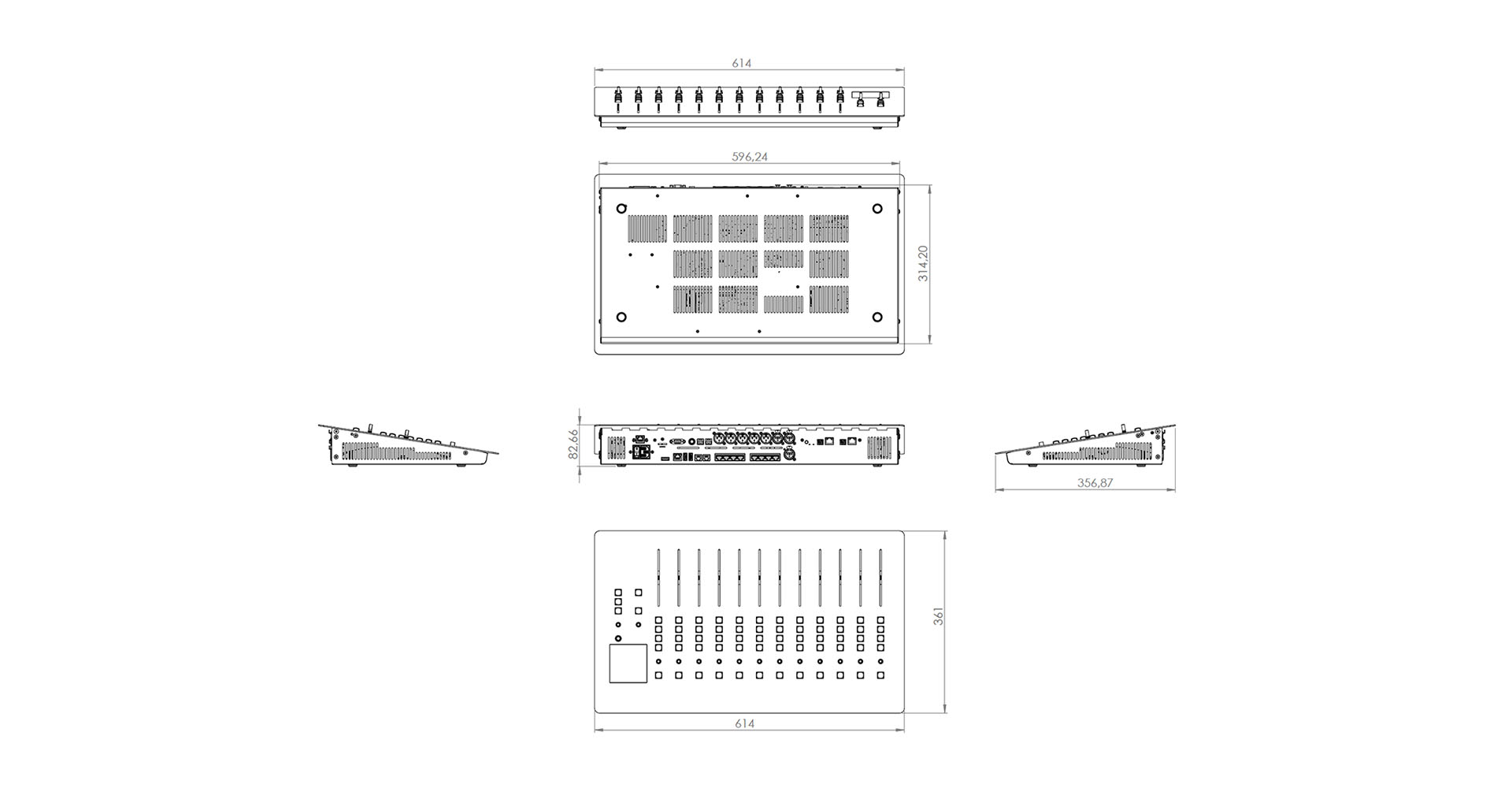
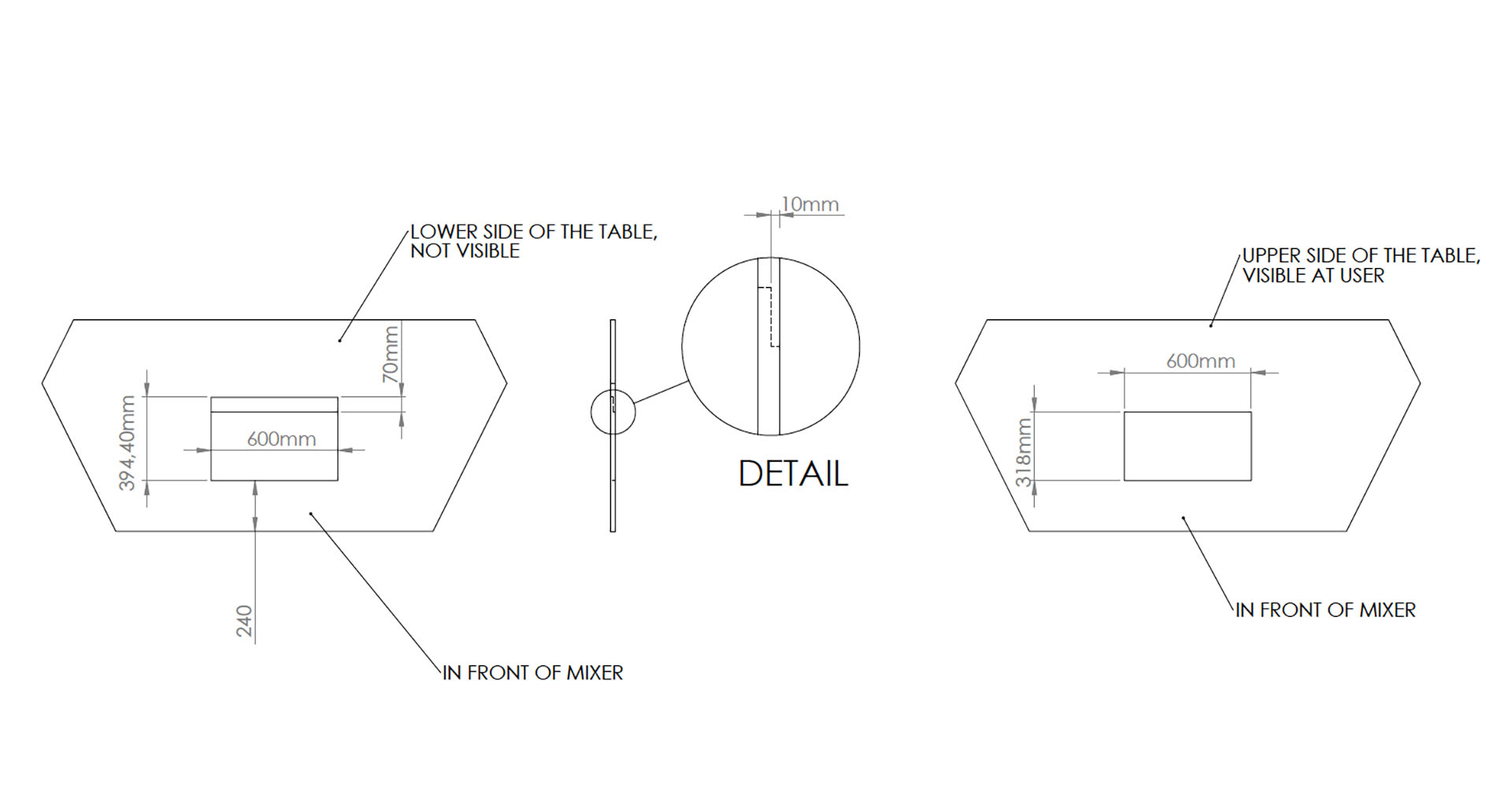
Oxygen 2000 is a fully Digital Broadcast Console designed for On Air and Production in any Radio Station: a compact 12 faders unit, 5 microphone inputs with Automix, with a powerful internal audio routing and a wide range of controls and I/O in a rugged and classy steel chassis. Oxygen 2000 DSP based audio processing delivers high-end quality and guarantees latest features and flexibility. Reliable and easy to use as an analogue mixing console Oxygen 2000 offers top class features: Low Latency, Users Preset, Smart Keys, EQ, Compressors, Telephone Hybrid, HDMI Output, Analogue and Digital I/O, USB, BT, Dante™ AoIP, Telco, Presenter Talk Box.
Oxygen 2000 can be remotely controlled through a dedicated application.
Input & Output
- 5 microphone inputs with Automix
- 3 stereo analogue inputs (4 if the console is configured for 3 Mic)
- 4 stereo analogue outputs
- 1 built-in telephone hybrid
- 1+4 telco interface with GPIO
- BT audio interface (optional)
- 1 digital Out (AES/EBU)
- 2 USB audio interfaces (disabled with Dante™ option installed)
- 8 stereo inputs + 8 stereo outputs via Dante™ (optional)
General
- Fully Digital Broadcast Console for Radio Broadcasting with 12 faders
- A/B Fast source switch buttons for each fader
- 4+1 busses (PGM, SUB, Aux1, Aux2, PFL)
- Near 0 latency (< 0,7 ms I/O)
- Complete Remote Control by means of an application replicating the surface
- Remote configuration and maintenance via Web Interface
- User-definable Presets & Snapshot
- 5 bands fully parametric Equalizer on every input
- Dynamic Processor with expander and compressor section on each microphone inputs
- Advanced and configurable Monitor Facilities for Control Room and Studio
- Customizable RGB colored buttons
- High Resolution (120 leds) meter bars for outputs
- HDMI Out for console status display
- 2 Timers (Ctrl-Room and Studio microphones timers on HDMI Monitor)
- TalkBox for guest and presenter (optional)
Versions
- Oxygen 2000
- Oxygen 2000 Dante™
Options
- Talk Box
- Dante™ I/O Board
- RJ45 adapters for:
o Mic with GPIO
o Line In
o Line Out with GPIO
o Telco with GPIO
The complete Oxygen Line Up
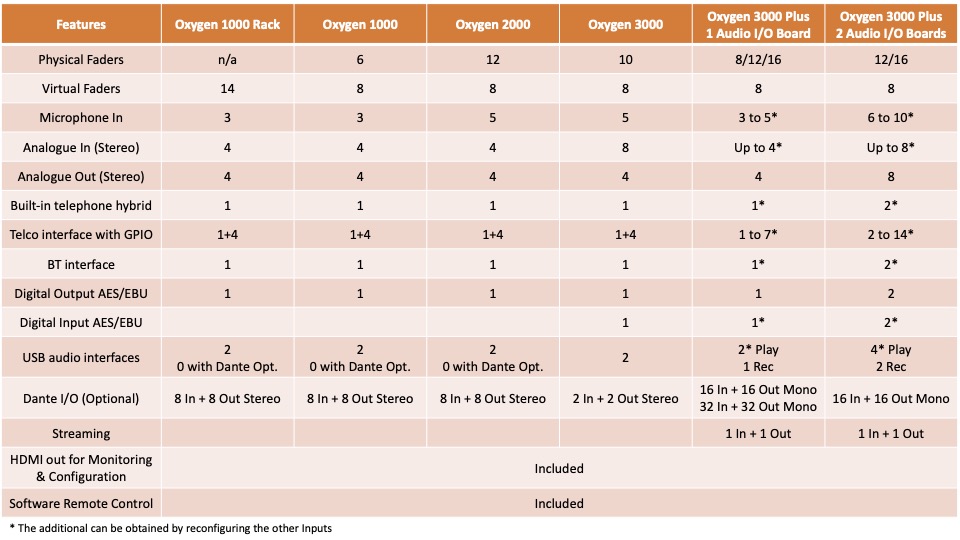
Microphone Inputs
- 5 microphone inputs with Automix
- Mic 1 on XLR, Mic 2-5 on RJ45, all balanced with + 48V Phantom and GPIO
- Independent ON AIR Lights and Cut Off control, when opening Control Room and Studio microphones
- PFL button switches to private conversation on Hybrid/Telco/BT mode
- Enable TalkBack feature on any Studio or Control Room microphone
- Parametric Compressors/Expander for MICROPHONE and MONO inputs
- Save and recall microphone presets including Compressor/Expander settings
- Phase inversion on microphone inputs
- Ducking / AutoFader assignable to all sources (automatic attenuation of music on speech)
Automix
Automix feature simplifies mixing activities in the presence of many guests in the studio.
The function adds, to the existing sources, a new source called Automix, which is the sum of all enabled microphones.
The Automix source has all the features of a microphone source such as:
- Studio/Control Room loudspeakers control
- Studio/Control Room light control
- Can be used as audio in Private mode for phone calls
Using this new source, the user can manage in a very simple manner all the microphones of the studio with a series of benefits:
- Just 1 fader for the management of studio microphones;
- A dedicated AGC section for each microphone input automatically adjusts the correct level;
- Automatic management of attenuation on microphones not in use, simulating a slight closure of the fader;
- Final compressor that allows an automatic leveling of the Automix source;
- Possibility to use the microphones individually.
This feature further simplifies the work of the mixer engineer, even in the case he/she is also the host of the show.
Available settings in the Automix menu:
-
- MIC-1 ON/OFF
- MIC-2 ON/OFF
- MIC-3 ON/OFF
- MIC-4 ON/OFF
- MIC-5 ON/OFF
- Idle Mic Attenuation
- Attenuation Attack Speed
- Attenuation Release Speed
- Compression Threshold
- Compression Ratio
- Compression Attack Speed
- Compression Release Speed
- Autogain Speed
- Autogain Max Gain
- Autogain Max Attenuation
Analogue inputs
- Line Stereo Inputs: 3 (4 if the console is configured for 3 Mic)
- Balanced on XLR for Line 1, Balanced on RJ45 for Line 2-4
- Channel mode selection: STEREO, MONO, L, R, INV-L, INV-R, INV
- Stereo-1 & DANTE-1 inputs can be configured as 4 Telco Inputs
USB audio I/O
- 2 Built-in stereo USB (Type-B) I/O Audio Interfaces allow to directly connect the PC to the Oxygen 2000 console, with no need for audio cards
- In facts the PC detects each of the console USB as a digital audio card with 1 stereo inputs and 1 stereo outputs for simultaneous playout and recording
Telephone hybrid and Telco
- Telephone Hybrid: 1 POTS/PSTN telephone line with Line.In and Tel.Set connection
- Telco: 1 in/out N-1 to connect external telephone hybrid with control via TLC/GPIO
- 4 mono additional Telco can be obtained configuring Analog Inputs (Stereo-1 & DANTE-1) and (OUT-2 & DANTE-1) stereo outputs.
- GPI and GPO management on all 5 Telco channels
- RING and HOOK on F1 key for each TELCO channels
- N-1 on Telco outputs for all BUS (PGM, SUB, AUX-1, and AUX-2)
Analogue outputs
- 4 Balanced Outputs:
- OUT-1 – XLR – Fixed as PGM
- OUT-2 – XLR – by default assigned as SUB
- OUT-3 – RJ45 – by default assigned as AUX-1
- OUT-4 – RJ45 – by default assigned as AUX-2
- OUT-2 stereo output can be configured as N-1 to achieve up to 2 mono additional Telco
- OUT-1 & OUT-2 outputs are both equipped with a GPO
Digital output
- 1 AES/EBU output on XLR
Headphones and local monitor outputs
- OUT-2-4 outputs: can be configured as Studio Presenter and Studio Guest Headphones
- Unbalanced outputs: 2 Line out on Jack 6.3 for Control Room Headphones
- Adjustable maximum Control Room and Studio speakers volume
- Adjustable maximum Control Room and Studio headphones volume
- Adjustable CUT or Attenuation mode (-40, -30, -20, -10 dB) on Control Room and Studio speakers
- Independent source selection (PGM, SUB, AUX1, AUX2, EXT) for control room and studio speakers, control room and studio headphones with or without PFL (Studio Speakers only via Software Remoter)
- Independent Talk Back management on Control Room and Studio speakers (only via Software Remoter)
- Independent Talk Back management on Control Room, Studio headphones (only via Software Remoter)
- Same source selection for Control Room and Studio headphones, with independent level (Studio Speakers only via Software Remoter)
GPI/GPO
- GPI: 9 in total, for Talk back, Telephone Hybrid or other features
- GPO: 9 total, to control OnAir lamps or provide HOOK and RING commands for external telephone Hybrid
- User custom GPIs (e.g. Ring, Talkback, channel ON/OFF, etc.)
- User custom GPOs (e.g. Hook/ONAIR, Studio-Light, Control Room-Light)
Surface & Management
- Direct Firmware update via Internet
- WEB UI for Console configuration and service features (Save, restore, update, logs, etc.)
- Save and recall EQ presets (up to 10)
- New real-time EQ algorithm with graphic
- Fast and accurate Led Meters display
- Save and recall control panel configuration with 10 Snapshots
- Save and recall total console configuration. The configuration can be saved to internal memory (microSD), USB and PC (via WEB interface)
- Gain adjustment knobs with adaptive speed
- Dimmable buttons light
- Adjustable fader ON/OFF threshold (from -50 dB to 0 dB)
BT
Oxygen 2000 has a BT module. This allows airing the calls made via GSM, Skype, Viber and WhatsApp with a Smartphone, a Tablet or a PC. Oxygen 2000 has two BT connection modes: bidirectional to support phone calls, monodirectional to put on air high quality stereo audio (A2DP) streamed by BT sources.
With BT calls, PFL enables PRIVATE conversation mode.
Telephone Hybrid and Telco
The built-in telephone hybrid allows direct connection of a telephone line POTS/PSTN on RJ-11C. The audio is processed via DSP that delivers a state-of-the-art audio processing. It’s also available a Telco N-1 in/out, to connect Oxygen 2000 to an external telephone hybrid. The Telco N-1 is always available on RJ45. TLC commands are available on the same RJ45 with Hook and Ring interface.
TLC commands for Telco-2-5 are available and configurable on GPIO-DB9 connector with Hook and Ring.
Software Remote Control
Oxygen Remoter is a software tool available for free with any Oxygen console. It offers advanced remote control features such as accessing to any set up and information, fader and buttons control and any other operation available on the physical consoles. It is very useful especially for compact consoles and in any environment that has limited space.
The Virtual Fader technology enables users to assign each input to a virtual fader/channel on the remote surface, this is of course very useful when controlling channels remotely. Additionally, transforming the A/B pair into two virtual faders is a smart solution that maximizes the management of the available sources.
Oxygen Remoter can remotely control multiple consoles and create an ecosystem, this can be very helpful for remote productions where, for instance, a portion of the channels may need to be controlled from a studio while the others are still managed from the physical surface in the control room.
Oxygen Remoter is a powerful tool that provides extra flexibility and control’s tools to all the Oxygen consoles.
Oxygen Remoter is downloadable from the Oxygen console’s administration web page.
HDMI output
The HDMI output allows to connect an HD display monitor to the console, suitable to be used in two flavours:
-
- Monitor, that displays the following information:
-
- Audio input source levels
- 4+1 BUS output levels
- A/B source names assigned of 10 channels
- Display On-Air sources
- Microphone On timer (control room & studio)
- Large Clock
- Audio output level (Loudspeakers & Headphones)
- On-Air microphone
- Telephone active
- Configure, for configuring all of the device features.
- HDMI output combined with 4 rotary knobs allow the fast and intuitive programming of all the mixer parameters.
- The programming GUI has been designed in order to be very easy and intuitive.
- Selectable home page layouts are available, with many theme icons.
-
- Monitor, that displays the following information:
HDMI output can be personalised with the customer logo. Selectable display layouts are available.
Talk Box
It is a device dedicated to the presenter and guests. Talk Box is very simple to connect to the On Air Console: its take 2 RJ45 cables of the length that is needed to connect it to the mixer. It is possible to connect up to 4 Talk Boxes to the Oxygen 2000. The Talk Box offers a direct connection of the microphone and relative On-Air light, it is also possible to directly connect the studio’s On-Air Light. The Talk Box has a headphone amplifier with two 6.3mm outputs. Through the two large backlit buttons it is possible to activate and deactivate your own microphone (On / Off / Cough) or enable Talk back to the console.
Dante™ AoIP Interface
Oxygen 2000 can be equipped with a Dante™ interface (also supporting AES67 and SMPTE ST 2110-30 transport protocols) which provides 8 Stereo Inputs and 8 Stereo Outputs on a dedicated Ethernet port, with independent Level Control and Sample Rate Conversion.
On Oxygen 2000 Dante™ versions the USB I/O ports are disabled.
Dante™ AoIP interface is installed at the factory and must be requested at ordering stage.
Cable Adapters
RJ45 adapters are available for:
o Mic with GPIO
o Line In
o Line Out with GPIO
o Telco with GPIO
Analog Balanced Microphone Inputs
Connector RJ45 & XLR Balanced – EMI Suppressed
Input Impedance 2,4 KΩ
Nominal Input Level (sensitivity) -9/-66 dBu
Max Input Level (clipping point) +9 dBu
A/D conversion 24 bit / 48 Khz
Signal To Noise Ratio (referred to peak level) >90 dB
THD+N <0,01%
Analog Gain Adjustable +0 ÷ +57 dB (3dB step)
Phantom Power +48V
Analog Balanced Stereo Inputs
Connector XLR & RJ45 Balanced – EMI Suppressed
Input Impedance 10 KΩ
Nominal Input Level (sensitivity) 0 dBu
Max Input Level (clipping point) +18 dBu
A/D conversion 24 bit / 48 Khz
Frequency response +/-0,5 dB from 20 Hz to 20 kHz
Signal To Noise Ratio (referred to peak level) >100 dB
Stereo Separation (referred to peak level) >90 dB
THD+N <0,002 %
Analog Balanced Telco Input
Connector RJ45 Balanced – EMI Suppressed
Input Impedance 10 KΩ
Nominal Input Level (sensitivity) 0 dBu
Max Input Level (clipping point) +18 dBu
A/D conversion 24 bit / 48 Khz
Signal To Noise Ratio (referred to peak level) >100 dB
THD+N <0,002%
PSTN Interface
Connector RJ11
Transhybrid loss >20 dB
Analog Balanced Stereo Outputs
Connector RJ45 Balanced – EMI Suppressed
Output Impedance 23 Ω, nominal 600 Ω
Nominal Output Level 0 dBu
Max Output Level (clipping point) +18 dBu
D/A conversion 24 bit / 48 Khz
Signal To Noise Ratio (referred to peak level) >100 dB
Stereo Separation (referred to peak level) >90 dB
THD+N <0,002 %
USB Audio Digital I/O
Connector USB Type B – EMI Suppressed
Playback And Recording Sample Rate SRC 44.1-48 KHz
Resolution 16 bit
Available Stereo Channels 1 Play & 1 Rec for each USB interface
Digital Output
Connector Balanced on 1 XLR – EMI Suppressed
Input Impedance 110 Ω
Standard AES3
Audio Sample Rate 48 KHz
Resolution 24 bit
Dynamic Range (Converter Values) 124 dB
Analog Balanced Telco Output
Connector RJ45 Balanced – EMI Suppressed
Output Impedance 23 Ω, nominal 600 Ω
Nominal Output Level 0 dBu
Max Output Level (clipping point) +18 dBu
D/A conversion 24 bit / 48 Khz
Signal To Noise Ratio (referred to peak level) >100 dB
THD+N <0,002 %
System
Audio Core Analog Devices ADAU1452 32bit 294 MHz fixed point DSP
Audio CODECs Cirrus CS42448 24 bit/192 kHz
System Core Allwinner A20 dual core cortex-A7 at 800MHz, 1GB RAM
LAN Connection RJ45 - 100Mbit
Nominal Delay (analog input to analog output) 0,7 ms
GPIO Inputs/Outputs 4 GPI/4 GPO on DB9; 4 GPI/2 GPO on Mic2 & Mic3 RJ45; 2 GPO on Out3 & Out4 RJ45; 1 GPI/1 GPO on Telco RJ45
Communication Port 2xUSB type-A, 2xUSB type-B , 1xLAN, 1xHDMI
Operating Temperature 0°C ÷ 40°C
PSU
Power Supply 90-260 VAC / 47-63 Hz / 30 W
Dimensions
Dimensions (W; H; D) 614mm; 80mm; 343mm
Weight 7.1 Kg

Oxygen 1000
Smart search
Digital Broadcast Consol
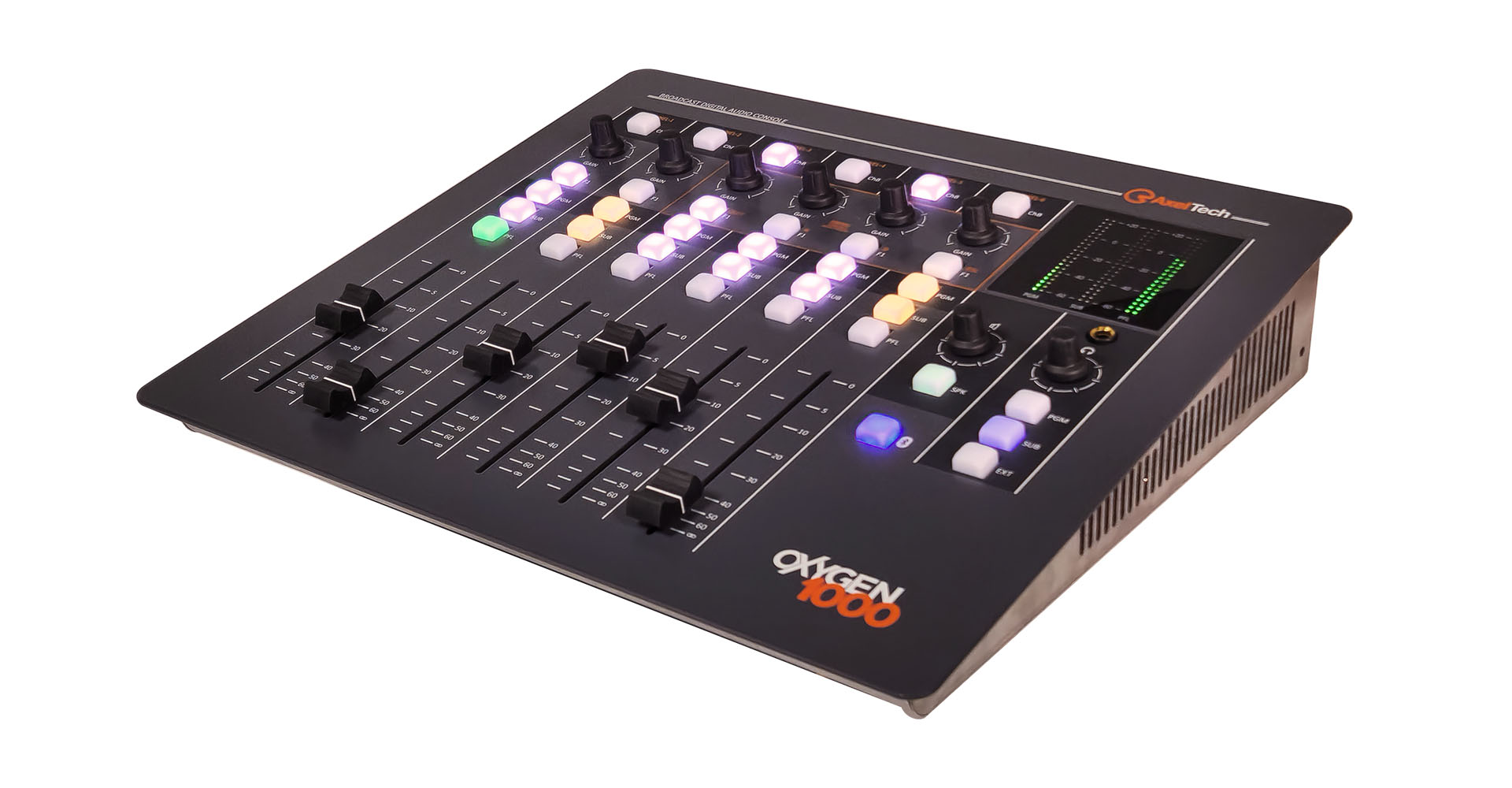
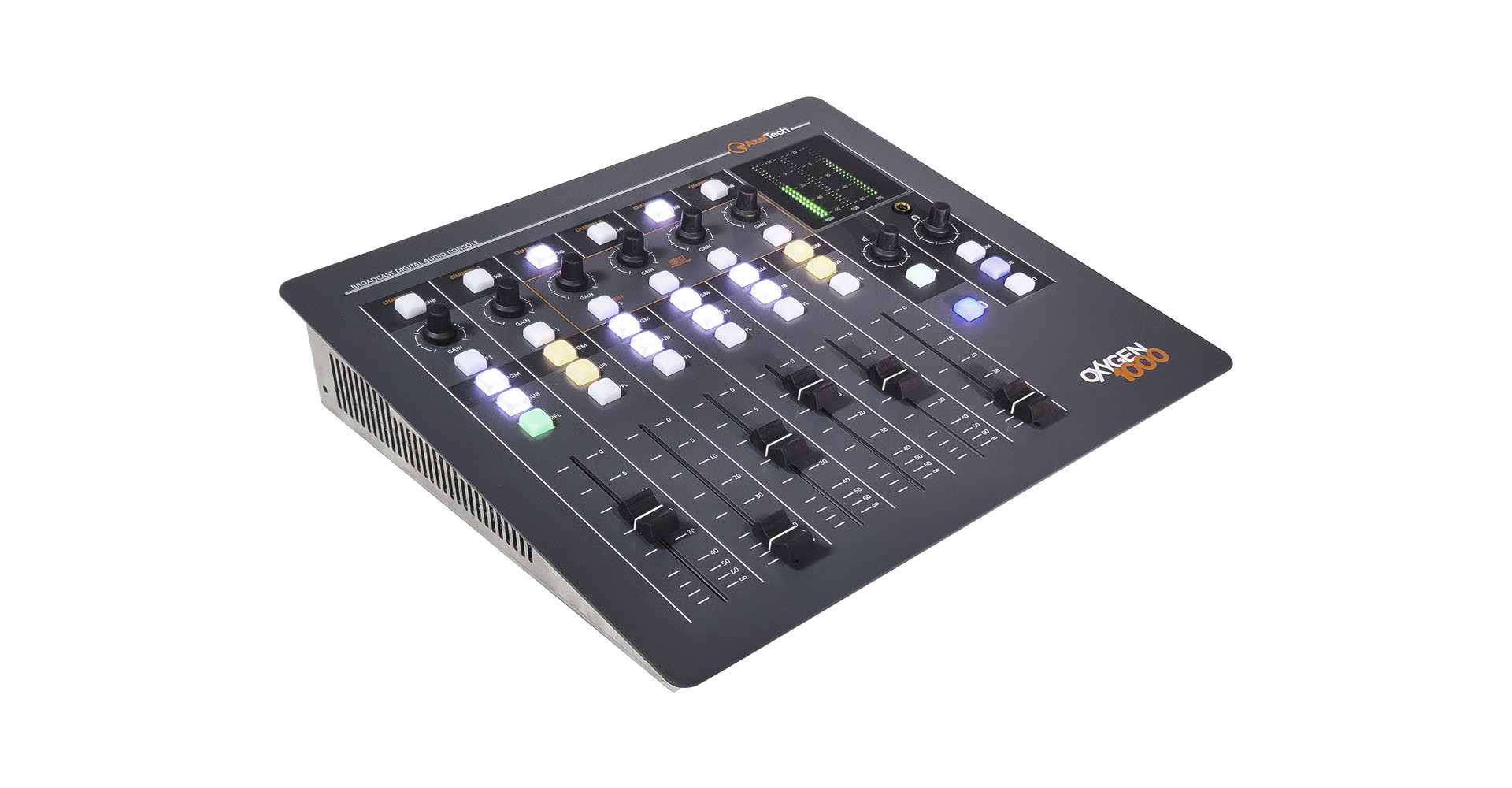
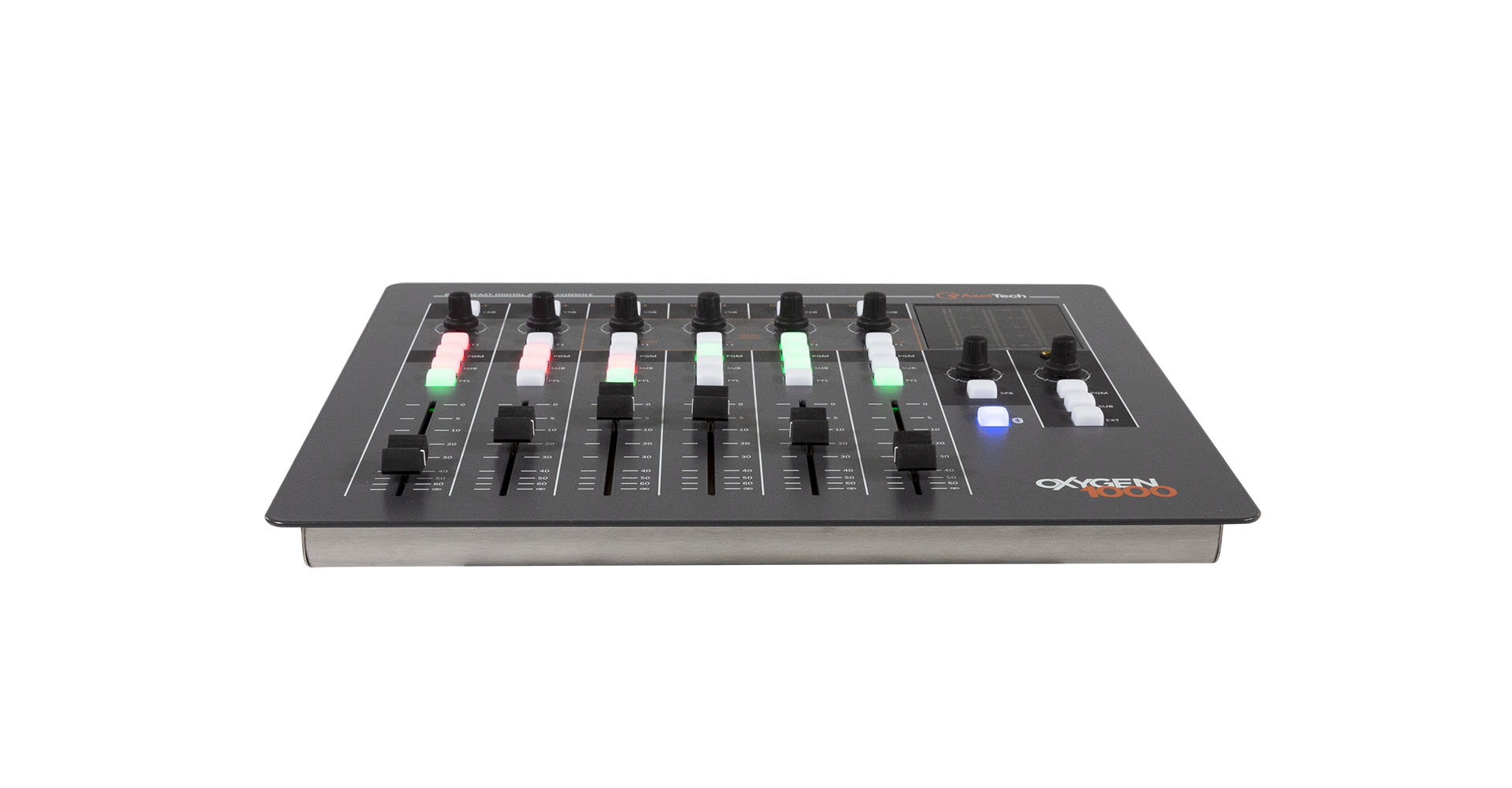
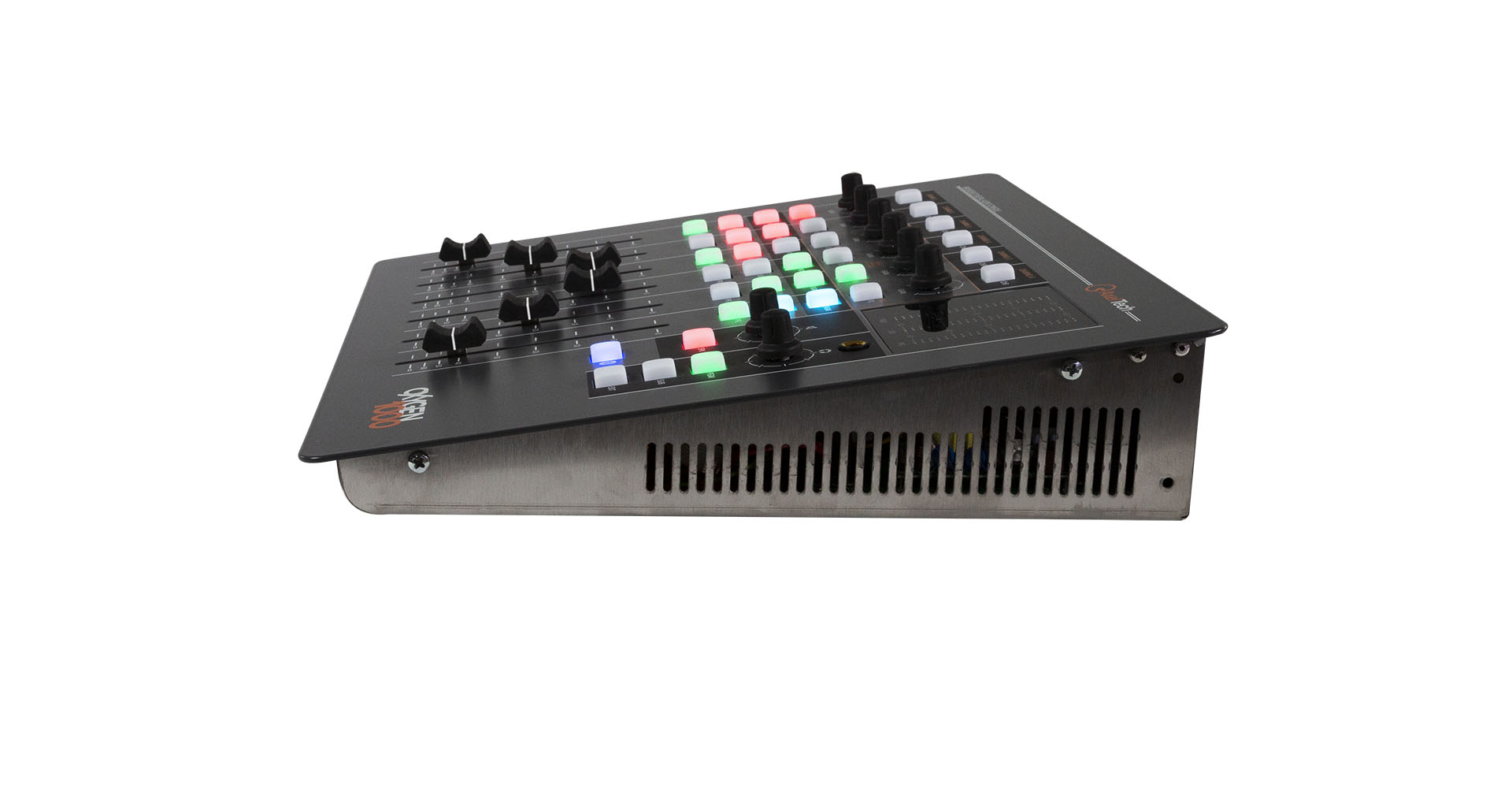
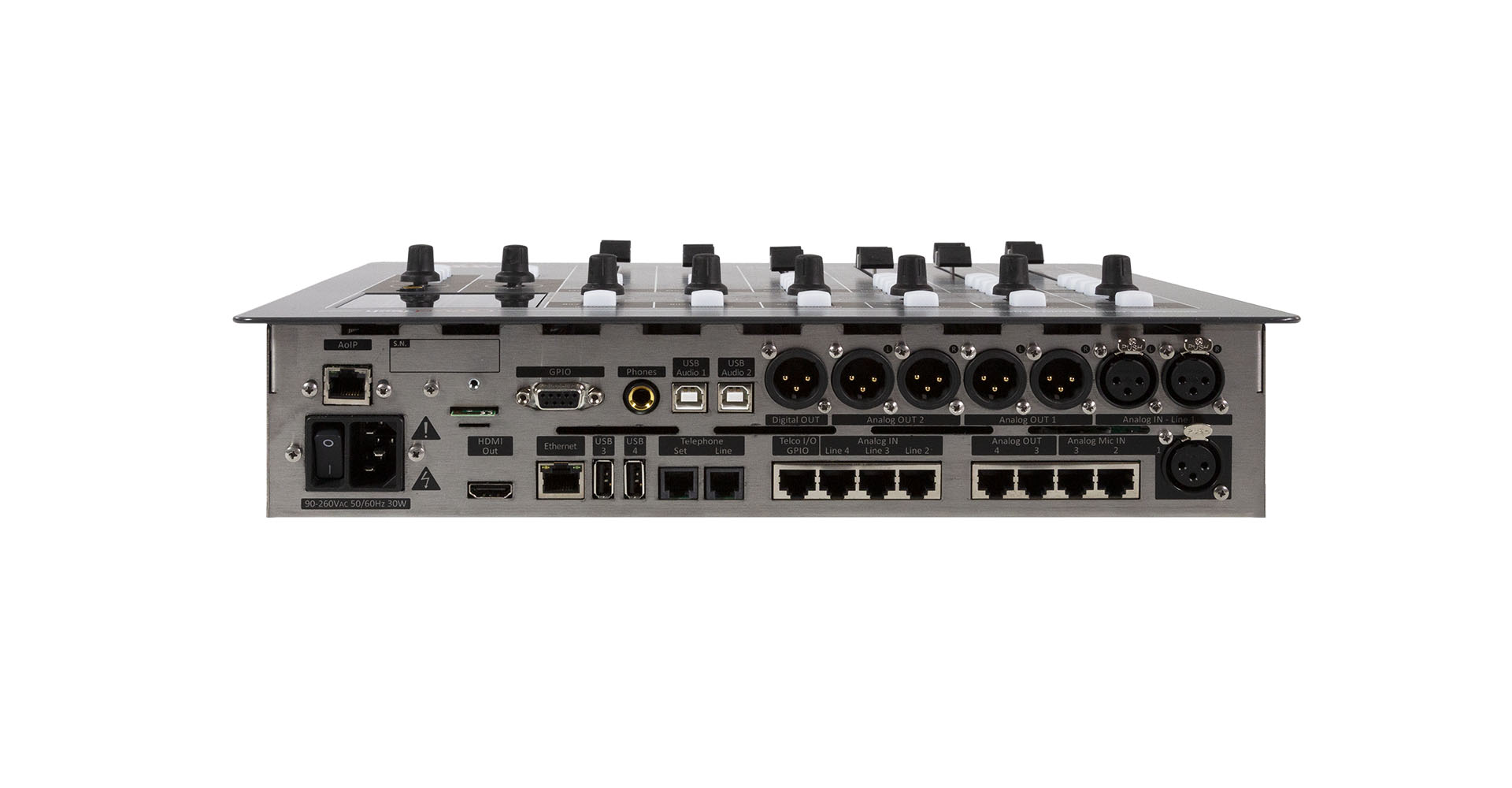
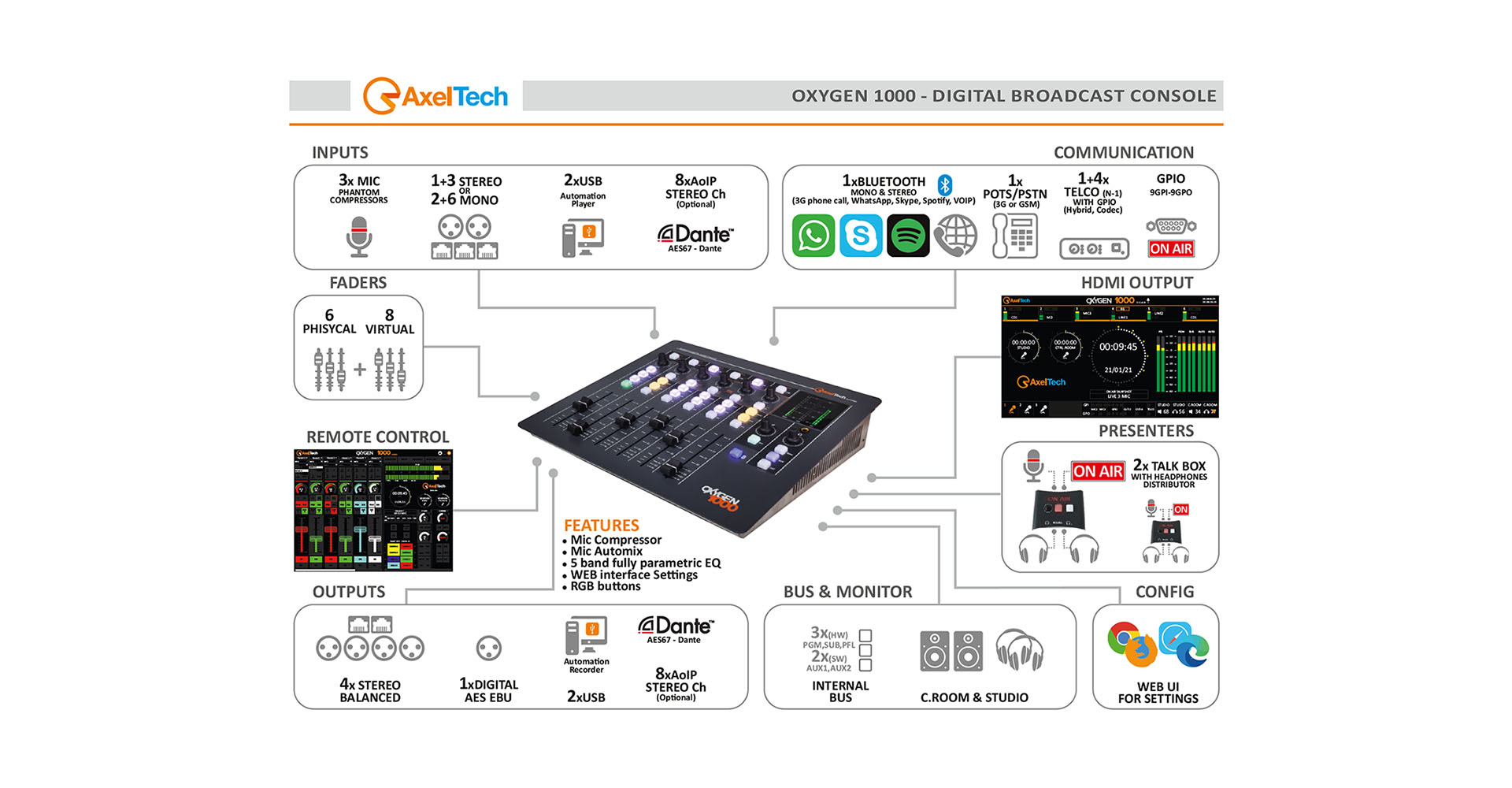
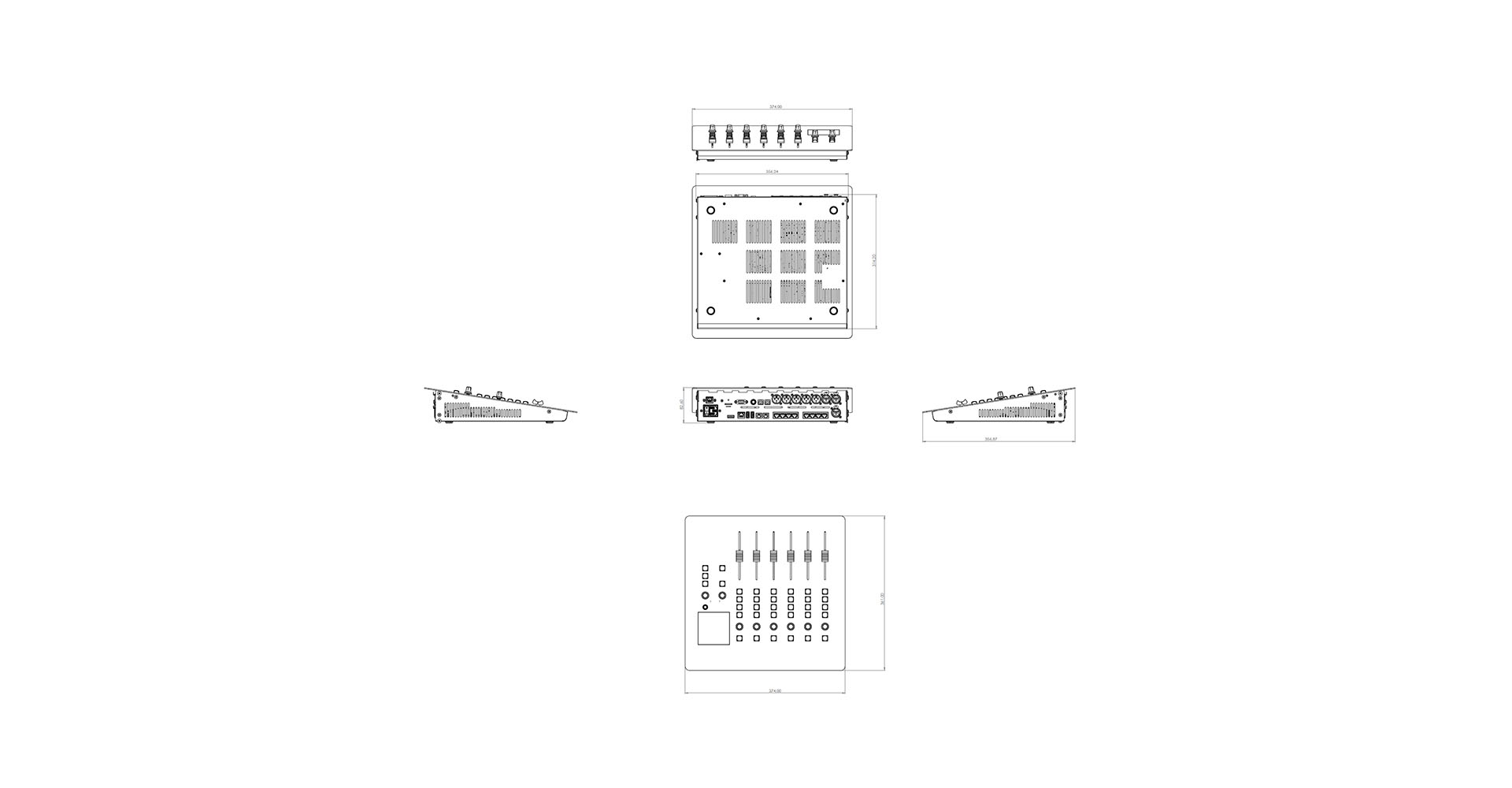
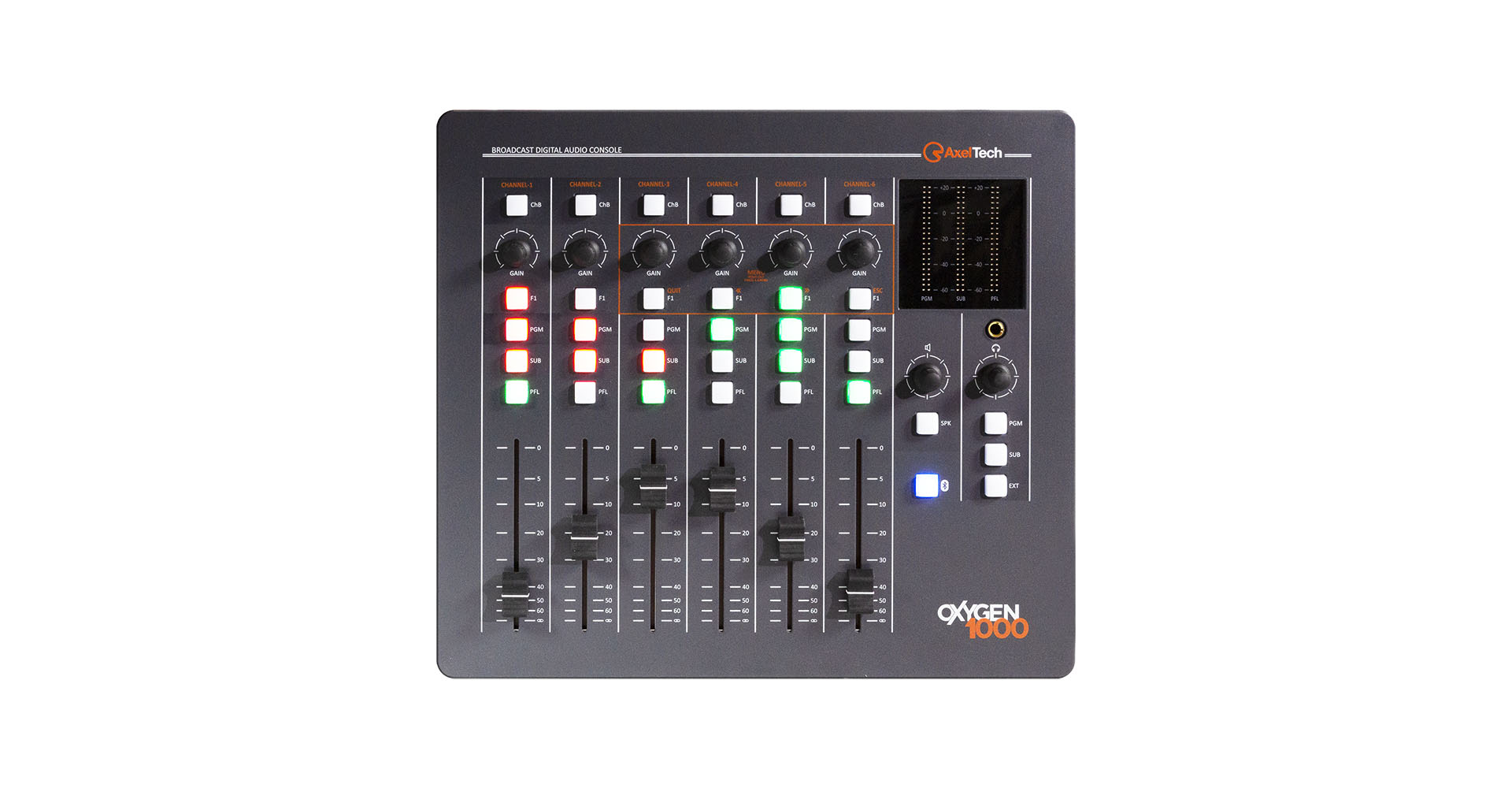
Oxygen 1000 is a fully Digital Broadcast Console designed for On Air and Production in any Radio Station: a compact 6 faders unit, 3 microphone inputs with Automix, with a powerful internal audio routing and a wide range of controls and I/O in a rugged and classy steel chassis.
Oxygen 1000 DSP based audio processing delivers high-end quality and guarantees latest features and flexibility.
Reliable and easy to use as an analogue mixing console Oxygen 1000 offers top class features: Low Latency, Users Preset, Smart Keys, EQ, Compressors, Telephone Hybrid, HDMI Output, Analogue and Digital I/O, USB, BT, Dante™ AoIP, Telco, Presenter Talk Box.
Oxygen 1000 can be remotely controlled through the Oxygen Remoter tool.
Input & Output
- 3 microphone inputs with Automix
- 4 stereo analogue inputs
- 4 stereo analogue outputs
- 1 built-in telephone hybrid
- 1+4 telco interface with GPIO
- BT audio interface
- 1 digital Out (AES/EBU)
- 2 USB audio interfaces (disabled with Dante™ option installed)
- 8 stereo inputs + 8 stereo outputs via Dante™ (optional)
General
- Fully Digital Broadcast Console for Radio Broadcasting with 6 faders
- A/B Fast source switch buttons for each fader
- 4+1 busses (PGM, SUB, Aux1, Aux2, PFL)
- Near 0 latency (< 0,7 ms I/O)
- Complete Remote Control by means of an application replicating the surface
- Remote configuration and maintenance via Web Interface
- User-definable Presets & Snapshot
- 5 bands fully parametric Equalizer on every input
- Dynamic Processor with expander and compressor section on each microphone inputs
- Advanced and configurable Monitor Facilities for Control Room and Studio
- Customizable RGB colored buttons
- High Resolution (120 leds) meter bars for outputs
- HDMI Out for console status display
- 2 Timers (Ctrl-Room and Studio microphones timers on HDMI Monitor)
- TalkBox for guest and presenter (optional)
Versions
- Oxygen 1000
- Oxygen 1000 Dante™
Options
- Talk Box
- Dante™ I/O Board
- RJ45 adapters for:
o Mic with GPIO
o Line In
o Line Out with GPIO
o Telco with GPIO
The complete Oxygen Line Up
Microphone Inputs
- 3 Microphone Inputs with Automix
- Mic 1 on XLR, Mic 2 & 3 on RJ45, all balanced with + 48V Phantom and GPIO
- Independent ON AIR Lights and Cut Off control, when opening Control Room and Studio microphones
- PFL button switches to private conversation on Hybrid/Telco/BT mode
- Enable TalkBack feature on any Studio or Control Room microphone
- Parametric Compressors/Expander for MICROPHONE and MONO inputs
- Save and recall microphone presets including Compressor/Expander settings
- Phase inversion on microphone inputs
- Ducking / AutoFader assignable to all sources (automatic attenuation of music on speech)
Automix
Automix feature simplifies mixing activities in the presence of many guests in the studio.
The function adds, to the existing sources, a new source called Automix, which is the sum of all enabled microphones.
The Automix source has all the features of a microphone source such as:
- Studio/Control Room loudspeakers control
- Studio/Control Room light control
- Can be used as audio in Private mode for phone calls
Using this new source, the user can manage in a very simple manner all the microphones of the studio with a series of benefits:
- Just 1 fader for the management of studio microphones;
- A dedicated AGC section for each microphone input automatically adjusts the correct level;
- Automatic management of attenuation on microphones not in use, simulating a slight closure of the fader;
- Final compressor that allows an automatic leveling of the Automix source;
- Possibility to use the microphones individually.
This feature further simplifies the work of the mixer engineer, even in the case he/she is also the host of the show.
Available settings in the Automix menu:
-
- MIC-1 ON/OFF
- MIC-2 ON/OFF
- MIC-3 ON/OFF
- Idle Mic Attenuation
- Attenuation Attack Speed
- Attenuation Release Speed
- Compression Threshold
- Compression Ratio
- Compression Attack Speed
- Compression Release Speed
- Autogain Speed
- Autogain Max Gain
- Autogain Max Attenuation
Analogue inputs
- Line Stereo Inputs: 4
- Balanced on XLR for Line 1, Balanced on RJ45 for Line 2-4
- Channel mode selection: STEREO, MONO, L, R, INV-L, INV-R, INV
- Stereo-1 & DANTE-1 inputs can be configured as 4 Telco Inputs
USB audio I/O
- 2 Built-in stereo USB (Type-B) I/O Audio Interfaces allow to directly connect the PC to the Oxygen 1000 console, with no need for audio cards
- In facts the PC detects each of the console USB as a digital audio card with 1 stereo inputs and 1 stereo outputs for simultaneous playout and recording
Telephone hybrid and Telco
- Telephone Hybrid: 1 POTS/PSTN telephone line with Line.In and Tel.Set connection
- Telco: 1 in/out N-1 to connect external telephone hybrid with control via TLC/GPIO
- 4 mono additional Telco can be obtained configuring Analog Inputs (Stereo-1 & DANTE-1) and (OUT-2 & DANTE-1) stereo outputs.
- GPI and GPO management on all 5 Telco channels
- RING and HOOK on F1 key for each TELCO channels
- N-1 on Telco outputs for all BUS (PGM, SUB, AUX-1, and AUX-2)
BT
Oxygen 1000 has a BT module. This allows airing the calls made via GSM, Skype, Viber and WhatsApp with a Smartphone, a Tablet or a PC. Oxygen 1000 has two BT connection modes: bidirectional to support phone calls, monodirectional to put on air high quality stereo audio (A2DP) streamed by BT sources.
With BT calls, PFL enables PRIVATE conversation mode.
Analogue outputs
- 4 Balanced Outputs:
- OUT-1 – XLR – Fixed as PGM
- OUT-2 – XLR – by default assigned as SUB
- OUT-3 – RJ45 – by default assigned as AUX-1
- OUT-4 – RJ45 – by default assigned as AUX-2
- OUT-2 stereo output can be configured as N-1 to achieve up to 2 mono additional Telco
- OUT-1 & OUT-2 outputs are both equipped with a GPO
Digital output
- 1 AES/EBU output on XLR
Headphones and local monitor outputs
- OUT-2-4 outputs: can be configured as Studio Presenter and Studio Guest Headphones
- Unbalanced outputs: 2 Line out on Jack 6.3 for Control Room Headphones
- Adjustable maximum Control Room and Studio speakers volume
- Adjustable maximum Control Room and Studio headphones volume
- Adjustable CUT or Attenuation mode (-40, -30, -20, -10 dB) on Control Room and Studio speakers
- Independent source selection (PGM, SUB, AUX1, AUX2, EXT) for control room and studio speakers, control room and studio headphones with or without PFL (Studio Speakers only via Software Remoter)
- Independent Talk Back management on Control Room and Studio speakers (only via Software Remoter)
- Independent Talk Back management on Control Room, Studio headphones (only via Software Remoter)
- Same source selection for Control Room and Studio headphones, with independent level (Studio Speakers only via Software Remoter)
GPI/GPO
- GPI: 9 in total, for Talk back, Telephone Hybrid or other features
- GPO: 9 total, to control OnAir lamps or provide HOOK and RING commands for external telephone Hybrid
- User custom GPIs (e.g. Ring, Talkback, channel ON/OFF, etc.)
- User custom GPOs (e.g. Hook/ONAIR, Studio-Light, Control Room-Light)
Surface & Management
- Direct Firmware update via Internet
- WEB UI for Console configuration and service features (Save, restore, update, logs, etc.)
- Save and recall EQ presets (up to 10)
- New real-time EQ algorithm with graphic
- Fast and accurate Led Meters display
- Save and recall control panel configuration with 10 Snapshots
- Save and recall total console configuration. The configuration can be saved to internal memory (microSD), USB and PC (via WEB interface)
- Gain adjustment knobs with adaptive speed
- Dimmable buttons light
- Adjustable fader ON/OFF threshold (from -50 dB to 0 dB)
Telephone Hybrid and Telco
The built-in telephone hybrid allows direct connection of a telephone line POTS/PSTN on RJ-11C. The audio is processed via DSP that delivers a state-of-the-art audio processing. It’s also available a Telco N-1 in/out, to connect Oxygen 1000 to an external telephone hybrid. The Telco N-1 is always available on RJ45. TLC commands are available on the same RJ45 with Hook and Ring interface.
TLC commands for Telco-2-5 are available and configurable on GPIO-DB9 connector with Hook and Ring.
HDMI output
The HDMI output allows to connect an HD display monitor to the console, suitable to be used in two flavours:
-
- Monitor, that displays the following information:
-
- Audio input source levels
- 4+1 BUS output levels
- A/B source names assigned of 10 channels
- Display On-Air sources
- Microphone On timer (control room & studio)
- Large Clock
- Audio output level (Loudspeakers & Headphones)
- On-Air microphone
- Telephone active
- Configure, for configuring all of the device features.
- HDMI output combined with 4 rotary knobs allow the fast and intuitive programming of all the mixer parameters.
- The programming GUI has been designed in order to be very easy and intuitive.
- Selectable home page layouts are available, with many theme icons.
-
- Monitor, that displays the following information:
HDMI output can be personalized with the customer logo. Selectable display layouts are available.
Talk Box
It is a device dedicated to the presenter and guests. Talk Box is very simple to connect to the On Air Console: its take 2 RJ45 cables of the length that is needed to connect it to the mixer. It is possible to connect up to 2 Talk Boxes to the Oxygen 1000. The Talk Box offers a direct connection of the microphone and relative On-Air light, it is also possible to directly connect the studio’s On-Air Light. The Talk Box has a headphone amplifier with two 6.3mm outputs. Through the two large backlit buttons it is possible to activate and deactivate your own microphone (On / Off / Cough) or enable Talk back to the console.
Dante™ AoIP Interface
Oxygen 1000 can be equipped with a Dante™ interface (also supporting AES67 and SMPTE ST 2110-30 transport protocols) which provides 8 Stereo Inputs and 8 Stereo Outputs on a dedicated Ethernet port, with independent Level Control and Sample Rate Conversion.
On Oxygen 1000 Dante™ versions the USB I/O ports are disabled.
Dante™ AoIP interface is installed at the factory and must be requested at ordering stage.
Cable Adapters
RJ45 adapters are available for:
o Mic with GPIO
o Line In
o Line Out with GPIO
o Telco with GPIO
Analog Balanced Microphone Inputs
Connector RJ45 & XLR Balanced – EMI Suppressed
Input Impedance 2,4 KΩ
Nominal Input Level (sensitivity) -9/-66 dBu
Max Input Level (clipping point) +9 dBu
A/D conversion 24 bit / 48 Khz
Signal To Noise Ratio (referred to peak level) >90 dB
THD+N <0,01%
Analog Gain Adjustable +0 ÷ +57 dB (3dB step)
Phantom Power +48V
Analog Balanced Stereo Inputs
Connector XLR & RJ45 Balanced – EMI Suppressed
Input Impedance 10 KΩ
Nominal Input Level (sensitivity) 0 dBu
Max Input Level (clipping point) +18 dBu
A/D conversion 24 bit / 48 Khz
Frequency response +/-0,5 dB from 20 Hz to 20 kHz
Signal To Noise Ratio (referred to peak level) >100 dB
Stereo Separation (referred to peak level) >90 dB
THD+N <0,002 %
Analog Balanced Telco Input
Connector RJ45 Balanced – EMI Suppressed
Input Impedance 10 KΩ
Nominal Input Level (sensitivity) 0 dBu
Max Input Level (clipping point) +18 dBu
A/D conversion 24 bit / 48 Khz
Signal To Noise Ratio (referred to peak level) >100 dB
THD+N <0,002%
PSTN Interface
Connector RJ11
Transhybrid loss >20 dB
Analog Balanced Stereo Outputs
Connector RJ45 Balanced – EMI Suppressed
Output Impedance 23 Ω, nominal 600 Ω
Nominal Output Level 0 dBu
Max Output Level (clipping point) +18 dBu
D/A conversion 24 bit / 48 Khz
Signal To Noise Ratio (referred to peak level) >100 dB
Stereo Separation (referred to peak level) >90 dB
THD+N <0,002 %
USB Audio Digital I/O
Connector USB Type B – EMI Suppressed
Playback And Recording Sample Rate SRC 44.1-48 KHz
Resolution 16 bit
Available Stereo Channels 1 Play & 1 Rec for each USB interface
Digital Output
Connector Balanced on 1 XLR – EMI Suppressed
Input Impedance 110 Ω
Standard AES3
Audio Sample Rate 48 KHz
Resolution 24 bit
Dynamic Range (Converter Values) 124 dB
Analog Balanced Telco Output
Connector RJ45 Balanced – EMI Suppressed
Output Impedance 23 Ω, nominal 600 Ω
Nominal Output Level 0 dBu
Max Output Level (clipping point) +18 dBu
D/A conversion 24 bit / 48 Khz
Signal To Noise Ratio (referred to peak level) >100 dB
THD+N <0,002 %
System
Audio Core Analog Devices ADAU1452 32bit 294 MHz fixed point DSP
Audio CODECs Cirrus CS42448 24 bit/192 kHz
System Core Allwinner A20 dual core cortex-A7 at 800MHz, 1GB RAM
LAN Connection RJ45 - 100Mbit
Nominal Delay (analog input to analog output) 0,7 ms
GPIO Inputs/Outputs 4 GPI/4 GPO on DB9; 4 GPI/2 GPO on Mic2 & Mic3 RJ45; 2 GPO on Out3 & Out4 RJ45; 1 GPI/1 GPO on Telco RJ45
Communication Port 2xUSB type-A, 2xUSB type-B , 1xLAN, 1xHDMI
Operating Temperature 0°C ÷ 40°C
PSU
Power Supply 90-260 VAC / 47-63 Hz / 30 W
Dimensions
Dimensions (W; H; D) 344mm; 80mm; 343mm
Weight < 5Kg
Oxygen 3000
The number 1 of the category, upgraded with extended features
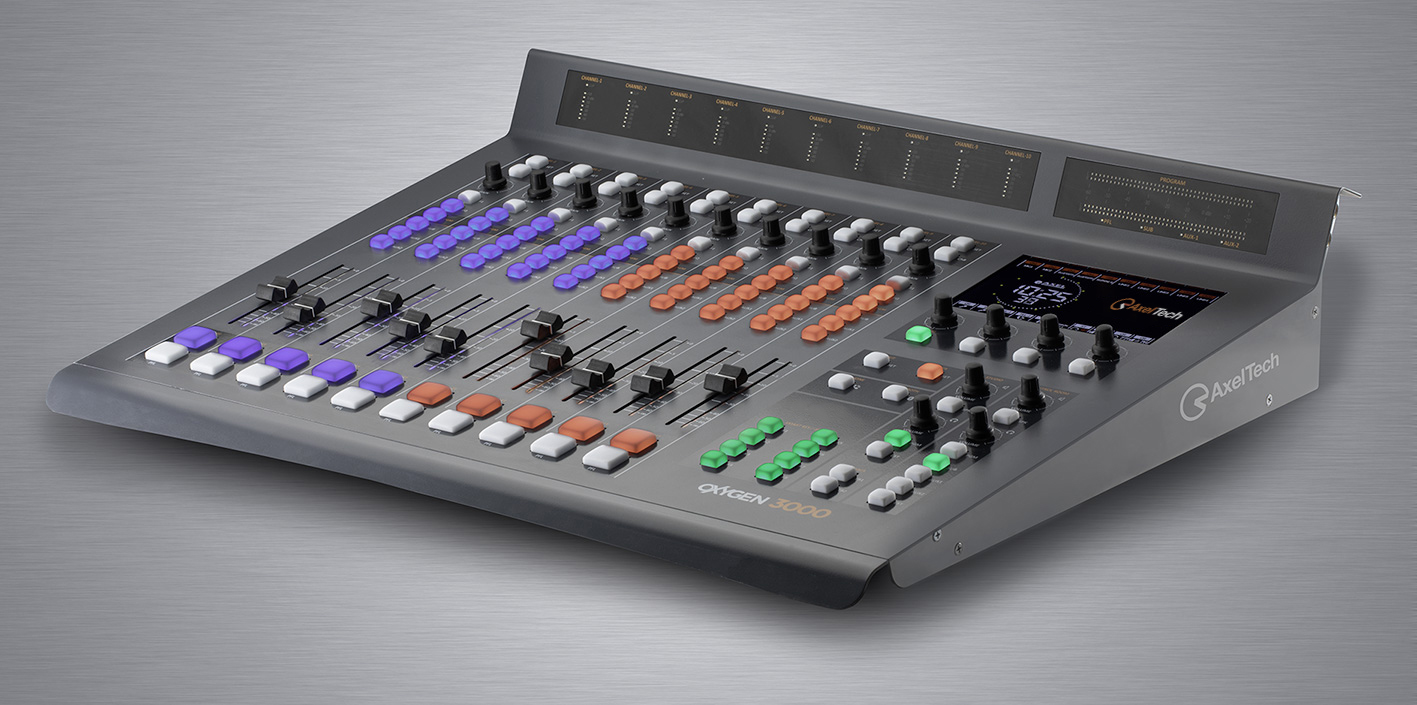
Oxygen 3000 Digital Mixing Console for Radio defined a new standard in the broadcast market. Characterized by an elegant design and compact size, Oxygen 3000 is suitable to be used as On Air Console and Production Console. Oxygen 3000 is based on digital technology with DSP audio processing to deliver high-end quality, latest features and flexibility with ease of use. Oxygen 3000 is the Bestseller in its category at the best quality/price ratio. Oxygen 3000 is a powerful and compact unit featuring 10 faders, meters for each single channel, built-in 7” display for settings, wide range of connectivity and accessories in a rugged and classy steel chassis.
Easy and reliable as the analogue mixing consoles, Oxygen 3000 adds the value of the digital engine that grants a near 0 latency ( < 0,7 ms I/O ) and plenty of advanced functions as the internal routing signal, customizable preset and easy recall, user defined smart keys, analog and digital I/O.
Oxygen 3000 completely revised with a brand new firmware.
Oxygen 3000 New Features
General
- Automatic firmware update via Internet
- Conditional Access (4-digit PIN)
- Save and recall EQ presets (up to 10)
- New real-time EQ algorithm with graphic
- Faster and more accurate Led Meters display
- Save and recall control panel configuration with 10 Snapshots
- Save and recall total console configuration. The configuration can be saved to internal memory (microSD), USB and PC (via WEB interface)
- User custom GPIs (e.g. Ring, Talkback, channel ON/OFF, etc.)
- User custom GPOs (e.g. Hook/ONAIR, Studio-Light, Control Room-Light)
- Selectable home page layouts for built-in 7" display
- Selectable home page layouts for HDMI Output
- Gain adjustment knobs with adaptive speed
- Dimmable buttons light
- Adjustable fader ON/OFF threshold (from -50db to 0 db)
- CountUp/Timer/CountDown on studio and control room microphones on the built-in 7" display
- A & B source names on the 7" Display and HDMI Out
- Ducking / AutoFader assignable to all sources (automatic attenuation of music on speech)
- WEB UI with service features (Save, restore, update, logs, etc)
- New theme icons on display screens
Stereo Inputs
- Channel mode selection: STEREO, MONO, L, R, INV-L, INV-R, INV
Bluetooth Module
- With Bluetooth calls, PFL enables PRIVATE conversation mode
MIC-Mono Inputs
- Independent ON AIR Lights and Cut Off control, when opening Control Room and Studio microphones
- PFL button switches to private conversation on Hybrid/Telco/Bluetooth mode
- Enable TalkBack feature on any Studio or Control Room microphone
- Parametric Compressors/Expander (drive, threshold, attack time, release time) for MICROPHONE and MONO inputs
- Save and recall microphone presets including Compressor/Expander settings
- Phase inversion on microphone inputs
Telco Channels
- GPI and GPO management on all 5 Telco channels
- RING and HOOK on F1 key for each TELCO channels
- N-1 on Telco outputs for all BUS (PGM, SUB, AUX-1, and AUX-2)
Monitor Out
- Adjustable maximum Control Room and Studio speakers volume
- Adjustable maximum Control Room and Studio headphones volume
- Adjustable CUT or Attenuation mode (-40, -30, -20, -10 dB) on Control Room and Studio speakers
- Independent source selection (PGM, SUB, AUX1, AUX2, EXT) for control room and studio speakers, control room and studio headphones with or without PFL
- Independent Talk Back management on Control Room and Studio speakers
- Independent Talk Back management on Control Room, Studio and Guest headphones
- Selectable source for Guest headphones (PGM, SUB, AUX1, AUX2, EXT)
- Same source selection for Control Room and Studio headphones, with independent level
Highlights
General
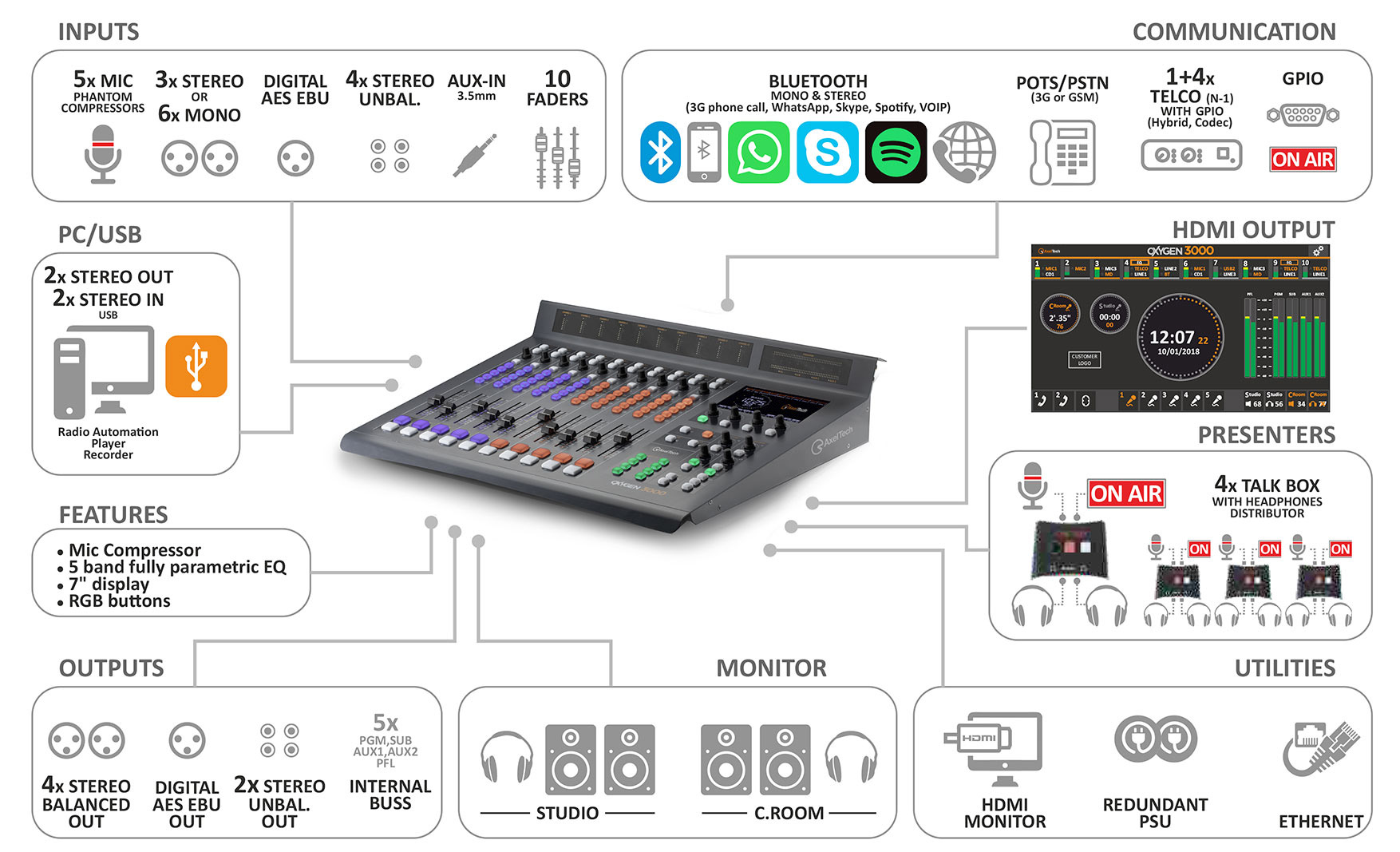
- Fully Digital Broadcast Console
- Near 0 latency ( < 0,7 ms I/O)
- Digital Signals routing
- 10-fader console
- 4+1 busses (PGM, SUB, Aux1, Aux2, PFL)
- User-definable Snapshot
- 5 band fully parametric EQ
- Dyn Processor on microphone inputs
- Webpage
- Customizable RGB colored buttons
- 7” Graphic Color Display
- Ctrl-Room and Studio Facilities
- A/B Fast source switch buttons
- 10 led meter bars for input source monitoring
- High Resolution led meter bars for outputs (164 leds)
- HDMI Out - Full HD connection for mixer monitor
- 2 Timers (Ctrl-Room and Studio microphones timers on HDMI Monitor)
- TalkBox for guest and presenter*
- Redundant PSU (optional)
Input Output
- 5 microphones inputs
- 8 stereo inputs
- 7 stereo outputs
- 1 built-in telephone hybrid,
- 1+4 telco interface with GPIO
- Bluetooth audio interface
- 1 digital In/Out (AES EBU)
- 2 USB audio interface
Inputs & Outputs
Microphone Inputs - Oxygen 3000 allows connection of XLR and RJ45 connector:
- Inputs replicated from XLR to RJ45: 2-3-4-5, balanced with + 48V Phantom and GPIO
- Telco: Microphone No. 5 mutually exclusive
Digital input line:
- Digital Input: 1 AESEBU Input on XLR
Analogue Outputs:
- Line Outputs: 6
- Balanced outputs: 4 Line out on XLR - PGM, SUB, AUX-1, AUX-2
- Unbalanced outputs: 2 Line out on RCA - REC-1, REC-2
Headphones and local monitor outputs:
- Balanced outputs: 2 line out on RJ45 for Studio Presenter and Studio Guest Headphones
- Unbalanced outputs: 2 Line out on RCA for Control Room and Studio Speaker
- Unbalanced outputs: 2 Line out on Jack 6.3 for Control Room and Studio Headphones
Analogue inputs lines:
- Line Inputs: 8
- Balanced inputs: 3 Line In on XLR
- Unbalanced Inputs: 4 Line on RCA
- Aux Input: 1 Line In Jack 3.5mm
Telephone hybrid and Telco:
- Telephone Hybrid: 1 POTS/PSTN telephone line with Line.In and Tel.Set connection
- Telco: 1 in/out N-1 to connect external telephone hybrid with control via TLC/GPIO
- 4 inputs/outputs N-1 on inputs STEREO 4/5 and outputs REC 1/2
Digital output:
- Digital Output: 1 AESEBU output on XLR
GPI/GPO:
- GPI: 12 in total, for Talk back, Telephone Hybrid or other features
- GPO: 10 total, to control OnAir lamps or Telephone Hybrid
Talk Box
It is a device dedicated to the presenter or guests.
This TalkBox is very simple to connect to the On Air Console, actually its take 2 RJ45 cables of the length that needed to connect it to the mixer. It is possible to connect maximum up to 4 units.
The TalkBox offer a direct connection of the microphone and relative On-Air light, it is also possible to directly connect the studio's On-Air Light. The Talk Box has a headphone amplifier with two 6.3mm outputs.
Through the two large backlit buttons it is possible to activate and deactivate your own microphone (On / Off / Cough) or enable Talk back to the console.
Details
USB audio interface
The USB audio interface allows to directly connect the PC to the Oxygen 3000 console, with no need for audio cards: infact the PC detects the console as a digital audio card with 2 stereo inputs and 2 stereo outputs for simultaneous playout and recording.
Telephone Hybrid and Telco
The built-in telephone hybrid allows direct connection of a telephone line POTS/PSTN on RJ-11C. It’s also available a Telco N-1 in/out, to connect Oxygen 3000 to an external telephone hybrid. The output Telco N-1 is always available on XLR male, while the input receiving line is mutually shared with Mic-5. TLC commands are available on SubD connector with Hook and Ring interface for external telephone hybrid.
4 inputs/outputs N-1 on inputs STEREO 4/5 and outputs REC 1/2 are also available without GPIO controls.
Bluetooth
Oxygen 3000 has a Bluetooth connection. This allows airing the calls made via Skype, Viber, Whatsapp or a normal phone calls by a Smartphone and Tablet.
Oxygen 3000 has two modes of Bluetooth connection, bidirectional to support phone calls and mono monodirectional for streaming high quality stereo audio (A2DP): this last feature allows airing the music from smartphones and tablets.
GPIO
The console Oxygen 3000 has 12 GPI and 10 GPO, which allow connections to OnAir signal lamps according the opening of a microphone channel, or provide HOOK and RING commands for external telephone Hybrid.
Features details
Display 7"
The OXYGEN 3000 has a 7 " colour graphic display for displaying all the airing parameters and for configuring all the device feature.
The large display combined with the 4 rotary knobs allow the fast and intuitive programming of all the mixer parameters. actually, Oxygen 3000 have a very easy and intuitive programming interface has been specially designed.
HDMI output
The HDMI output in OXYGEN 3000 is offer the possibility to connect a display monitor FullHD at the console. This feature providing multiple information on settings and operating levels. List of HDMI output display components.
- Audio input source leavle
- 4+1 BUS output leavle
- A/B sources assigned of 10 channels
- Display ON-Air sources
- Microphone On timer (control room & studio)
- Large Clock
- Audio output level (Loudspeakers & Headphones)
- OnAir microphone
- Telephone active
The HDMI interface also offers the possibility for radio stations to upload their own logo on the graphic interface.
Power supply
Universal Power on IEC Schuko cord, thanks to the universal power supply switching with working voltage between 90Vac and 264Vac and frequency between 50-60Hz. The PSU is able to adapt itself to the operating voltage of any country in the world. It’s also available redundant power supply (optional)
Technical Specifications
Analog Balanced Stereo Inputs
Connector XLR Balanced – EMI Suppressed
Input Impedance 10Kohm
Nominal Input Level (sensitivity) 0dBu
Max Input Level (clipping point) +18,5dBu
A/D conversion 24 bit / 48 Khz
Frequency response +/-0,5dB from 20Hz to 20kHz
Signal To Noise Ratio (referred to peak level) >100dB
Stereo Separation (referred to peak level) >90dB
THD+N <0,002%
Analog Unbalanced Stereo Inputs
Connector RCA unbalanced – EMI Suppressed
Input Impedance 10Kohm
Nominal Input Level (sensitivity) 0dBu
Max Input Level (clipping point) +18,5dBu
A/D conversion 24 bit / 48 Khz
Signal To Noise Ratio (referred to peak level) >90dB
Stereo Separation (referred to peak level) >80dB
THD+N <0,05%
Analog Balanced Microphone Inputs
Connector XLR Balanced – EMI Suppressed
Input Impedance 2,4Kohm
Nominal Input Level (sensitivity) -21dBu
Max Input Level (clipping point) +7dBu
A/D conversion 24 bit / 48 Khz
Signal To Noise Ratio (referred to peak level) >90dB
THD+N <0,01%
Analog Gain Adjustable +0 ÷ +60dB (3dB step)
Phantom Power +48V
Analog Balanced Telco Input (shared with MIC5, mutually exclusive)
Connector XLR Balanced – EMI Suppressed
Input Impedance 2,4Kohm
Nominal Input Level (sensitivity) 0dBu
Max Input Level (clipping point) +18,5dBu
A/D conversion 24 bit / 48 Khz
Signal To Noise Ratio (referred to peak level) >90dB
THD+N <0,01%
Analog Balanced Stereo Outputs
Connector XLR Balanced – EMI Suppressed
Output Impedance 23ohm, nominal 600ohm
Nominal Output Level 0dBu
Max Output Level (clipping point) +18,5dBu
D/A conversion 24 bit / 48 Khz
Signal To Noise Ratio (referred to peak level) >100dB
Stereo Separation (referred to peak level) >90dB
THD+N <0,002%
Analog Unbalanced Stereo Outputs
Connector RCA Unbalanced – EMI Suppressed
Output Impedance nominal 560ohm
Nominal Output Level 0dBu
Max Output Level (clipping point) +19dBu
D/A conversion 24 bit / 48 Khz
Signal To Noise Ratio (referred to peak level) >90dB
Stereo Separation (referred to peak level) >80dB
THD+N <0,05%
Analog Balanced Talkbox Outputs
Connector RJ45 balanced – EMI Suppressed
Output Impedance 100ohm, nominal 600ohm
Nominal Output Level 0dBu
Max Output Level (clipping point) +14dBu
D/A conversion 24 bit / 48 Khz
Signal To Noise Ratio (referred to peak level) >100dB
Stereo Separation (referred to peak level) >90dB
THD+N <0,05%
Analog Balanced Telco Output
Connector XLR Balanced – EMI Suppressed
Output Impedance 23ohm, nominal 600ohm
Nominal Output Level 0dBu
Max Output Level (clipping point) +18,5dBu
D/A conversion 24 bit / 48 Khz
Signal To Noise Ratio (referred to peak level) >100dB
THD+N <0,002%
Digital Input
Connector Balanced on 1 XLR – EMI Suppressed
Input Impedance 110Ω
Standard AES3
Audio Sample Rate 32/44.1/48KHz with aSRC
Resolution 24 bit
Dynamic Range (Converter Values) 124dB
Digital Output
Connector Balanced on 1 XLR – EMI Suppressed
Input Impedance 110Ω
Standard AES3
Audio Sample Rate 48KHz
Resolution 24 bit
Dynamic Range (Converter Values) 124dB
USB Audio Digital I/O
Connector USB Type B – EMI Suppressed
Playback And Recording Sample Rate 48KHz fixed
Resolution 16 bit
Available Stereo Channels 1 Play & 1 Rec for each USB interface
PSTN Interface
Connector RJ11
Transhybrid loss >36dB
System
Audio Core Analog Devices ADAU1452 32bit 294MHz fixed point DSP
Audio CODECs Cirrus CS42448 24bit/192kHz
System Core Allwinner A20 dual core cortex-A7 at 800MHz, 1GB RAM
System display 7” TFT 800x480 LCD
LAN Connection RJ45 - 100Mbit
Nominal Delay (analog input to analog output) 0,7ms
GPIO Inputs/Outputs 12 GPI / 10 GPO
Communication Port 2xUSB type-A, 2xUSB type-B , 1xLAN, 1xHDMI
Operating Temperature 0°C ÷ 40°C
PSU (optionally redundant)
Power Supply 90-260 Vac / 47-63 Hz 45W
Dimensions
Dimensions (W; H; D) 660mm; 142mm; 540mm
Weight < 20Kg
Dimensions